Page 11 of 19
CM3.6-8 | CM3.6-8 | Vector Biology and Control Measures — SDL Guide
Learning Objectives
- Define vector and classify arthropod vectors of public health importance with their associated diseases
- Describe the life cycle and identifying features of Anopheles, Aedes, and Culex mosquitoes, and the housefly, sandfly, and rat flea
- Describe vector control measures: biological, environmental, chemical (insecticide classes, modes of action, application methods), and personal protection
- Describe the National Vector Borne Disease Control Programme (NVBDCP/NCVBDC) including its disease scope, strategies, and elimination targets
- Describe key surveillance indicators: Annual Parasite Incidence, Slide Positivity Rate, and Aedes larval indices
INSTRUCTIONS
Vector-borne diseases—malaria, dengue, chikungunya, lymphatic filariasis, kala-azar, Japanese encephalitis—collectively represent one of India's largest infectious disease burdens. India is pursuing elimination targets for malaria (2027), kala-azar (2030), and lymphatic filariasis, making vector biology and control a live, consequential field of public health action. Understanding which vector carries which disease, how to identify and control it, and which insecticide acts by which mechanism is essential knowledge for a physician who will encounter these diseases daily.
References
- Park's Textbook of Preventive and Social Medicine, 26th ed., K Park, Ch 8 (Vector-Borne Diseases) and Ch 29 (Entomology) (textbook)
- National Centre for Vector Borne Diseases Control (NCVBDC) — Programme Guidelines, Ministry of Health & Family Welfare (programme)
- WHO Pesticides and Their Application for the Control of Vectors, 6th ed. 2006 (reference)
Version 2.0 | NMC CBUC 2024
CLINICAL SCENARIO
During the post-monsoon season in a district of Odisha, the district surveillance unit reports: 34 confirmed malaria cases in 2 weeks from a tribal hamlet (all Plasmodium falciparum), 12 dengue cases in the adjacent town, and a cluster of limb swelling cases (suspected lymphatic filariasis) in a peri-urban area. Three different diseases, three different mosquito species, three different interventions—all converging in the same district in the same fortnight. The medical officer must identify which Anopheles breeding sites to drain (malaria), which domestic water containers to inspect and treat for Aedes larvae (dengue), and which evening-biting Culex population warrants larviciding (filariasis). Without knowing the identifying features, life cycles, and control strategies for each vector, the officer's interventions will be at best inefficient and at worst directed at the wrong species entirely.
WHY THIS MATTERS
India carries one of the world's heaviest vector-borne disease burdens. In 2022, India reported approximately 1.96 million malaria cases with ~6,000 deaths (NCVBDC), though true burden is estimated to be significantly higher. Dengue reported cases exceeded 2.3 lakh in 2023 with over 300 deaths. Lymphatic filariasis affects an estimated 650 million people across 338 districts. Kala-azar (visceral leishmaniasis) threatens populations in Bihar, Jharkhand, West Bengal, and Uttar Pradesh. All of these diseases are preventable through effective vector control—making entomology a core clinical and public health competency, not an academic curiosity.
RECALL
Before proceeding, recall: (a) the arthropod body plan—three-segment body (head, thorax, abdomen), six legs; insects (6 legs) vs arachnids (8 legs, e.g. ticks and mites); (b) the concept of a biological vector—the pathogen undergoes part of its life cycle inside the vector, distinguishing biological vectors (Anopheles for Plasmodium) from mechanical vectors (housefly for enteric pathogens); (c) from pharmacology/physiology, acetylcholinesterase and its role in terminating neuromuscular transmission—this is the target of organophosphate insecticides; and (d) the concept of insecticide resistance—natural selection pressure from insecticide use, requiring rotation of classes.
The Burden of Vector-Borne Diseases in India
Vector-borne diseases are infectious diseases transmitted to humans by arthropod vectors—insects and arachnids that carry and transmit pathogens during feeding. In India, the vector-borne disease burden is among the highest in the world and is shaped by the country's climatic diversity, monsoon hydrology, and sanitation infrastructure.
The six diseases under the NVBDCP/NCVBDC umbrella are: malaria (Plasmodium vivax and P. falciparum, the latter causing 45-50% of cases and nearly all deaths), dengue, chikungunya, lymphatic filariasis (Wuchereria bancrofti, Brugia malayi), kala-azar (visceral leishmaniasis, Leishmania donovani), and Japanese encephalitis (JE, Flavivirus transmitted by Culex mosquitoes).
The economic and social burden is enormous: malaria reduces labour productivity in tribal and rural communities; dengue hospitalisations strain urban hospitals during epidemic peaks; lymphatic filariasis causes chronic disability (lymphoedema and hydrocele) that reduces the ability to work. India's national elimination targets—malaria by 2027, kala-azar by 2030, lymphatic filariasis by 2030—represent ambitious goals that depend critically on effective vector surveillance and control.
The dramatic decline of malaria from 6.4 million cases in the 1970s (post-DDT era resurgence following DDT-resistance emergence and programme lapses) to under 2 million in 2023 demonstrates what sustained vector control combined with early diagnosis and treatment can achieve—and it is a lesson in both the power and the limits of single-insecticide reliance.
The Role of Vectors: Classification and Disease Association
A vector is an arthropod that transmits a pathogen from one host to another. Vectors are classified as:
- Biological vectors: the pathogen undergoes development or multiplication within the vector (e.g. Plasmodium completes sporogony in Anopheles; Wuchereria microfilariae develop to infective larvae in Culex). The vector is essential for disease transmission.
- Mechanical vectors: the pathogen is carried on the body or mouthparts of the arthropod without development or multiplication (e.g. housefly carries Salmonella, polio virus, and E. histolytica cysts on its legs and proboscis from faeces to food).
The major arthropod vectors and their associated diseases in India are:
Mosquitoes (Diptera: Culicidae):
- Anopheles (>60 species; key Indian vectors: A. culicifacies, A. stephensi, A. fluviatilis): transmits malaria (Plasmodium vivax, P. falciparum) and (some species) lymphatic filariasis (Brugia malayi).
- Aedes aegypti (and A. albopictus): transmits dengue, chikungunya, Zika, and yellow fever.
- Culex quinquefasciatus: transmits lymphatic filariasis (Wuchereria bancrofti) and Japanese encephalitis.
Flies (Diptera):
- Housefly (Musca domestica): mechanical vector for enteric diseases (typhoid, cholera, dysentery, amoebiasis).
- Sandfly (Phlebotomus argentipes in India): transmits kala-azar (visceral leishmaniasis) and cutaneous leishmaniasis.
- Tsetse fly (Glossina spp.): transmits African sleeping sickness (not endemic in India).
Fleas:
- Rat flea (Xenopsylla cheopis): transmits bubonic plague (Yersinia pestis) and murine typhus (Rickettsia typhi).
Lice (Pediculus humanus):
- Body louse (Pediculus humanus corporis): transmits epidemic typhus (Rickettsia prowazekii) and relapsing fever (Borrelia recurrentis).
Ticks (Ixodidae, Argasidae):
- Transmit Crimean-Congo haemorrhagic fever (CCHF — Hyalomma ticks), Lyme disease, Rocky Mountain spotted fever, and tick-borne encephalitis (not major India burden except CCHF in Gujarat, Rajasthan).
Life Cycles and Identifying Features of Key Vectors
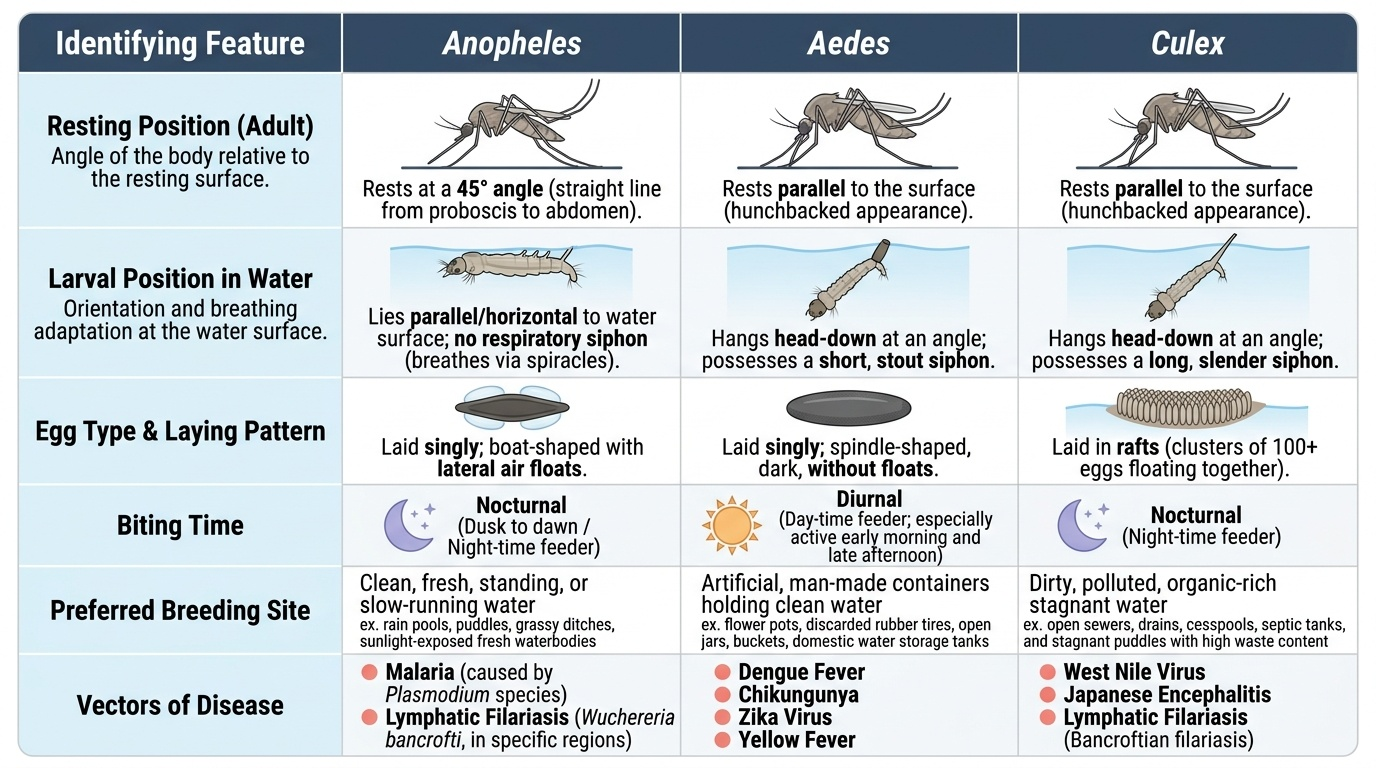
All mosquitoes (Anopheles, Aedes, Culex) share the same four-stage life cycle: egg → larva (4 instars) → pupa → adult. The aquatic stages (egg, larva, pupa) take 7-14 days to complete at typical tropical temperatures (longer at lower temperatures). Only the adult female is a vector—she requires a blood meal for egg development. Key differences among the three genera are summarised in the figure below, which is the most high-yield entomological table for the MBBS examination.
Provided image
The most clinically useful distinctions are:
- Resting angle: Anopheles adult rests with body at 45° angle to the surface (head down, abdomen up); Culex and Aedes rest with body parallel to the surface.
- Larval position: Anopheles larva lies parallel to the water surface (no siphon, breaths through spiracles in abdominal segment 8); Culex and Aedes larvae hang head-down from the surface via a siphon.
- Egg type: Anopheles lays eggs singly with lateral floats; Culex lays eggs in a raft (mass, stuck together); Aedes lays eggs singly but on moist surfaces (not floating on water) near the water line of containers.
- Breeding site: Anopheles prefers clean, slow-moving or stagnant water (rice fields, irrigation channels, ponds); Culex prefers polluted/organic water (drains, cesspools, stagnant waste water); Aedes aegypti breeds in clean stored water in domestic containers (flower pots, overhead tanks, tyres, coolers, water jars)—the 'container breeder.'
- Biting time: Anopheles and Culex are night-biting; Aedes aegypti is a day-biter (peak dawn and dusk).
Sandfly (Phlebotomus): tiny (2-3 mm), hairy, holds wings erect at rest; breeds in dark moist organic matter (cracks in walls, termite mounds); active at dusk and night; doesn't fly far (<50 m from breeding site). Identifying it is important because IRS (indoor residual spraying) with DDT or synthetic pyrethroid is effective given its peridomestic behaviour.
Rat flea (Xenopsylla cheopis): laterally compressed body (adapts to moving through hair); powerful jumping hind legs; lacks wings; host specificity is important—fleas from dead/dying rats seek alternative hosts including humans, which is the mechanism of plague transmission.
SELF-CHECK
During a post-monsoon survey in a town, a health worker finds mosquito larvae in a household overhead tank and in a drain behind the house. Larvae in the overhead tank hang head-down from the surface via a siphon tube, and the tank water is clean and clear. Larvae in the drain hang head-down from an organic-rich, cloudy surface. Which genera do these most likely represent, and what is the public health priority?
A. Both are Anopheles; priority is draining both breeding sites equally
B. Tank larvae are most likely Aedes (clean stored water, container breeder); drain larvae are most likely Culex (polluted water); priority is eliminating the Aedes domestic breeding site for dengue prevention
C. Tank larvae are most likely Anopheles; drain larvae are most likely Aedes; priority is anti-larval treatment of the drain
D. Both are Culex; the tank represents a filariasis risk and the drain represents a Japanese encephalitis risk
Reveal Answer
Answer: B. Tank larvae are most likely Aedes (clean stored water, container breeder); drain larvae are most likely Culex (polluted water); priority is eliminating the Aedes domestic breeding site for dengue prevention
Aedes aegypti is the classic 'container breeder' that prefers clean stored water in domestic containers—overhead tanks, flower pots, water storage jars, coolers. The siphon (head-down hanging) identifies the larvae as Culex or Aedes (not Anopheles, which lies parallel to the surface). Clean water in a domestic overhead tank strongly suggests Aedes. The drain's organic, polluted water is classic for Culex quinquefasciatus (lymphatic filariasis/JE vector). The public health priority is eliminating the Aedes domestic breeding site (dengue prevention) through: covering/emptying the overhead tank, weekly cleaning, or adding temephos (abate) if the tank cannot be emptied. The drain is also a concern but is a municipal/engineering intervention.