Page 15 of 32
CM5.{7-8,19} | CM5.{7-8,19} | Food Hygiene, Fortification and Food Labels — SDL Guide
Learning Objectives
- Describe food hygiene principles and the major sources and types of food contamination
- Describe and discuss the importance and methods of food fortification, and the health effects of food additives and adulteration
- Assess the nutritional content of processed foods by reading FSSAI-compliant food labels
- Counsel patients to make informed nutritional decisions at point of purchase
INSTRUCTIONS
Safe food and nutritious food are not the same thing — a food can be microbiologically safe but nutritionally empty, or it can be nutritious but contaminated with adulterants. This module covers all three dimensions of food safety: microbial hygiene, fortification to prevent deficiency, and label literacy to empower informed consumer choice.
References
- Park's Textbook of Preventive and Social Medicine, 26th ed., Ch. 12 — Food Hygiene (textbook)
- WHO — Five Keys to Safer Food Manual, 2006 (guideline)
- FSSAI Act 2006 and Food Safety and Standards (Food Products Standards and Food Additives) Regulations (regulation)
Version 2.0 | NMC CBUC 2024
CLINICAL SCENARIO
In September 1998, an epidemic of unexplained oedema with cardiovascular involvement struck New Delhi and spreading rapidly to Bihar and Uttar Pradesh. Within weeks, 65 people had died and thousands were hospitalised with bilateral leg oedema, ascites, pleural effusion, and cardiac failure — in patients who had no pre-existing heart disease. Epidemiological investigation traced the outbreak to adulterated mustard oil — argemone oil (from Argemone mexicana seeds) had been mixed into mustard oil, and sanguinarine, a toxic alkaloid in argemone oil, had been consumed through cooked food. This was not an isolated incident: argemone oil adulteration of mustard oil has caused recurring epidemic dropsy outbreaks in India. The lesson for every physician: food contamination and adulteration are real public health emergencies, and food hygiene is not a kitchen concept — it is clinical epidemiology.
WHY THIS MATTERS
Food hygiene, fortification, and label literacy are directly actionable clinical competencies. CM5.7 (food hygiene) is examined in outbreaks, community medicine postings, and family health assessments. CM5.8 (fortification and additives) is tested in national programme knowledge — understanding WHY rice is fortified, WHICH nutrients are added, and HOW adulteration causes disease. CM5.19 (food labels) is a skill competency requiring you to 'assess the nutritional content of processed foods' and 'empower patients to make informed nutritional decisions' — a counselling skill increasingly relevant as India's processed food market grows. In clinical practice, a patient with hypertension asking 'is this biscuit OK to eat?' requires you to read a food label in real time and advise on sodium content.
RECALL
From the cm-nutrition-requirements module: recall that trans fatty acids should constitute <1% of total dietary energy, and that sodium intake should be limited to <5 g/day (WHO) to reduce cardiovascular risk — these thresholds will be directly referenced on food labels. Recall that iodised salt is mandated at 15 ppm consumer level — relevant to food fortification legislation. From cm-nutrition-disorders: recall that the NIDDCP uses salt iodisation as its primary control measure. From general microbiology (understanding from Pathology/Microbiology): recall that bacterial growth is temperature-dependent — the 'danger zone' for rapid bacterial multiplication is 5-63°C.
Burden of Food-Borne Disease and Unsafe Food in India
Unsafe food causes an estimated 600 million episodes of food-borne illness annually worldwide, resulting in 420,000 deaths (WHO, 2015). In India, food-borne disease constitutes a major but substantially under-reported public health burden. India's IDSP (Integrated Disease Surveillance Programme) captures notified food poisoning outbreaks, which likely represent a fraction of actual cases — most food-borne gastroenteritis is treated empirically at the community level without laboratory confirmation or reporting.
The burden has two dimensions. First, acute food-borne illness from contaminated food: Staphylococcal food poisoning, Salmonella typhi and non-typhoidal Salmonella, Vibrio cholerae, Hepatitis A and E viruses, and parasitic contamination (Taenia, Entamoeba, Ascaris from faecal contamination of raw vegetables) cause millions of illness episodes annually. Outbreaks cluster around mass gatherings (temples, weddings, school meals), street food, and seasonal events. Second, chronic harm from food adulteration: the argemone oil epidemics, melamine-adulterated milk (causing kidney stones in infants — China 2008 outbreak prompted India to mandate melamine testing in dairy), and lead/cadmium-contaminated spices cause cumulative, organ-specific toxicity.
A third, emerging dimension is the health burden of ultra-processed foods — high in added sugar, sodium, saturated fat, and trans fats — which now constitute an increasing proportion of the Indian urban diet and drive the epidemic of Type 2 diabetes, hypertension, and obesity. This is the context that makes CM5.19 (food label literacy) a genuinely clinical competency rather than a consumer protection exercise.
WHO 5 Keys to Safer Food
Food Hygiene — Contamination, Safety Principles and Legislation
Food hygiene is defined as all conditions and measures necessary to ensure the safety and suitability of food at all stages of the food chain — from production through to consumption. Contamination can occur at any stage: farm, processing, storage, transport, or point of preparation.
Sources of food contamination:
1. Biological: Bacteria (Salmonella in poultry/eggs, Staphylococcus aureus in dairy/meat, Vibrio cholerae in water/seafood, Clostridium botulinum in improperly canned foods, Listeria in refrigerated ready-to-eat foods, Bacillus cereus in reheated rice), Viruses (Hepatitis A, Norovirus, Rotavirus — faecal-oral route), Parasites (Taenia saginata from undercooked beef, Taenia solium from pork, Entamoeba histolytica and Ascaris from contaminated raw vegetables), Fungi and mycotoxins (Aspergillus flavus producing aflatoxin B1 — Group 1 carcinogen, causes hepatocellular carcinoma; found in improperly stored groundnuts, maize, chillies).
2. Chemical: Pesticide residues (organophosphates, organochlorines), heavy metals (lead in spices packaged with non-food-grade materials; cadmium in contaminated irrigation water; arsenic in groundwater-irrigated rice), industrial pollutants, veterinary drug residues (antibiotics in poultry), and intentional adulterants (argemone oil, metanil yellow, melamine).
3. Physical: Foreign bodies — insects, glass fragments, stones, plastic, metal shavings — from inadequate processing or storage.
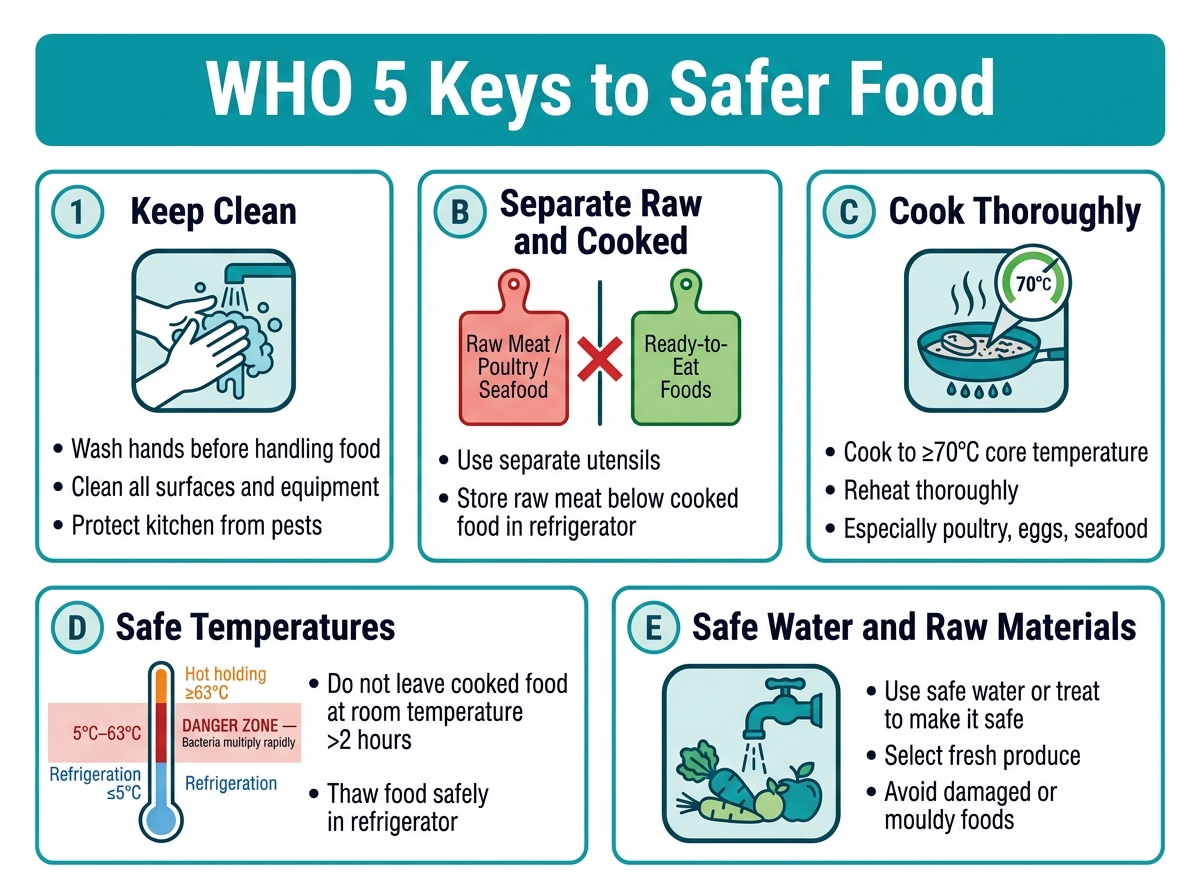
WHO 5 Keys to Safer Food:
1. Keep clean: Wash hands before handling food and after using the toilet; clean all surfaces and equipment; protect food areas from insects and pests. Hand hygiene alone can reduce food-borne diarrhoea by 40%.
2. Separate raw and cooked: Raw meat, poultry, and seafood must be kept separate from cooked and ready-to-eat foods — in storage (different containers, shelves) and preparation (different cutting boards, utensils). Cross-contamination is a leading cause of food-borne illness.
3. Cook thoroughly: Food must reach a core temperature of ≥70°C to kill pathogens. Use a food thermometer. Poultry, minced meat, and whole cuts of meat are highest risk. Reheating leftovers must reach 70°C throughout.
4. Keep food at safe temperatures: The danger zone is 5°C-63°C — the temperature range in which bacteria multiply rapidly (doubling time as short as 20 minutes). Never leave cooked food at room temperature for more than 2 hours. Refrigerate at ≤4°C; freeze at ≤-18°C.
5. Use safe water and raw materials: Use safe water for drinking and food preparation (boiled or treated). Select fresh, intact produce; avoid foods with signs of mould, unusual odour, or damage.
FSSAI and food safety legislation: The Food Safety and Standards Act 2006 established the Food Safety and Standards Authority of India (FSSAI) as the apex statutory body for food safety regulation. FSSAI sets standards for food products, food additives, contaminants, and labelling; licenses food businesses; conducts surveillance sampling; and initiates enforcement action. State Food Safety Officers (FSOs) conduct inspections and testing at retail and distribution levels. Consumers can access FSSAI's 'Food Safety Connect' app to report food safety concerns.
SELF-CHECK
A caterer serves a buffet for 200 guests at a wedding. Two hours into the event, the cooked chicken curry, rice, and dal are still sitting on the buffet table at room temperature (approximately 32°C). Guests start developing nausea, vomiting, and abdominal cramps 2-4 hours after eating. Which food safety principle was violated and what is the most likely causative organism?
A. Cook thoroughly (≥70°C not achieved) — Salmonella
B. Keep food at safe temperatures (danger zone violation) — Staphylococcus aureus
C. Separate raw and cooked (cross-contamination) — Vibrio cholerae
D. Keep clean (hand hygiene failure) — Hepatitis A virus
Reveal Answer
Answer: B. Keep food at safe temperatures (danger zone violation) — Staphylococcus aureus
The violation is 'keep food at safe temperatures' — cooked food held at room temperature (~32°C) for >2 hours is in the bacterial danger zone (5-63°C), allowing rapid bacterial multiplication. Staphylococcus aureus is the most likely cause given the 2-4 hour incubation period and the symptoms (nausea, vomiting predominating) — S. aureus produces a heat-stable preformed toxin that survives reheating; the illness is toxin-mediated, not infection. Salmonella typically has a longer incubation (6-48 hours). Vibrio cholerae causes profuse watery diarrhoea with rapid dehydration. Hepatitis A has an incubation of 2-6 weeks.
Food Fortification — Types, Indian Programmes and Additives
Food fortification is defined by the WHO as 'the practice of deliberately increasing the content of an essential micronutrient, i.e. vitamins and minerals (including trace elements) in a food, irrespective of whether the nutrients were originally in the food before processing or not, so as to improve the nutritional quality of the food supply and provide a public health benefit with minimal risk to health.' Fortification is distinct from supplementation (which delivers nutrients directly to individuals in tablet/liquid form) and dietary diversification (which promotes a varied diet).
Types of fortification:
- Mass fortification: A staple food that nearly the whole population consumes is fortified — e.g. iodised salt (consumed by >93% of households), edible oil (Vitamin A and D), wheat flour (iron, folic acid in some countries). Reaches the entire population without behaviour change.
- Targeted fortification: Foods consumed by a specific at-risk group are fortified — e.g. fortified complementary foods for infants (e.g. cerelac enriched with iron, zinc, B vitamins), therapeutic foods (F-100 and RUTF with micronutrient supplement).
- Market-driven/voluntary fortification: Manufacturers voluntarily add nutrients to commercially produced foods (e.g. fortified breakfast cereals, Vitamin D-fortified milk, iron-fortified bread). Regulated by FSSAI under the FSSAI Fortification Regulations.
India's major fortification programmes:
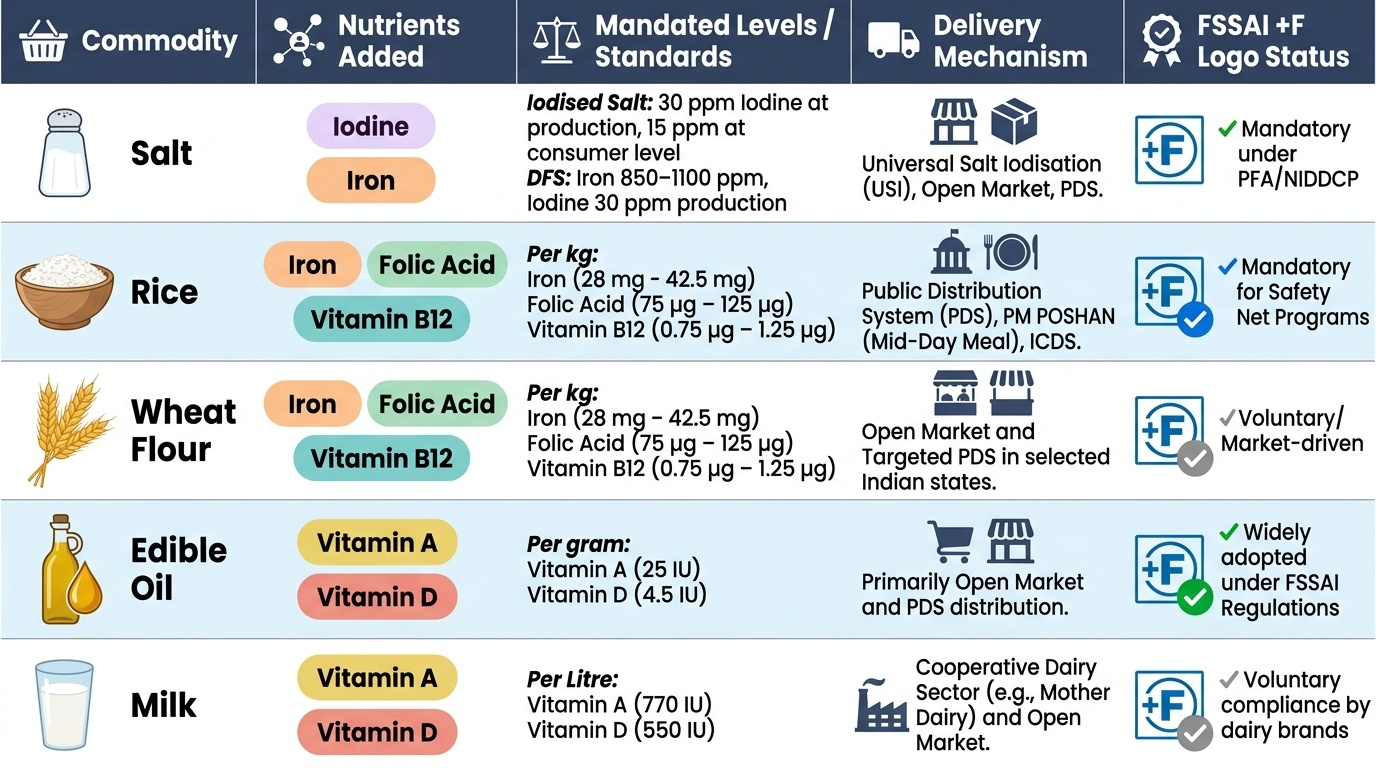
- Iodised salt (mandatory): 30 ppm iodine at production, 15 ppm at consumer level — mandated under Prevention of Food Adulteration Act and NIDDCP.
- Vanaspati (mandatory): Vitamin A (25 IU/g) and Vitamin D (1.75-2.0 IU/g) — mandatory fortification of all vanaspati (hydrogenated vegetable fat) sold in India.
- PDS rice fortification (from 2024, mandatory): Government of India mandates that all rice distributed through PDS (Public Distribution System), MDM (midday meals), and ICDS be fortified with iron (14 mg/kg), folic acid (75 µg/kg), and Vitamin B12 (0.1 µg/kg). This is achieved by blending 1 part fortified rice kernels (FRK — made by extrusion process) with 99 parts regular rice. Target: reduce anaemia in the 800 million PDS beneficiaries.
- FSSAI +F (Plus Fortified) logo: Voluntary fortification standard; foods meeting FSSAI's fortification standards for rice, wheat flour, edible oil, milk, or double-fortified salt (DFS) can display the +F logo — enabling consumers to identify fortified products.
Food additives: Substances added to food for technological purposes — preservation, colour, flavour, texture, or shelf life. FSSAI maintains a permitted list of food additives with maximum allowed levels. Permitted additives are generally regarded as safe (GRAS) at approved doses. However:
- Non-permitted artificial colours (e.g. metanil yellow — a non-food dye used to colour turmeric, sweets, and snacks) are hepatotoxic and potentially carcinogenic; commonly found as adulterants in Indian street foods.
- Preservatives: Sodium benzoate and potassium sorbate are permitted at specified concentrations; hyperactivity concerns in children have been raised for some azo-dyes (e.g. tartrazine) used in combination with sodium benzoate.
Food adulteration is the addition of a substance to food that lowers its quality, defrauds the consumer, or is hazardous to health. Major adulterants in India and their health effects:
- Argemone oil in mustard oil: Sanguinarine → epidemic dropsy (oedema, cardiac failure, glaucoma)
- Metanil yellow in turmeric and lentils: Non-food industrial dye → hepatotoxicity, potentially carcinogenic
- Melamine in milk and infant formula: Kidney stones, renal failure (China 2008 — 300,000 affected infants)
- Chalk powder in flour and salt: Physical adulteration; nutritional dilution
- Non-permitted synthetic dyes in sweets and confectionery: Variable toxicity
Provided image
SELF-CHECK
A state government distributes rice through PDS that is fortified under Government of India's 2024 rice fortification programme. Which three micronutrients are mandated to be added per kilogram of fortified PDS rice?
A. Iron, Vitamin A, and Zinc
B. Iron, Folic acid, and Vitamin B12
C. Iron, Calcium, and Vitamin D
D. Zinc, Iodine, and Folic acid
Reveal Answer
Answer: B. Iron, Folic acid, and Vitamin B12
The Government of India's PDS rice fortification mandate (FSSAI standards 2022, rollout from 2024) specifies fortification of rice with three micronutrients: iron (14 mg/kg), folic acid (75 µg/kg), and Vitamin B12 (0.1 µg/kg). These three were selected because they address India's most prevalent micronutrient deficiencies (iron deficiency anaemia, folate deficiency contributing to neural tube defects and megaloblastic anaemia, and B12 deficiency particularly in vegetarian populations). Vitamin A, calcium, zinc, iodine, and Vitamin D are addressed through other fortification programmes (vanaspati, iodised salt) or supplementation.