Page 11 of 17
FM2.17-19 | Deaths from Physical Agents & Neglect — SDL Guide (Part 3)
Medicolegal Aspects: Physical Agent Deaths and Neglect
The medico-legal framework for physical agent deaths shares a common structure: the forensic physician establishes the nature and extent of the injury, confirms the vital reaction (or its absence), and the investigating authority and court determine whether that injury reflects accident, negligence, or homicide. The following table and narrative summarise the key points for each agent.
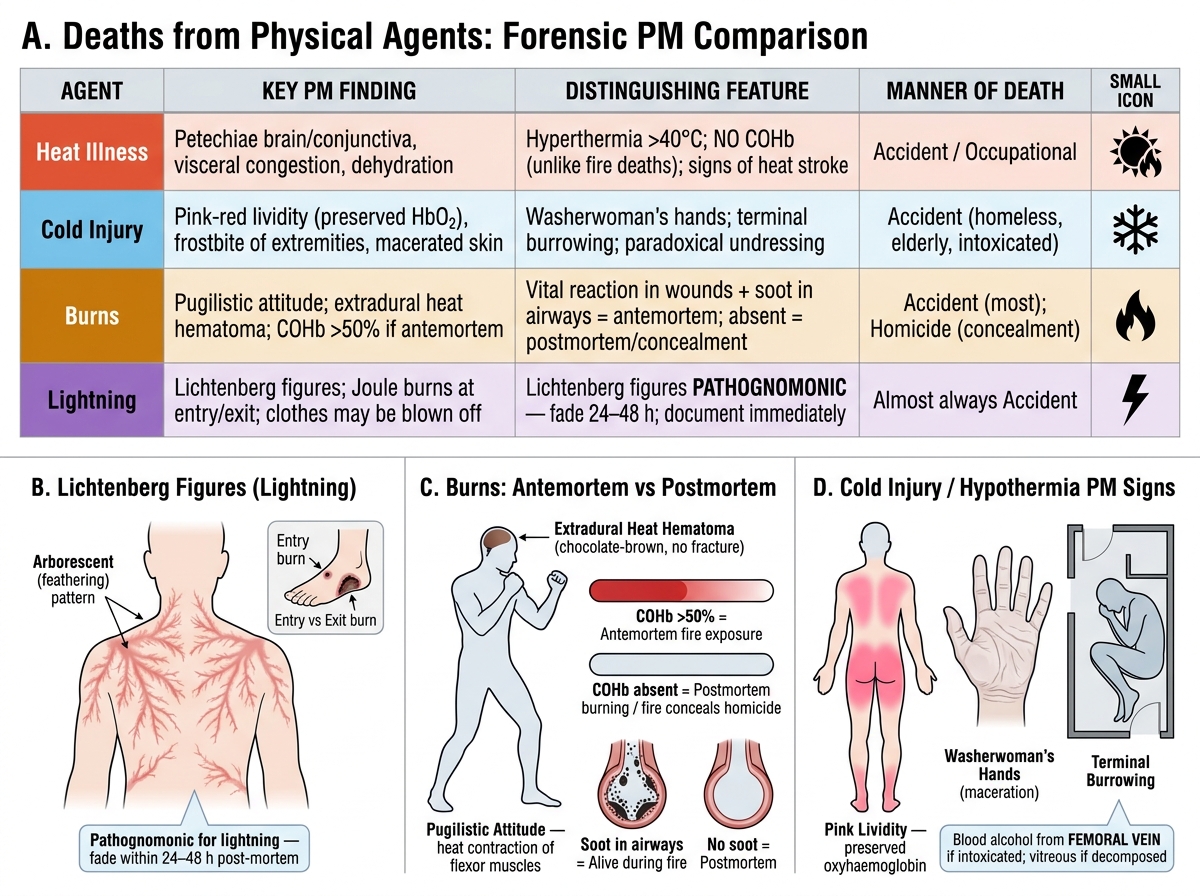
Deaths from Physical Agents — Forensic PM Comparison
Heat illness:
• Industrial/occupational deaths → employer's duty under Factories Act 1948 and Occupational Health regulations; potential IPC 304A if negligence established
• Child or elderly deaths in locked rooms → child/elder abuse consideration; IPC 302 or 304 if evidence of deliberate exposure
Cold injury:
• Exposure deaths of homeless or displaced persons in winter → social welfare failure; IPC 304A if a specific duty bearer can be identified
• Hypothermia in intoxicated individuals → alcohol forensics important (blood alcohol from femoral vein; vitreous if decomposed)
Burns:
• Fire deaths: COD = carboxyhaemoglobin poisoning (most fire deaths) vs burns vs smoke inhalation; ante-mortem vs post-mortem fire exposure determines whether fire conceals homicide
• Child scalding: immersion (forcible) vs splash pattern → non-accidental injury determination
• Occupational burns → Workmen's Compensation Act 1923 (now Employees' Compensation Act 2009); industrial accident reporting
Lightning:
• Lichtenberg figures are pathognomonic and should be documented immediately (fade within 24–48 hours)
• Lightning deaths are almost invariably accidental; the role of the state government in warning and prevention (weather alerts) has policy implications but rarely criminal liability
• Never confuse Lichtenberg figures with domestic electrocution marks — the mechanisms are entirely different
Electrocution:
• Domestic accidents: faulty wiring, wet conditions — employer/landlord liability (IPC 304A)
• Homicidal electrocution (rigged traps, wet floor, tampered switches) — criminal investigation; scene forensics by electrical engineers is essential
• Suicide by electrocution: rare; usually deliberate contact with live conductor; single entry/exit wound at specific contact site
Radiation:
• AERB notification mandatory for any radiation accident death; national security involvement for illicit sources
• Occupational exposure documentation
Starvation and neglect:
• Document all PM organ weights
• Scene documentation (food availability, confinement)
• IPC 304A for negligent caregivers; IPC 302 for deliberate deprivation with intent to kill
• Juvenile Justice Act 2015 for child neglect
The general principle for all physical agent deaths:
Establish the cause of death → establish the mechanism (which physical agent, how applied) → determine whether the exposure was ante-mortem → assess whether the manner was accidental, negligent, suicidal, or homicidal → cite the appropriate legal framework in the report.
CLINICAL PEARL
Lichtenberg figures are pathognomonic of lightning — but they fade. These branching, fern-like skin markings appear within the first few hours after a lightning strike and may disappear within 24–48 hours. They must be photographed immediately and in their entirety as part of the PM examination. No other cause produces Lichtenberg figures — not domestic current, not high-voltage industrial electrocution, not burns. Their presence is definitive evidence of a lightning event, and a good-quality photograph of them may be the pivotal exhibit in both insurance claims and criminal investigations.