Page 1 of 18
FM2.13-15 | Autopsy: Principles, Types & Legal Requirements — SDL Guide
Learning Objectives
- Describe the aims, objectives, and types of autopsy (FM2.13)
- Explain the legal requirements for post-mortem examination and the medico-legal autopsy in India (FM2.14)
- Describe obscure autopsy and Virtopsy — indications and limitations (FM2.15)
INSTRUCTIONS
When a person dies under unexplained, sudden, or suspicious circumstances, society requires a systematic, legally-sanctioned examination to determine what happened. The medico-legal autopsy is the forensic physician's most powerful investigative tool — and a statutory duty that no individual, family, or institution can override. This module builds your understanding of why autopsies are performed, what types exist, what the law in India demands, and how emerging imaging-based methods are reshaping the field.
References
- KSN Reddy — Essentials of Forensic Medicine & Toxicology, 34th ed., Ch. 4–5 (textbook)
- BV Subrahmanyam — Modi's Medical Jurisprudence and Toxicology, 24th ed., Ch. 6 (textbook)
Version 2.0 | NMC CBUC 2024
CLINICAL SCENARIO
A 28-year-old man is found dead in his locked apartment at 7 AM. Neighbours report no disturbance. The family insists he had no illness and demands the body for immediate last rites. The police sub-inspector arrives at 8 AM and requests the duty doctor to examine the body. Within the hour, the doctor must answer: What happened? How did this person die? And — critically — does the law require a formal post-mortem examination, and who has the authority to order it?
WHY THIS MATTERS
The medico-legal autopsy sits at the intersection of medicine, law, and justice. As a future doctor, you may be posted as a duty medical officer, casualty physician, or forensic faculty member who receives such cases. Understanding autopsy types and legal requirements is not an academic exercise: failing to perform a mandatory post-mortem, or performing one without proper authority, can compromise a criminal investigation, expose you to legal liability, and deny justice to the deceased and their family. These competencies are tested in professional examinations and are integral to your fitness to practice in any clinical setting.
RECALL
Before proceeding, refresh your understanding of: (1) gross pathology — what constitutes normal versus abnormal organ findings on external and internal examination; (2) inquest procedures — you encountered inquest briefly in the medico-legal death certification module; (3) cause vs manner vs mechanism of death — these three distinct concepts are central to any autopsy report. If you are uncertain about any of these, review FM Chapter 1 (death and its certification) before continuing.
The Purpose and Scope of the Autopsy
An autopsy (from the Greek autopsia — 'seeing with one's own eyes') is the systematic medical examination of a dead body to determine the cause, manner, and mechanism of death and to document all pathological findings. It represents the final act of medicine on behalf of a patient who can no longer speak for themselves — and in forensic contexts, it is simultaneously the primary tool of a criminal or administrative investigation.
The scope of the autopsy extends far beyond simply identifying the cause of death. A properly conducted examination yields information about the sequence of events leading to death (the mechanism), the classification of death as natural, accidental, homicidal, or suicidal (the manner), the approximate time since death through post-mortem changes, injuries sustained before or around death, the presence of natural disease, the presence of toxic substances, and the identity of the deceased when unknown. Each of these dimensions may have profound legal, familial, and public health consequences.
In medicolegal practice, the autopsy also serves as the physician's formal statement to the court. The findings, documented meticulously in the post-mortem report, become evidence in criminal, civil, insurance, and inquest proceedings. This evidentiary function distinguishes the medico-legal autopsy from its clinical counterpart and imposes a standard of documentation and chain of evidence that must never be compromised.
Key terms to anchor your understanding:
- Cause of death: the disease or injury responsible for initiating the sequence leading to death (e.g. subdural haemorrhage due to blunt force trauma)
- Mechanism of death: the physiological derangement that actually caused death (e.g. transtentorial herniation and brainstem compression)
- Manner of death: the classification — natural, accidental, homicidal, suicidal, or undetermined
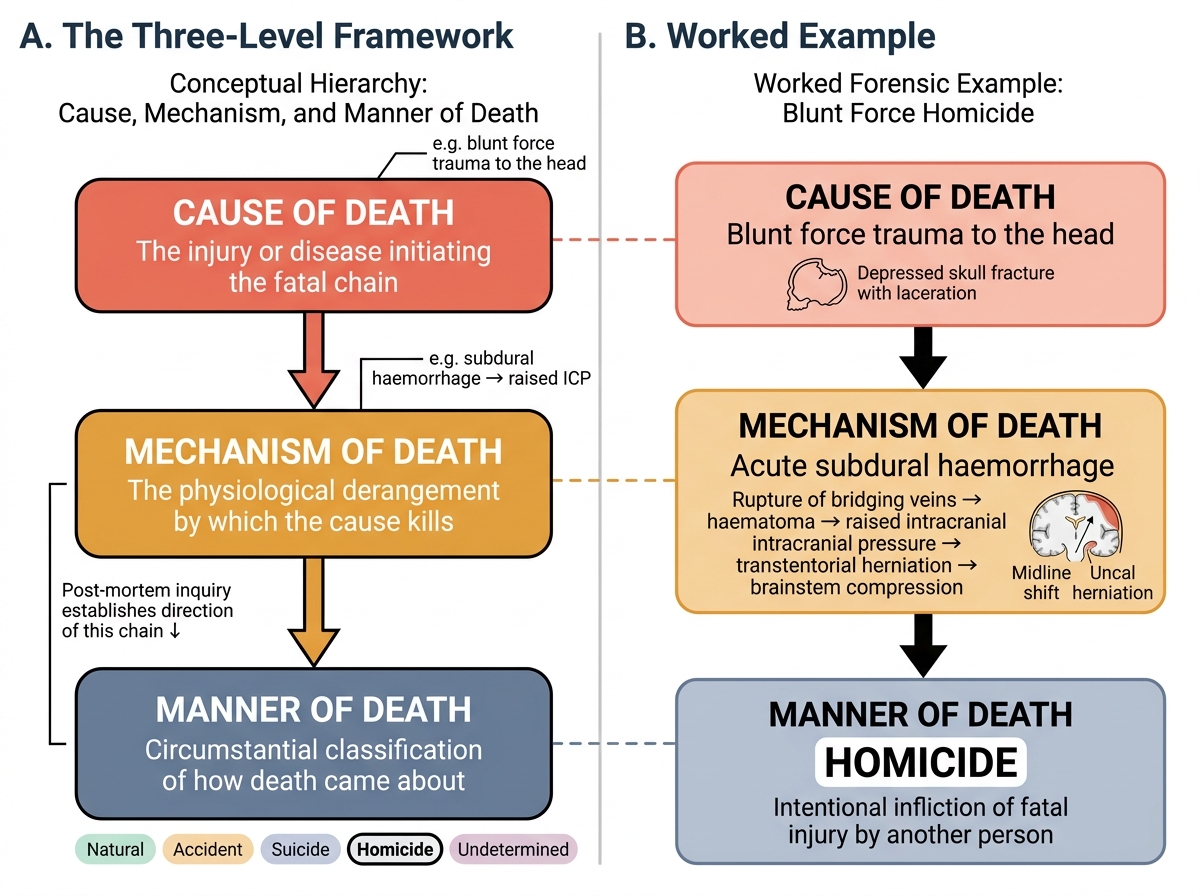
Cause, Mechanism, and Manner of Death: Framework and Worked Forensic Example
Scientific Basis: What an Autopsy Reveals
The scientific power of the autopsy derives from its capacity to integrate findings across multiple organ systems, correlate them with the clinical history, and draw inferences that no single investigation can replicate. External examination reveals injuries (their pattern, age, and mechanism), body habitus, and post-mortem changes. Internal examination — evisceration of thoracic, abdominal, and cranial contents — exposes organ pathology at the gross level, which is then supplemented by histology, toxicology, and microbiology as required.
Post-mortem changes are particularly important in the forensic autopsy because they allow estimation of the post-mortem interval (PMI) and can mimic or mask injuries. Rigor mortis — the stiffening of muscles due to ATP depletion and actin-myosin cross-linking — begins approximately 1–2 hours after death, reaches full establishment at 6–12 hours, and resolves by 24–36 hours at ambient temperatures of 25–30°C. These timings are temperature-dependent and must always be interpreted with the environmental context. Livor mortis (hypostasis) — the gravitational pooling of blood in dependent vessels — appears within 1–2 hours, becomes fixed at approximately 8–12 hours (when haemolysis fixes pigment in tissue), and is useful for estimating whether a body has been moved after death. Decomposition proceeds through autolysis, putrefaction, adipocere formation, and skeletonisation, each with timeline implications.
The autopsy also establishes what natural disease was present at the time of death. A ruptured atheromatous coronary artery plaque causing acute myocardial infarction in a young adult who died during a fight may alter the manner of death from homicide to accident or undetermined — a determination with profound medicolegal consequences. Conversely, undetected natural disease does not excuse a fatal assault: a thin-skulled victim remains a homicide victim even if an average-skulled person might have survived the same blow.
Systematic sampling — preserving viscera for chemical analysis, collecting blood and urine for toxicology, retaining relevant histology specimens — ensures that findings not apparent at gross examination are not permanently lost.
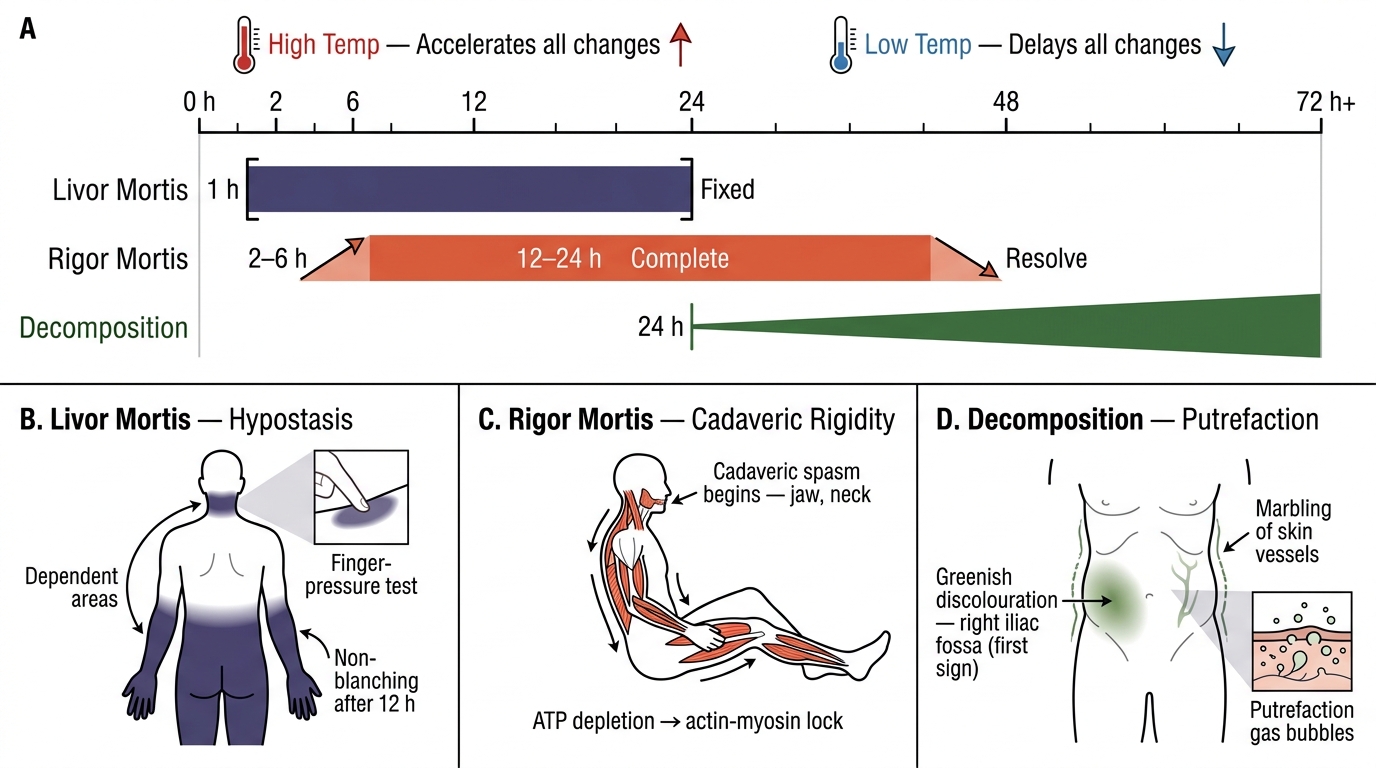
Post-Mortem Changes: Temporal Sequence from Death to 72 Hours
Types of Autopsy: Clinical vs Medico-Legal
Autopsies are divided into two fundamental categories based on their purpose and the authority under which they are conducted: clinical (hospital) autopsies and medico-legal (forensic) autopsies. These differ in almost every dimension — legal authority, consent requirements, purpose, performer, and documentation standards.
A clinical autopsy is performed in a hospital setting, primarily to clarify the cause of death in a patient who died under medical care, to audit diagnostic accuracy, to identify hospital-acquired conditions, and to contribute to medical education and research. The family's consent is required; in the absence of consent, a clinical autopsy cannot be performed. The findings inform the death certificate and feed back to clinical teams. The performer is typically a histopathologist or general pathologist.
A medico-legal autopsy is performed under statutory authority — the order of a magistrate or police officer — in cases where the cause of death is unknown, suspicious, or legally relevant. Consent is not required and cannot be withheld. The purpose is to establish facts for legal proceedings: cause, manner, and mechanism of death; collection of evidence; and documentation for inquest and court. The performer in India is a government forensic medicine specialist, and the report is a public document.
Within medico-legal autopsies, the following sub-categories are recognised:
- Routine medico-legal autopsy: the standard examination of bodies referred by police or magistrate
- Obscure autopsy: a second or subsequent post-mortem examination ordered when the first was inconclusive — discussed in detail in a later block
- Exhumation autopsy: examination after disinterment of a previously buried body
- Special autopsies: custodial deaths, anaesthetic deaths, disaster victim identification — each with protocol variants
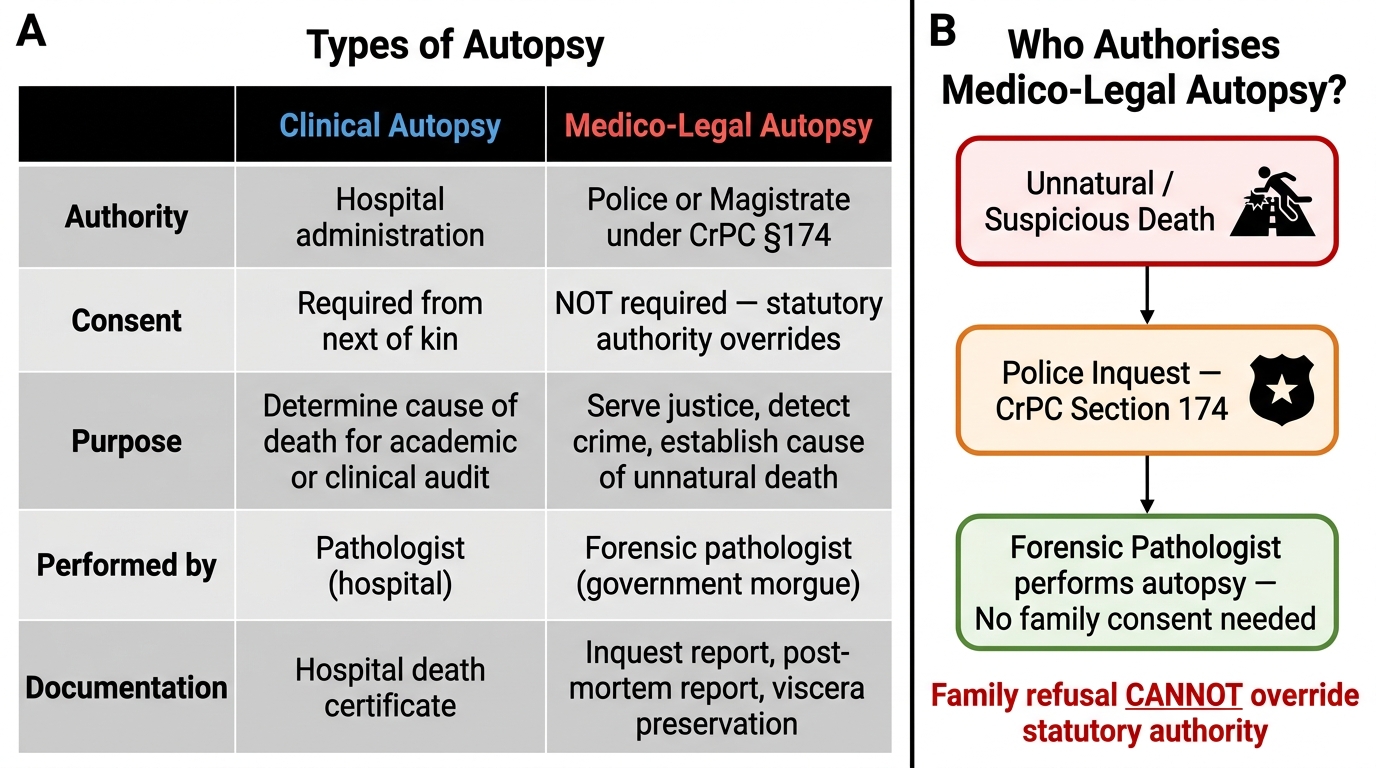
Clinical vs Medico-Legal Autopsy: Authority, Consent & Documentation
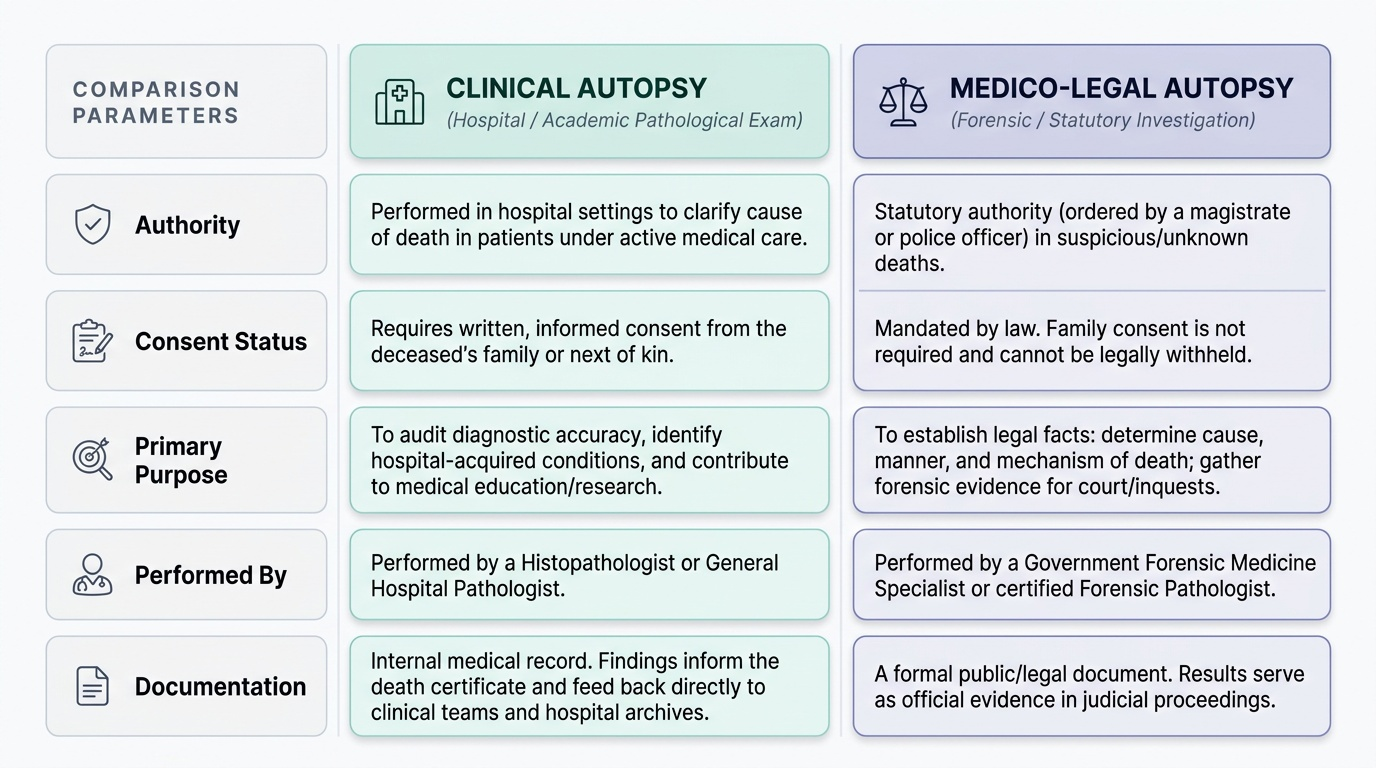
Provided image
SELF-CHECK
A family refuses consent for autopsy after their relative dies in a road traffic accident brought to the casualty. The duty doctor should:
A. Postpone the autopsy until consent is obtained
B. Proceed with the autopsy under medico-legal authority without consent
C. Issue a death certificate based on clinical findings and release the body
D. Refer the case to a private forensic lab for autopsy with family presence
Reveal Answer
Answer: B. Proceed with the autopsy under medico-legal authority without consent
A road traffic accident is an unnatural death and falls under the medico-legal category. The police inquest under CRPC Section 174 authorises the medico-legal autopsy. Family consent is not required and cannot override the statutory authority. Proceeding without consent is legally correct — refusing to do so on consent grounds is an error.