Page 1 of 20
FM6.1 | Firearms: Types, Ammunition & Terminology — SDL Guide
Learning Objectives
- Classify firearms by mechanism of action and barrel character
- Describe the structural components of major firearm types
- Identify and describe the components of a cartridge and types of bullets
- Explain the role and forensic significance of propellant charge
- Define the terminology: caliber, range, choking, muzzle velocity
- Outline the medico-legal documentation of firearm exhibits and chain of custody
INSTRUCTIONS
Forensic Medicine expects you to walk into a crime scene or post-mortem suite and recognise, interpret, and document firearm injuries accurately. That skill rests on a foundational understanding of weapons and ammunition — if you cannot describe what was fired, you cannot interpret how the wound was made. This module builds that technical foundation: firearm types, structural components, cartridge anatomy, propellant chemistry, and the critical terminology (caliber, choking, range) that appears in police reports, court exhibits, and ballistic expert testimony. A doctor who confuses a revolver with a pistol, or cannot explain the difference between tattooing and blackening, loses credibility in court.
References
- KSN Reddy — Essentials of Forensic Medicine & Toxicology (textbook)
- BV Subrahmanyam — Modi's Medical Jurisprudence and Toxicology (textbook)
Version 2.0 | NMC CBUC 2024
CLINICAL SCENARIO
A 32-year-old man is brought dead to the mortuary with a single wound on the right temple. The police report states 'self-inflicted firearm injury.' At post-mortem you find a circular, 8 mm wound with a distinct abrasion collar and heavy, sooty blackening with singing of hair over a 5 cm radius. The hand swabs show residue. Before you can determine whether this was suicide, homicide, or accident, you need to answer three questions: What type of firearm caused this wound? What propellant residue do you expect? And what does the distribution of blackening tell you about the range of fire? This module equips you to answer those questions from first principles — starting with the weapon itself.
WHY THIS MATTERS
India records approximately 40,000 firearm-related deaths annually, of which a significant proportion require forensic medical evaluation for manner-of-death determination. Forensic physicians are called to post-mortem rooms, crime scenes, and courtrooms where they must describe weapons, interpret ammunition, and explain wound characteristics to judges and juries. The Arms Act 1959 and its amendments govern weapon licensing in India, and medico-legal opinions often include identifying the class of weapon involved based on wound evidence. Understanding firearm types and ammunition is also essential for interpreting gunshot residue (GSR) analysis, which is increasingly used in Indian forensic laboratories. Without this technical foundation, every downstream step in the forensic evaluation of a firearm death — range estimation, manner of death, court testimony — is compromised.
RECALL
Before proceeding, activate your Year-1 knowledge:
- Wound types from mechanical trauma: abrasion (epidermis only), contusion (blunt force haemorrhage), laceration (blunt force tearing), incised wound (sharp edge, clean margins). Firearm wounds blend several of these.
- Kinetic energy: KE = ½mv² — you will use this to understand why high-velocity rifle bullets produce far more tissue destruction than low-velocity pistol rounds.
- Chemical combustion: rapid oxidation of propellant generates expanding gases — the same principle as an internal combustion engine, but operating in microseconds.
- Chain of custody in medicolegal work: any exhibit mishandled becomes legally inadmissible — this principle applies to firearm exhibits and residue samples as much as to biological specimens.
Types of Firearms and Their Structural Components
Firearms are mechanical devices that use rapidly expanding propellant gases to propel a projectile at high velocity through a barrel. The forensic significance of knowing firearm types is that each type leaves a distinct wound signature — a shotgun fired at contact range produces a star-shaped laceration with multiple pellet tracks, whereas a pistol at the same range produces a single punched-out hole with soot blackening. Classifying a firearm by mechanism and barrel character is therefore the first step in interpreting any gunshot wound.
By mechanism of action, firearms fall into three groups. Single-shot weapons (historical muskets, some hunting rifles and pistols) must be reloaded after each discharge; they require manual loading of a single cartridge. Repeating weapons can fire multiple rounds without complete disassembly; they subdivide into manually repeating (bolt-action, lever-action — each shot requires a manual action to cycle the next round) and self-loading or semi-automatic (each trigger pull fires one round, the action cycles automatically using gas or recoil energy). Automatic weapons continue to fire as long as the trigger is depressed and rounds remain in the magazine; these are restricted to military/police use.
By barrel character, firearms are either smooth-bore or rifled. A smooth-bore barrel (the shotgun) has no spiralling grooves and fires a charge of small pellets (shot) or a single large slug. A rifled barrel has helical grooves cut into its inner surface, which impart spin to the projectile and dramatically improve range and accuracy. Rifles and pistols/revolvers are rifled. The rifling pattern is unique to each manufacturer and even each individual weapon — rifling marks on a recovered bullet can be matched to the specific weapon that fired it, a cornerstone of forensic ballistics.
Handguns — the most common type encountered in urban Indian forensic practice — include the revolver (a rotating cylinder holding 6–8 chambers, each containing a complete cartridge; the cylinder rotates with each trigger pull to align the next chamber with the barrel) and the semi-automatic pistol (a magazine housed in the grip feeds cartridges into a single chamber in the barrel; the slide recoils to eject the spent case and load the next round). Shoulder arms include the rifle (rifled barrel, high muzzle velocity, long range) and the shotgun (smooth-bore, shorter effective range, multiple projectiles).
All firearms share common structural components: the barrel (the tube through which the projectile travels), the chamber (where the cartridge is seated before firing), the action (the mechanism that loads, fires, and ejects cartridges), the trigger and firing pin (the firing mechanism), and the stock or grip (the handle or shoulder rest). Knowing these components allows a forensic physician to describe a weapon intelligibly in court and to anticipate what evidence the weapon produces.
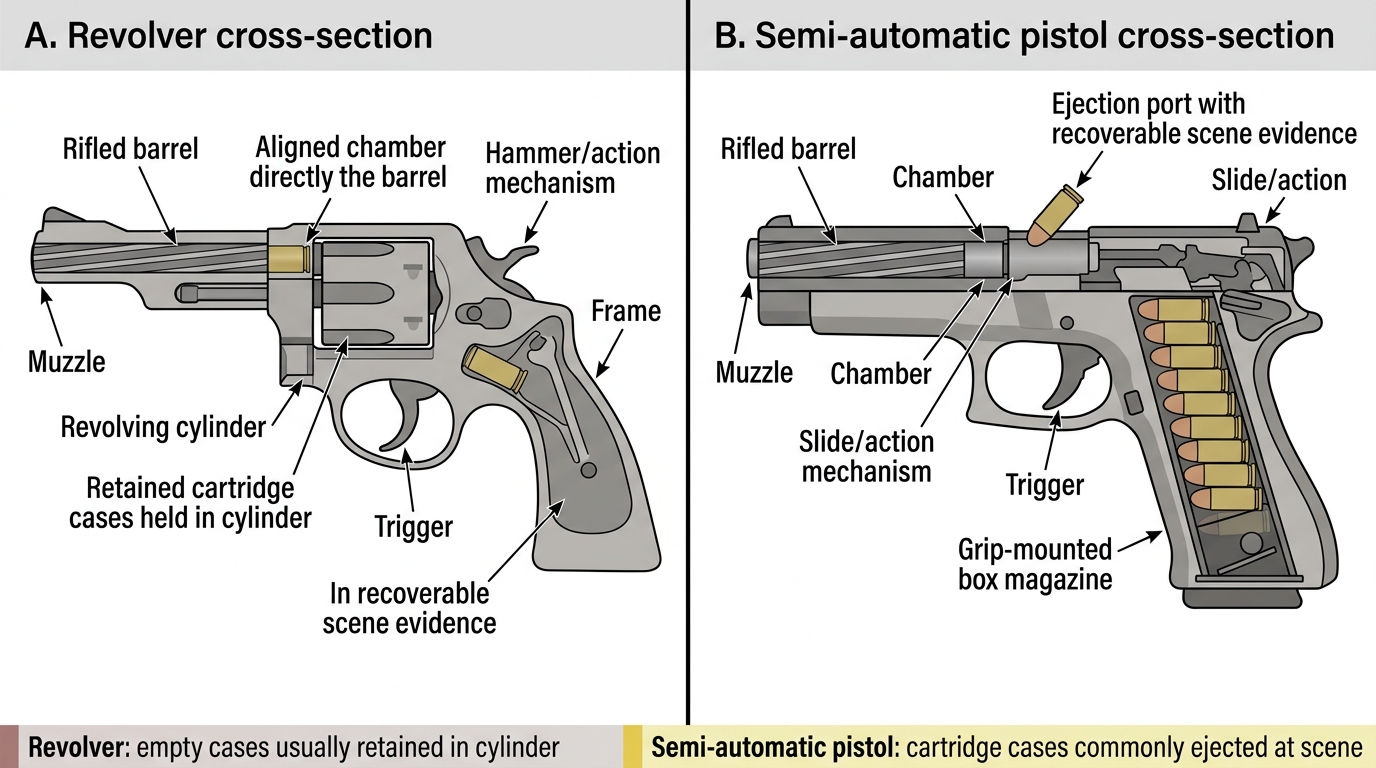
Cross-Sectional Comparison of Revolver and Semi-Automatic Pistol
| Firearm Type | Barrel | Loading | Typical Caliber/Gauge | Forensic Significance |
|---|---|---|---|---|
| Revolver | Rifled | Revolving cylinder | .32, .38, .455 | Empties retained in cylinder — useful if firearm recovered |
| Semi-auto pistol | Rifled | Box magazine | 9 mm, .45 ACP | Ejects cartridge cases at scene — recoverable evidence |
| Bolt-action rifle | Rifled | Manual bolt | .303, .308 | High-velocity, long-range; exit wounds common |
| Shotgun | Smooth-bore | Pump/break action | 12-gauge, 20-gauge | Multiple pellet tracks; range estimated by spread |
| Country-made pistol | Variable | Variable | Improvised | Common in India; irregular wounds, variable residue |
SELF-CHECK
A firearm is described as 'smooth-bore, 12-gauge, break-action.' Which category does it belong to, and what is the primary forensic advantage of the pellet spread in this type of weapon?
A. Rifled handgun; pellet spread allows fingerprint identification of the weapon
B. Smooth-bore shotgun; pellet spread pattern can be used to estimate the range of fire
C. Semi-automatic rifle; pellet spread indicates firing from cover
D. Automatic weapon; pellet spread confirms multiple shots were fired
Reveal Answer
Answer: B. Smooth-bore shotgun; pellet spread pattern can be used to estimate the range of fire
A smooth-bore, 12-gauge, break-action weapon is a shotgun. The pellet spread pattern on the target and wound expands with increasing distance from the muzzle; a tight cluster suggests close range, whereas a wide spread indicates distant firing. This is augmented by choke setting — tighter choke produces a narrower pattern at any given range.
Ammunition: Cartridge Structure and Bullet Types
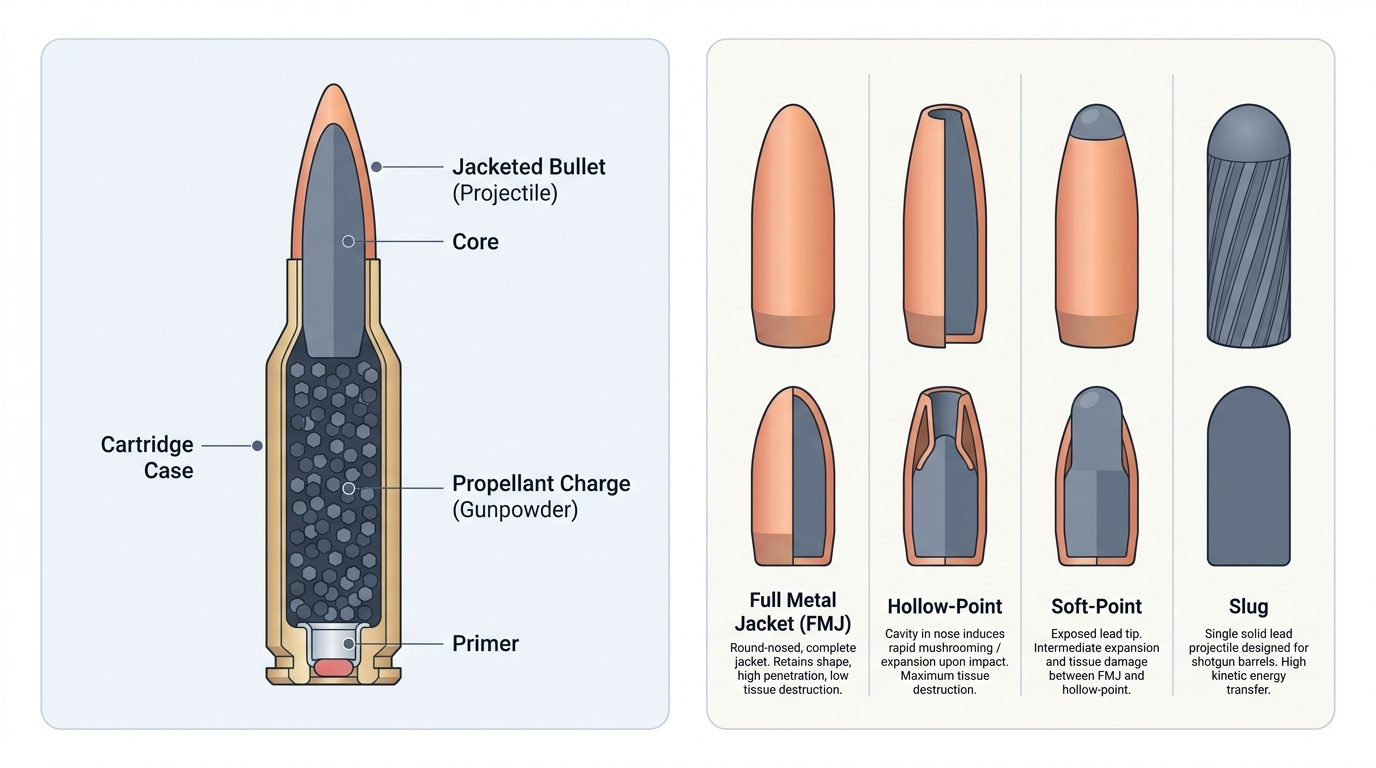
A cartridge (or round) is the complete unit of ammunition: a self-contained assembly that, when struck by the firing pin, propels the projectile down the barrel. The forensic physician must be able to describe cartridge components because recovered cartridge cases, bullets, and residue particles are all potential exhibits. Understanding cartridge structure is also the foundation for understanding gunshot residue (GSR) composition — each component contributes specific particles to the residue cloud.
A cartridge has four components. The case (or shell) is the metallic (usually brass or steel) cylinder that holds all other components; it expands on firing to seal the chamber and is ejected after the shot. The primer sits at the base of the case — it is a small percussion-sensitive charge (typically lead styphnate, barium nitrate, and antimony sulphide in modern primers) that ignites when struck by the firing pin; it provides the spark that lights the propellant. The propellant charge (see next section) is the chemical that produces the expanding gas. The bullet (or projectile) sits at the open end of the case and is propelled down the barrel. Note that 'bullet' refers specifically to the projectile — not the entire cartridge, a common lay error that a forensic physician should never make.
Bullet types carry medico-legal significance because their design determines wounding capacity. The full metal jacket (FMJ) bullet — also called round-nosed — has a soft lead core encased in a harder metal jacket (copper or gilding metal); it tends to pass through tissue with a smaller permanent cavity, causing less tissue destruction. FMJ bullets are mandated by the Hague Convention for military use. The hollow-point bullet has a cavity in the nose that causes the bullet to expand (mushroom) on impact, dramatically increasing its diameter and permanent cavity in tissue; hollow-points cause far more tissue destruction and are used by police for stopping power. The soft-point bullet has an exposed lead tip that partially expands on impact — an intermediate between FMJ and hollow-point. Slugs are single solid projectiles fired from shotguns. Tracer bullets contain a pyrotechnic compound in the base that ignites on firing, allowing the shooter to observe the trajectory; they leave distinctive residue. Armour-piercing bullets have hardened steel cores designed to penetrate body armour.
Provided image
For the forensic physician, the most critical issue is whether a recovered bullet can be matched to a specific weapon through its rifling marks (striations on the bullet surface imprinted by the barrel grooves) and whether the bullet's design — FMJ vs hollow-point — explains the severity of tissue destruction seen at autopsy.
Propellant Charge: Black Powder vs Smokeless Powder
The propellant charge is the chemical mixture that, when ignited by the primer, undergoes extremely rapid combustion to produce a large volume of hot gas that propels the bullet. The nature of the propellant determines the type and amount of gunshot residue (GSR) deposited around the wound and on the shooter's hands — and therefore determines which laboratory tests are relevant and how residue evidence should be interpreted.
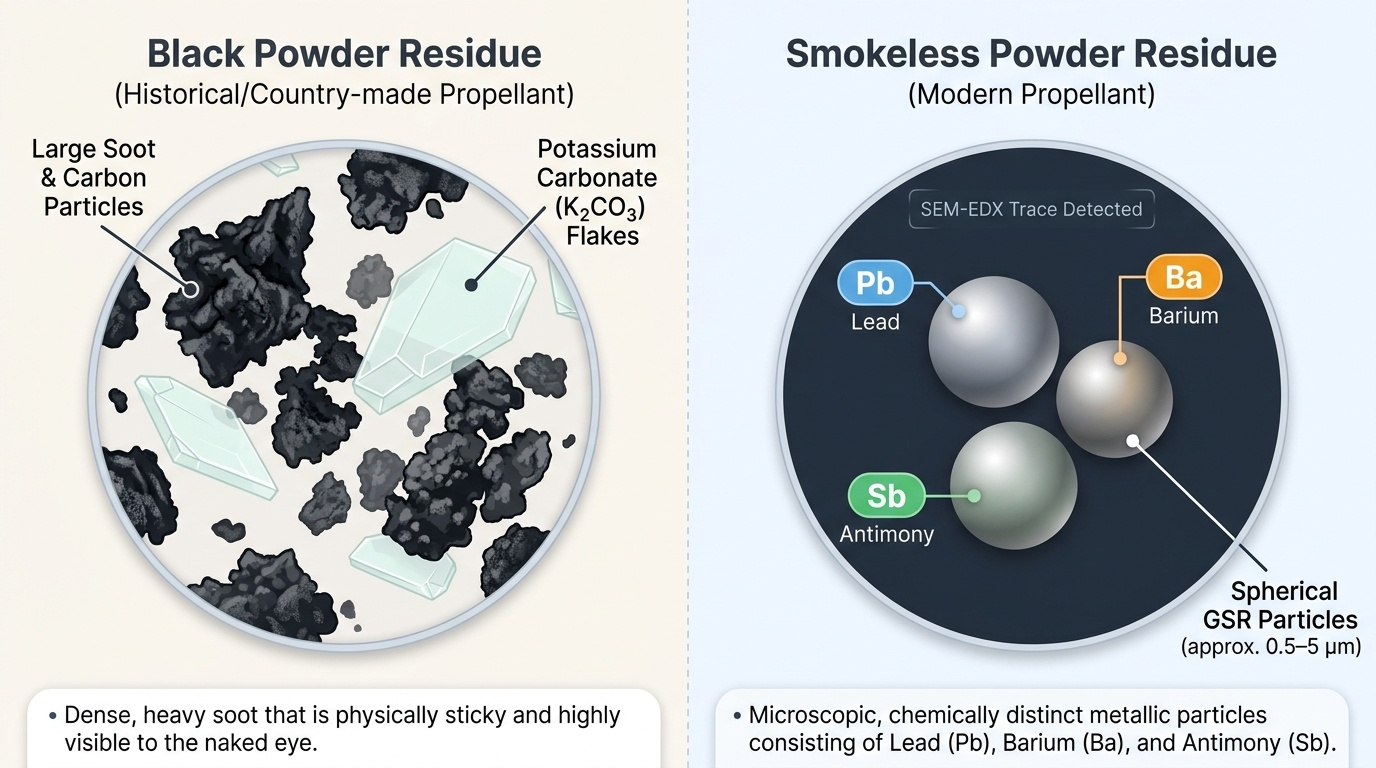
Black powder (gunpowder) is the historical propellant, composed of 75% potassium nitrate (saltpetre), 15% charcoal, and 10% sulphur. When ignited, it burns relatively slowly, produces dense black smoke, and generates large amounts of solid combustion products (soot/carbon particles, potassium carbonate, sulphur compounds). Old muzzle-loading weapons and some country-made firearms (katta, desi katta) use black powder. The heavy black sooting around a wound fired with black powder is characteristic and forensically significant — it cannot be wiped away from skin as easily as the soot from smokeless powder.
Smokeless powder is the modern propellant in almost all factory-loaded cartridges. It is based on nitrocellulose (single-base powders) or nitrocellulose plus nitroglycerin (double-base powders). Smokeless powder burns more completely, generates less visible smoke, produces much less solid residue, and achieves higher pressures — enabling higher muzzle velocities. The residue from smokeless powder is principally gunshot residue (GSR) particles: spherical or irregular particles containing characteristic elemental combinations (lead + barium + antimony in traditional primers; modern 'green' or lead-free primers use different combinations such as barium + aluminium or bismuth). GSR is detected by scanning electron microscopy with energy-dispersive X-ray spectroscopy (SEM-EDX), which identifies individual particles by morphology and elemental composition.
Provided image
For the forensic physician, the practical point is: ask the investigating officer whether the weapon used country-made (probable black powder) or factory-loaded ammunition (smokeless powder) — this determines which tests to request and how to interpret the residue on the wound edges and the suspect's hands.