Page 5 of 23
FM10.2-3 | NMC & State Medical Councils: Registration & Functions — SDL Guide
Learning Objectives
- Describe the Indian Medical Register and its purpose under the NMC Act 2020
- Explain the composition, functions, and role of the National Medical Commission and its four autonomous boards
- Describe the functions of State Medical Councils and their relationship with the NMC
- Explain the procedure for provisional and permanent registration of medical practitioners in India
INSTRUCTIONS
A medical degree is necessary but not sufficient to practise medicine legally in India. What makes your practice lawful is registration — your name appearing on the Indian Medical Register or a State Medical Register, maintained under the authority of the National Medical Commission and the respective State Medical Councils. Understanding this regulatory framework is both a legal necessity and a professional responsibility. The NMC Act 2020 fundamentally restructured Indian medical regulation, replacing the Medical Council of India with a new architecture that every practitioner must understand.
References
- KSN Reddy — Essentials of Forensic Medicine & Toxicology (textbook)
- BV Subrahmanyam — Modi's Medical Jurisprudence and Toxicology (textbook)
Version 2.0 | NMC CBUC 2024
CLINICAL SCENARIO
A freshly graduated MBBS doctor begins prescribing medicines at a private clinic immediately after receiving her degree certificate, without completing the registration formalities. Three months later, a patient she has been treating files a complaint. When the matter reaches the State Medical Council, it is discovered that she is not registered. Under Indian law, she has been practising medicine without a licence — an offence under the NMC Act 2020. Her degree does not protect her. Registration is not bureaucratic red tape — it is the legal instrument through which the state authorises a person to practise medicine, and through which the state can also remove that authorisation if the practitioner behaves unethically. This module explains the machinery of that authorisation: the Indian Medical Register, the National Medical Commission, and the State Medical Councils.
WHY THIS MATTERS
For every medical student in India, registration is the immediate practical outcome of passing MBBS — and it is governed by a framework that was substantially revised as recently as 2020. The NMC Act 2020 dissolved the Medical Council of India (MCI), which had existed since 1956 under the Indian Medical Council Act 1956, and replaced it with the National Medical Commission with a fundamentally different governance structure. This is not ancient history — it affects the institution that will register you, regulate your education, set examination standards for foreign medical graduates, and, if necessary, take disciplinary action against you. Understanding the NMC framework is a professional baseline, not an optional extra.
RECALL
Before we begin:
- What is the difference between a medical degree and a medical licence? Do you need both to legally practise medicine in India?
- You have heard of the 'Medical Council of India' — is it still the regulatory body for medicine in India? What replaced it, and when?
- Why do you think medical regulation was considered necessary in India? What problems was the Medical Council of India established to solve, and why was it replaced?
Legal and Professional Context: The Regulatory Framework for Indian Medicine
The practice of medicine in India is a regulated profession — meaning that the state sets standards for entry, monitors ongoing competence, and has the authority to remove a practitioner from practice if they fail to meet those standards. This regulatory function is exercised primarily through the National Medical Commission (NMC) at the national level and through State Medical Councils at the state level, both operating under the National Medical Commission Act 2020.
The rationale for medical regulation rests on the concept of asymmetric expertise: patients cannot independently evaluate the competence or integrity of the practitioners they consult. When a patient accepts a diagnosis or agrees to surgery, they are necessarily trusting the practitioner's competence and good faith — trust that they have no independent means to verify. Regulation substitutes for this individual verification: it provides a public assurance that registered practitioners have met a defined threshold of competence (through qualifying examinations) and continue to meet ethical standards (through disciplinary oversight).
The history of this regulation in India is directly relevant to understanding its current structure. The Indian Medical Council Act 1956 established the Medical Council of India (MCI), which maintained the Indian Medical Register and oversaw medical education and professional conduct for over six decades. By the 2010s, the MCI was widely regarded as compromised by corruption in its college recognition functions and ineffective in disciplinary enforcement. The NMC Act 2020 dissolved the MCI and replaced it with the NMC, introducing a new institutional architecture designed to address these failures.
Critical point for examinations and practice: NEVER cite the Indian Medical Council Act 1956 or the Medical Council of India (MCI) as the current regulatory authority. The MCI was dissolved in 2020. The operative statute is the NMC Act 2020 and the operative body is the National Medical Commission (NMC).
The Indian Medical Register and State Medical Registers
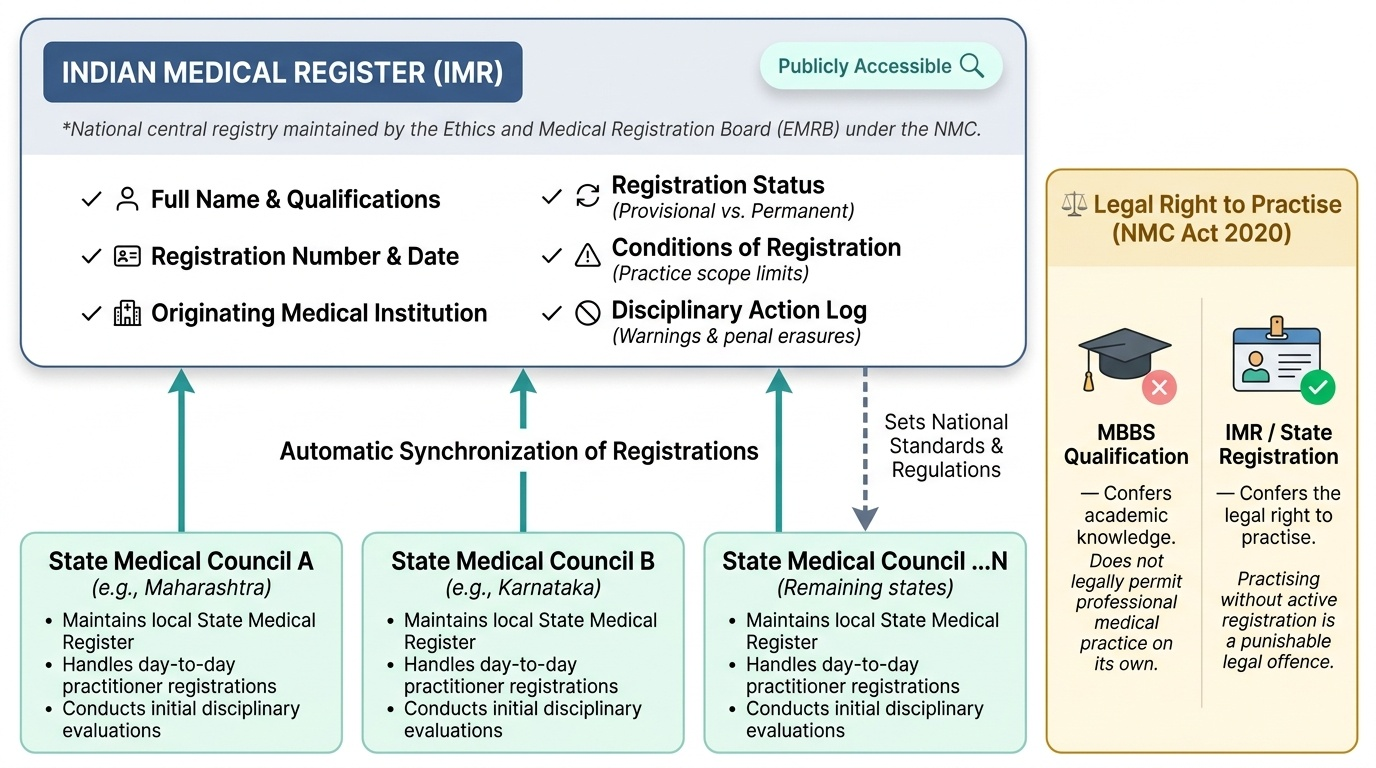
The Indian Medical Register (IMR) is the central, national registry of all persons qualified to practise medicine in India. It is maintained by the NMC (specifically by the Ethics and Medical Registration Board, one of its four autonomous boards, as described below). The IMR is a public document — any person can check whether a practitioner is validly registered.
The IMR contains, for each registered practitioner:
- Full name and qualifications
- Registration number and date of registration
- Medical institution from which the primary medical qualification was obtained
- Whether the registration is provisional or permanent
- Any conditions on registration (e.g. limited to a specific type of practice)
- Any disciplinary action recorded (warning notices, penal erasure)
In addition to the central IMR, each State Medical Council maintains its own State Medical Register for practitioners registered in that state. A practitioner may be registered with a State Council and that registration is automatically recorded in the IMR. The relationship between state and central registers is hierarchical: the NMC sets the standards, but state councils handle most day-to-day registration and initial disciplinary processes.
Why registration matters legally: Under the NMC Act 2020, it is an offence to practise medicine or to hold oneself out as a registered medical practitioner without being on the IMR or a State Medical Register. This is distinct from the qualification itself — a person may hold an MBBS degree but be unregistered (e.g. they have not completed their internship, or their registration has been erased). The degree confers knowledge; registration confers the legal right to practise.
Provided image
National Medical Commission: Composition, Functions and Role
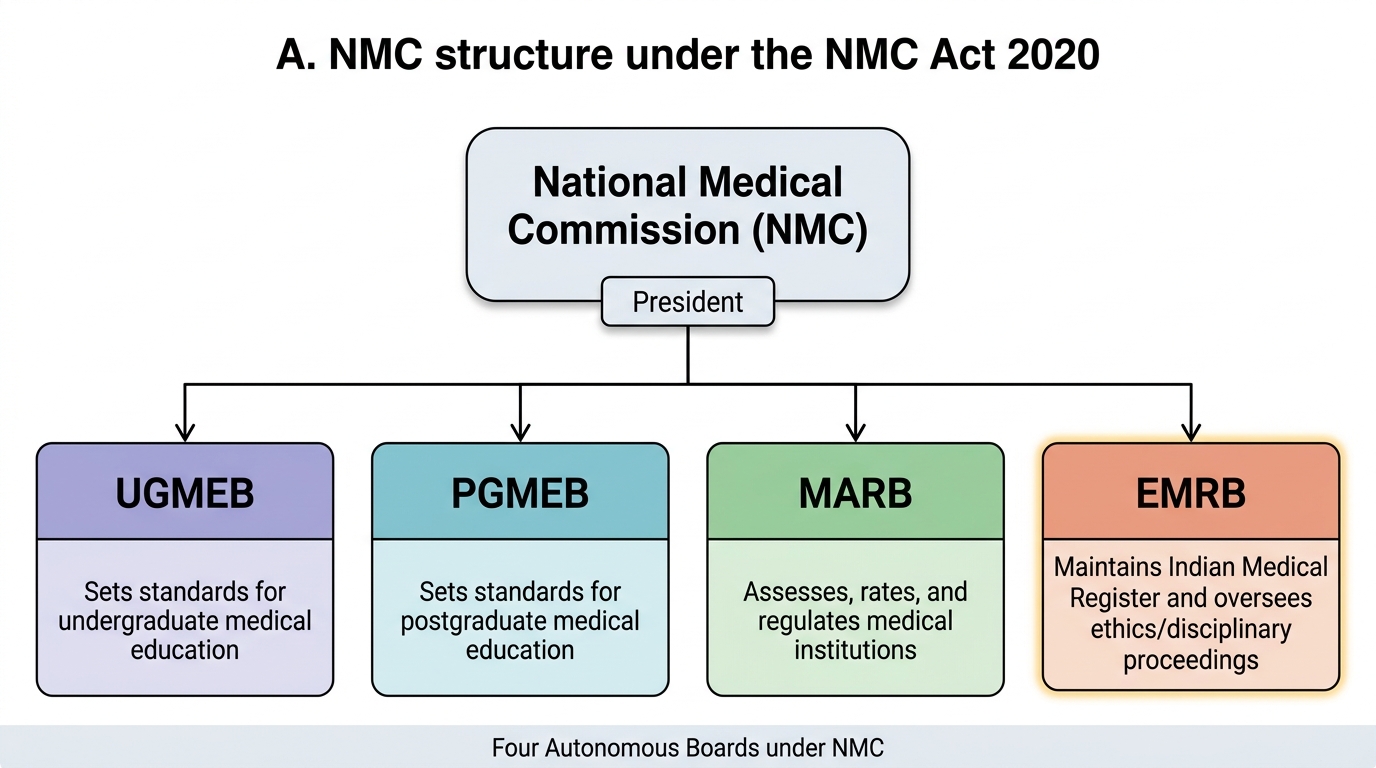
The National Medical Commission (NMC) was constituted under the NMC Act 2020 and is the apex regulatory body for modern medicine in India. Its structure reflects the lessons learned from the MCI's failures — in particular, by separating the functions of undergraduate education, postgraduate education, quality assessment, and ethics/registration into four distinct autonomous bodies, each with defined responsibilities.
The NMC itself consists of 25 members: the Chairperson (the President of the NMC), the Presidents of the four Autonomous Boards (by virtue of their office), elected members from State Medical Councils, nominated members from State governments, and experts nominated by the Central Government. The Chairperson is appointed by the Central Government from among eminent doctors.
The NMC operates primarily through its four Autonomous Boards, each handling a distinct domain:
1. Undergraduate Medical Education Board (UGMEB)
Responsible for setting standards for MBBS education: curriculum design, accreditation of medical colleges, eligibility criteria, and the conduct of the National Exit Test (NExT — the common exit examination that will replace the existing final MBBS examination and serve as the licensing examination).
2. Postgraduate Medical Education Board (PGMEB)
Responsible for MD/MS/DNB and other postgraduate medical programmes: setting standards, accrediting institutions, and overseeing the conduct of postgraduate entrance and exit assessments.
3. Medical Assessment and Rating Board (MARB)
Responsible for the quality assessment and rating of medical institutions — the 'inspection' function that the MCI was criticised for discharging corruptly. MARB conducts assessments on objective criteria.
4. Ethics and Medical Registration Board (EMRB)
Responsible for maintaining the Indian Medical Register, handling registration of medical practitioners, and overseeing professional ethics and disciplinary proceedings. The EMRB is the board most directly relevant to the day-to-day professional life of a registered practitioner — it is the body that can issue warning notices and initiate penal erasure proceedings.
NMC Structure Under the NMC Act 2020
SELF-CHECK
Under the NMC Act 2020, which body within the NMC structure is responsible for maintaining the Indian Medical Register and handling disciplinary proceedings against registered practitioners?
A. Undergraduate Medical Education Board (UGMEB)
B. Medical Assessment and Rating Board (MARB)
C. Ethics and Medical Registration Board (EMRB)
D. Postgraduate Medical Education Board (PGMEB)
Reveal Answer
Answer: C. Ethics and Medical Registration Board (EMRB)
The Ethics and Medical Registration Board (EMRB) is one of the four Autonomous Boards under the NMC Act 2020. It is specifically responsible for maintaining the Indian Medical Register, registering medical practitioners, and overseeing professional ethics including disciplinary proceedings (warning notices and penal erasure). UGMEB handles undergraduate education standards; PGMEB handles postgraduate education; MARB handles quality rating of medical institutions.