Page 12 of 23
FM10.{6,24} | Rights & Duties of a Registered Medical Practitioner — SDL Guide (Part 2)
Doctor-Patient Relationship: Professional Secrecy and Privileged Communication
Professional secrecy is one of the most fundamental obligations of the doctor-patient relationship. It rests on the recognition that the healing relationship requires patients to disclose intimate, sometimes incriminating, always sensitive information — and that patients would be deterred from seeking care if they could not trust that their disclosures would be protected. Professional secrecy is therefore not merely an ethical nicety but a practical prerequisite for effective medicine.
The obligation of professional secrecy is recognised in the NMC Code of Medical Ethics, in the Hippocratic tradition, and in the Declaration of Geneva ('I will respect the secrets which are confided in me, even after the patient has died'). In Indian law, the position on absolute legal protection of medical communications is less settled than it is for lawyer-client communications (which are protected under Section 126 of the Indian Evidence Act); medical communications have ethical protection but do not have the same degree of absolute legal protection.
Professional secrecy is NOT absolute. There are specific, bounded exceptions under which disclosure is permissible or required:
- Communicable disease notification: Statutory obligation to report notifiable diseases to public health authorities — this overrides confidentiality in the public interest
- Court order: A court can order a doctor to disclose patient information as evidence; the doctor must comply (unlike a lawyer, who can claim legal privilege)
- Fitness to drive / public safety: If a patient's medical condition makes them unsafe to drive or operate machinery, posing a risk to others, disclosure to appropriate authorities may be justified
- Patient's best interest with consent: The patient may themselves consent to disclosure (e.g. for insurance purposes, referral letters, medicolegal reports)
- Child protection: Where there is reasonable belief of child abuse or neglect, reporting to appropriate authorities overrides confidentiality
- Treating team: Information may be shared within the treating team (doctors, nurses, pharmacists) on a need-to-know basis — this is not a breach of confidentiality
- Research and audit: Anonymised data may be used for legitimate research and audit purposes; patient identifiable data requires consent
Privileged communication refers to the protection from compelled disclosure that attaches to information received in a professional relationship. In the medical context, the concept has two dimensions:
- Ethical privilege: The doctor should not disclose patient information without the patient's consent — this is the broad ethical duty of confidentiality
- Legal privilege: The legal protection from being compelled by courts to disclose — in India, this is NOT as absolute for doctors as it is for lawyers; a doctor can be ordered by court to testify about patient information, unlike a solicitor
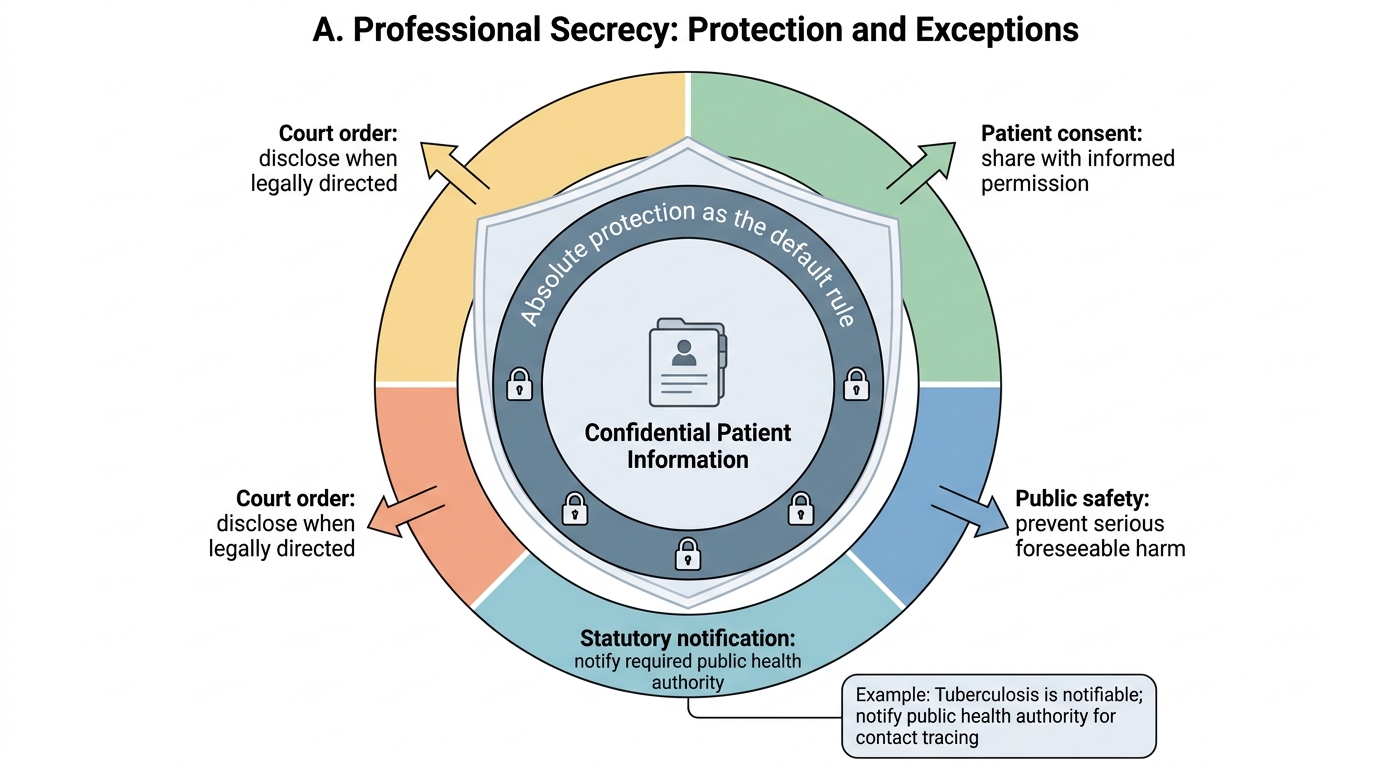
Professional Secrecy and Exceptions
SELF-CHECK
A patient diagnosed with pulmonary tuberculosis refuses to inform his household contacts and refuses treatment. The doctor is concerned that the contacts are at high risk of infection. Under the law and NMC Code, the doctor's MOST appropriate action is:
A. Maintain absolute confidentiality — the patient's right to privacy is paramount
B. Disclose to the patient's household contacts directly without further process
C. Notify the disease to the appropriate public health authority as a notifiable disease, which may then initiate contact tracing
D. Wait until the patient agrees — disclosure without consent is always prohibited
Reveal Answer
Answer: C. Notify the disease to the appropriate public health authority as a notifiable disease, which may then initiate contact tracing
Tuberculosis is a notifiable disease in India. The doctor has a statutory obligation to notify the public health authority of the case. This notification overrides the general obligation of confidentiality in the public interest — it is one of the defined exceptions to professional secrecy. The public health authority then has the powers and responsibilities for contact tracing and follow-up. Direct disclosure to contacts by the doctor is not the appropriate procedure; the notification mechanism exists precisely for this purpose.
Applied Practice: Navigating Rights and Duties in Clinical Scenarios
The rights-duties framework must be applied contextually — no right is absolute, and no duty is without qualification. The following worked scenarios illustrate the reasoning process.
Scenario 1: The HIV patient and the partner. A patient discloses HIV status in confidence and refuses to tell his partner. The partner is at direct risk of a serious, transmissible infection.
Analysis: The duty of confidentiality is strong, but it is not absolute. HIV is notifiable in India. There is a competing duty to public health and to the partner's right not to be exposed to serious harm without knowledge. Modern ethical guidance (and some jurisdictions' law) permits — and in some cases requires — disclosure to the partner where: (a) there is a clear, direct, and serious risk; (b) the patient has refused to disclose despite counselling; (c) the information cannot be communicated without identifying the patient; and (d) disclosure is limited to what is necessary. The doctor should first attempt to counsel the patient to disclose voluntarily; if this fails, the disclosure to the partner should be considered.
Documentation: Document the counselling conversations, the patient's refusal, and the reasoning for any disclosure decision.
Scenario 2: The police inquiry. Police ask the doctor whether a specific patient visited the clinic, as part of a robbery investigation.
Analysis: The general duty of confidentiality requires the doctor not to disclose patient information to police without a court order. An informal police inquiry is not a legal compulsion. The doctor should decline to confirm or deny the patient's attendance without a court order. This is not obstruction of justice — it is the maintenance of professional confidentiality, which the law itself recognises as important.
Scenario 3: The patient who wants to drive. A 60-year-old patient is found to have poorly controlled epilepsy with frequent seizures. He insists he needs to drive to work and asks the doctor not to report this.
Analysis: The Motor Vehicles Act 1988 prohibits a person with a disqualifying medical condition from holding a driving licence. Epilepsy with uncontrolled seizures is typically a disqualifying condition. The doctor's obligation to public safety (non-maleficence and justice — preventing harm to third parties on the road) may override confidentiality. The doctor should advise the patient strongly to cease driving and notify the licensing authority if the patient refuses and continues to drive, posing a direct public safety risk.
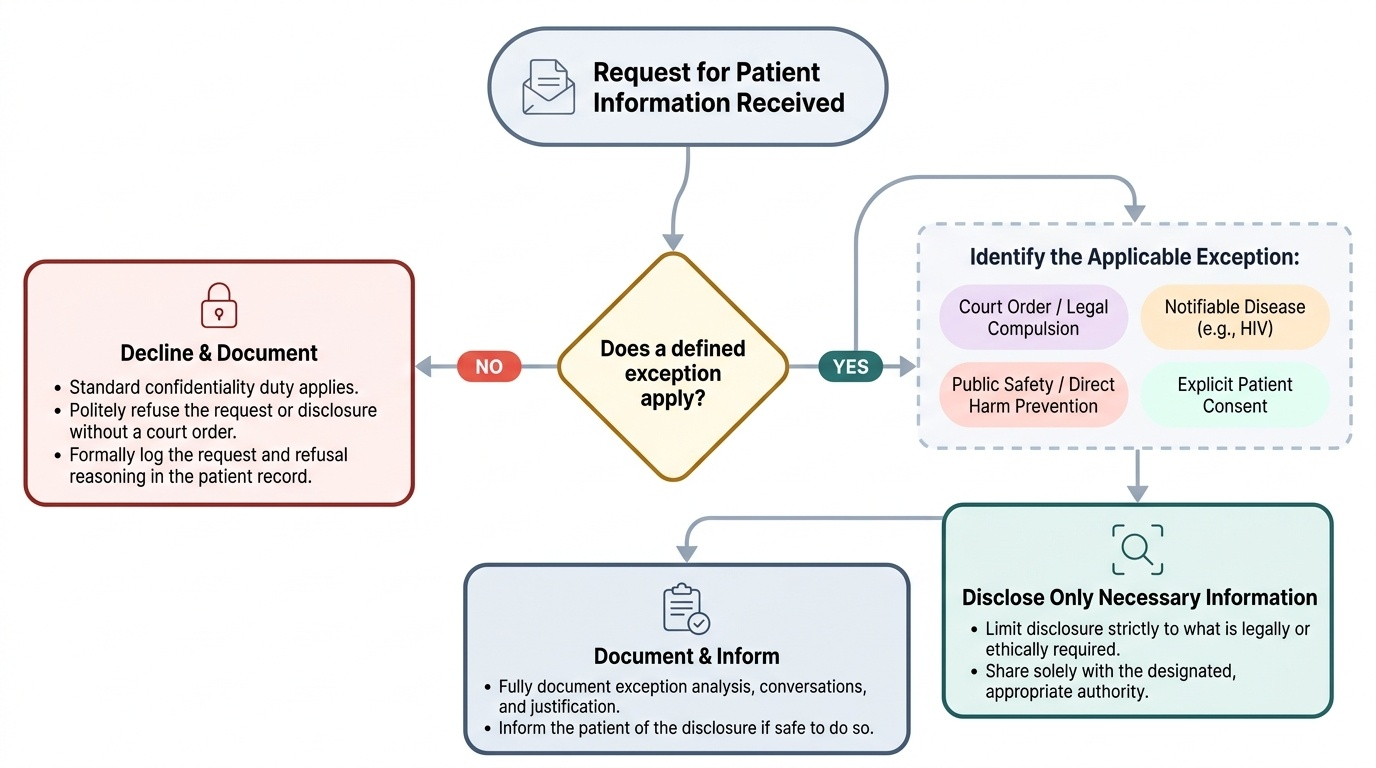
Steps for navigating confidentiality decisions:
1. Identify whether a defined exception to confidentiality applies (court order, notifiable disease, public safety, consent)
2. If in doubt, seek senior advice or consult the hospital ethics committee before disclosing
3. Disclose only what is necessary and only to the appropriate recipient
4. Document the decision and reasoning in the clinical record
5. Inform the patient that disclosure has been made (unless doing so would itself cause harm — e.g. domestic violence situations)
Provided image
SELF-CHECK
Under the NMC Code and Indian law, professional secrecy can be lawfully overridden in which of the following situations?
A. When the patient's family requests the information for family planning purposes
B. When a pharmaceutical company requests anonymised data for a drug effectiveness study without patient consent
C. When a court orders the doctor to provide information about the patient as part of legal proceedings
D. When the patient's employer requests a detailed medical report to decide on a salary increment
Reveal Answer
Answer: C. When a court orders the doctor to provide information about the patient as part of legal proceedings
A court order is one of the defined exceptions to professional secrecy — the doctor must comply with a court order to disclose patient information. Family requests without the patient's consent do not override confidentiality; the patient's wishes are primary. A pharmaceutical company's data request requires ethical approval and patient consent (even for anonymised data in most cases). An employer's request for detailed medical information without patient consent is not a legitimate exception.
CLINICAL PEARL
Professional secrecy and privileged communication are not identical. Professional secrecy is the broad ethical and regulatory duty to keep patient information confidential — it applies always and creates a strong default against disclosure. Privileged communication is a legal concept referring to protection from compelled disclosure in legal proceedings. In India, the privilege for medical communications is not absolute (unlike for lawyers under Section 126 of the Indian Evidence Act) — a doctor can be ordered by a court to disclose. Understanding this distinction is important in forensic medicine practice, where you will often be asked to provide evidence about patients.