Page 4 of 20
FM5.2-3 | Medico-legal Classification of Injuries (BNS) — SDL Guide
Learning Objectives
- Define injury, assault, and hurt as used in the Bharatiya Nyay Sanhita (BNS) 2023
- Enumerate all 8 categories of grievous hurt under BNS Section 118 and identify the distinguishing criteria for each
- Distinguish accidental, suicidal, and homicidal injuries on the basis of wound site, number, defence wounds, and circumstantial features
- Explain the criteria for ante-mortem vs post-mortem injuries including macroscopic and histological vital reaction
- Formulate a medico-legal opinion connecting wound examination findings to statutory injury categories under the BNS
INSTRUCTIONS
Every injury examined in a medico-legal context ultimately enters a legal framework — the question is not just what the wound is, but what it means in law. The Bharatiya Nyay Sanhita 2023 replaced the Indian Penal Code 1860 and renumbered many of the provisions that forensic physicians use daily. A doctor who still cites IPC section numbers in court documents is citing a repealed statute. This module builds the statutory vocabulary that bridges wound findings and legal charges: how to classify injuries under the BNS, how to determine whether an injury is accidental, suicidal, or homicidal, and how vital reaction decides the all-important question of ante-mortem versus post-mortem timing.
References
- KSN Reddy — Essentials of Forensic Medicine & Toxicology (textbook)
- BV Subrahmanyam — Modi's Medical Jurisprudence and Toxicology (textbook)
Version 2.0 | NMC CBUC 2024
CLINICAL SCENARIO
A 45-year-old man is brought to the emergency department unconscious after an alleged road traffic accident. He has a deep laceration over the right temporal region, two fractured ribs, and an abrasion on his left forearm. The police report states he was a pedestrian struck by a vehicle. However, a witness reports seeing the man in a physical altercation 30 minutes before the accident. The attendant physician prepares the MLC. What section of the BNS applies to the rib fracture? Is the temporal laceration grievous or simple hurt? And if a court later asks whether the injuries were accidental or homicidal — what clinical findings will your MLC need to address?
WHY THIS MATTERS
The medico-legal classification of injuries under the Bharatiya Nyay Sanhita is one of the most practically consequential domains in forensic medicine. When you certify an injury as 'grievous hurt' under BNS Section 118, you are directly enabling a charge that carries up to seven years' imprisonment. When you certify injuries as 'consistent with homicidal assault' rather than 'consistent with an accident', you change the direction of the police investigation. The attending forensic physician is thus a key witness whose factual observations and statutory interpretations carry weight far beyond the clinic. Since the BNS came into force on 1 July 2024, replacing the IPC 1860, all medico-legal certificates must cite BNS section numbers — the IPC is repealed and citing it is a legal anachronism that can be challenged in court.
RECALL
From the previous module on wound types (FM5.1), you will recall the precise definitions of abrasion, contusion, laceration, incised wound, stab wound, and chop wound — and particularly the tissue bridge test distinguishing laceration from incised wound. That morphological classification now connects to the statutory classification: the BNS defines 'hurt', 'grievous hurt', and the various offences against the body in terms that reference the physical nature and consequences of injuries. Additionally, from your anatomy and physiology studies, recall the principles of inflammatory response: the cellular infiltrates that appear in response to tissue injury within minutes to hours form the basis of the vital reaction criteria used to time injuries relative to death.
From Wound to Charge: How Medical Findings Drive Legal Outcomes
The relationship between a clinical wound finding and a statutory legal charge follows a defined pathway in the Indian justice system. The forensic physician is not a police officer or a judge — their role is strictly to record factual findings and render a medico-legal opinion that connects those findings to defined statutory categories. The Bharatiya Nyay Sanhita 2023 (BNS), which came into force on 1 July 2024 and replaced the Indian Penal Code 1860, provides the current framework within which all injury-related charges are framed.
Consider the sequence: the doctor examines the wound and characterises it by type, site, size, and severity. This characterisation directly determines which statutory category the injury falls into — simple hurt or grievous hurt — which in turn determines the minimum and maximum charges that the investigating authority can apply. A fracture of the femur, for instance, constitutes grievous hurt under BNS Section 118 ('fracture or dislocation of a bone or tooth'), enabling a charge under BNS Section 118 itself or, if caused with the intention of causing grievous hurt, under BNS Section 121 (voluntarily causing grievous hurt). If the same fracture was caused in circumstances suggesting an intention to kill, the applicable charge shifts towards culpable homicide (BNS Section 100) or murder (BNS Section 103).
The forensic physician therefore exercises significant legal influence through purely factual documentation. Accuracy in wound characterisation, completeness in examination, and precision in statutory language in the MLC are non-negotiable professional obligations. An MLC that says 'patient has a bone injury — simple hurt' when a fracture exists miscategorises the injury, enabling only a lesser charge. Such errors — whether from inadequate examination or imprecise terminology — can result in under-prosecution of serious offences.
Defining Injury and Hurt Under the Bharatiya Nyay Sanhita
The BNS provides precise statutory definitions for the terms used in injury-related offences. Understanding these definitions is essential for accurate medico-legal certification.
Injury is defined in BNS Section 2(d) as any harm illegally caused to any person — in body, mind, reputation, or property. In the context of physical injuries, the clinical focus is on harm to the body, but the forensic physician should note that psychological harm following assault may also be relevant to the overall complaint.
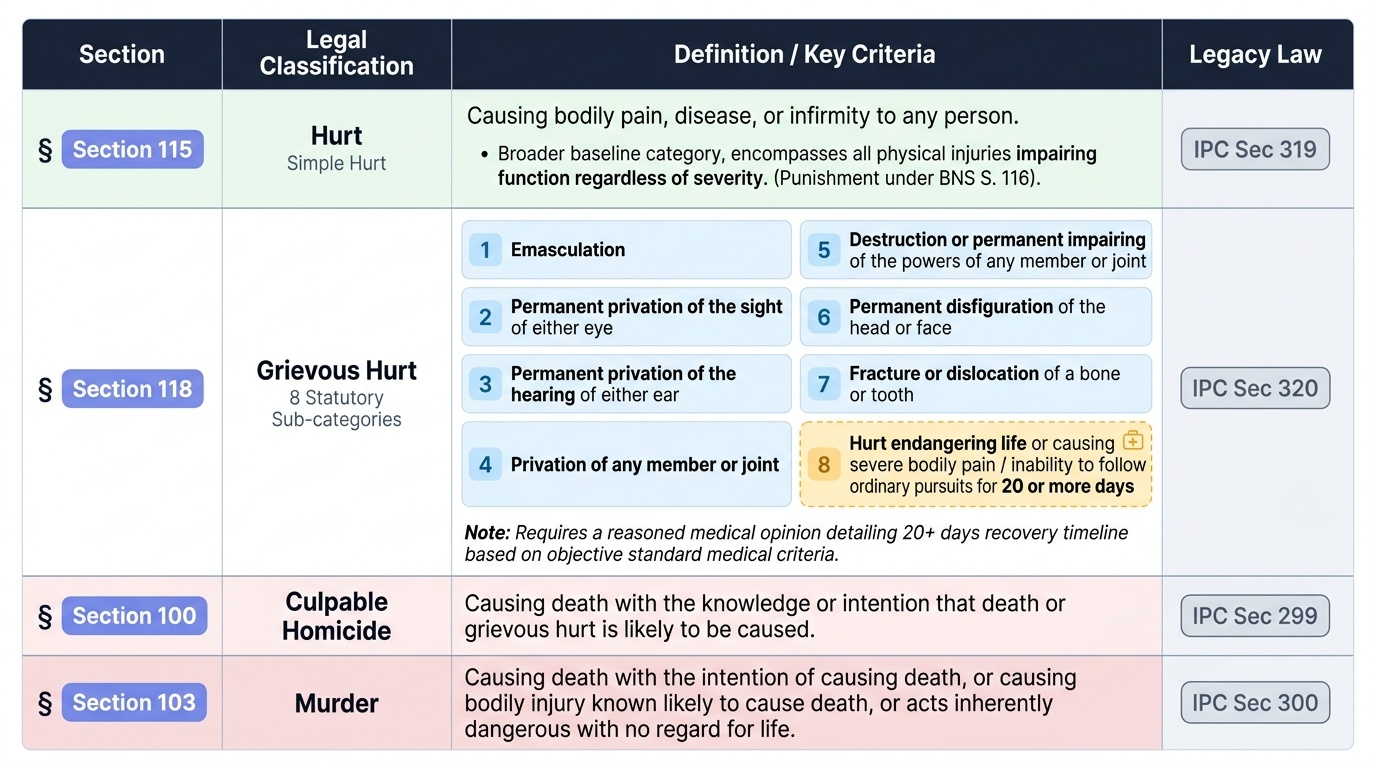
Hurt is defined under BNS Section 115 as causing bodily pain, disease, or infirmity to any person. This is a broad category that encompasses all physical injuries that cause pain or impair function, regardless of their severity. Simple hurt is prosecuted under BNS Section 116 (voluntarily causing hurt), with punishment of up to one year or a fine.
Grievous hurt is defined under BNS Section 118, which enumerates eight specific categories that constitute grievous hurt. These eight categories are:
1. Emasculation
2. Permanent privation of the sight of either eye
3. Permanent privation of the hearing of either ear
4. Privation of any member or joint
5. Destruction or permanent impairing of the powers of any member or joint
6. Permanent disfiguration of the head or face
7. Fracture or dislocation of a bone or tooth
8. Any hurt which endangers life or which causes the sufferer to be during the space of twenty days in severe bodily pain, or unable to follow his ordinary pursuits
The eighth category is the most commonly applied in practice, as it captures injuries that are severe but do not fall into the first seven. The threshold is important: inability to follow ordinary pursuits for 20 or more days is the statutory criterion, not the physician's subjective assessment of severity. A doctor who certifies an injury as grievous under the 8th category must document the nature of the injury and provide a reasoned opinion that recovery will require 20+ days, citing the injury type and standard recovery timelines.
Beyond hurt, the BNS addresses more serious offences: culpable homicide (BNS Section 100 — causing death with the knowledge or intention that death or grievous hurt is likely) and murder (BNS Section 103 — causing death with the intention of causing death, or grievous hurt known likely to cause death). The forensic physician's MLC feeds into the determination of which of these charges applies.
Provided image
SELF-CHECK
A patient presents after an assault with a fracture of the left ulna confirmed on X-ray. Under the Bharatiya Nyay Sanhita (BNS), which category does this injury fall under and what is the relevant section?
A. Simple hurt — BNS Section 115
B. Grievous hurt — BNS Section 118, category 7 (fracture of bone)
C. Grievous hurt — BNS Section 118, category 8 (endangers life)
D. Culpable homicide — BNS Section 100
Reveal Answer
Answer: B. Grievous hurt — BNS Section 118, category 7 (fracture of bone)
A fracture of a bone is specifically enumerated as grievous hurt under BNS Section 118, Category 7: 'fracture or dislocation of a bone or tooth.' This is a closed, precise category — any bone fracture attributable to an assault automatically constitutes grievous hurt under this provision, regardless of the duration of disability. Category 8 is for injuries not covered by categories 1-7 that endanger life or cause 20+ days of disability. Culpable homicide (S100) requires causing death.
Accidental, Suicidal, and Homicidal Injuries: Distinguishing Features
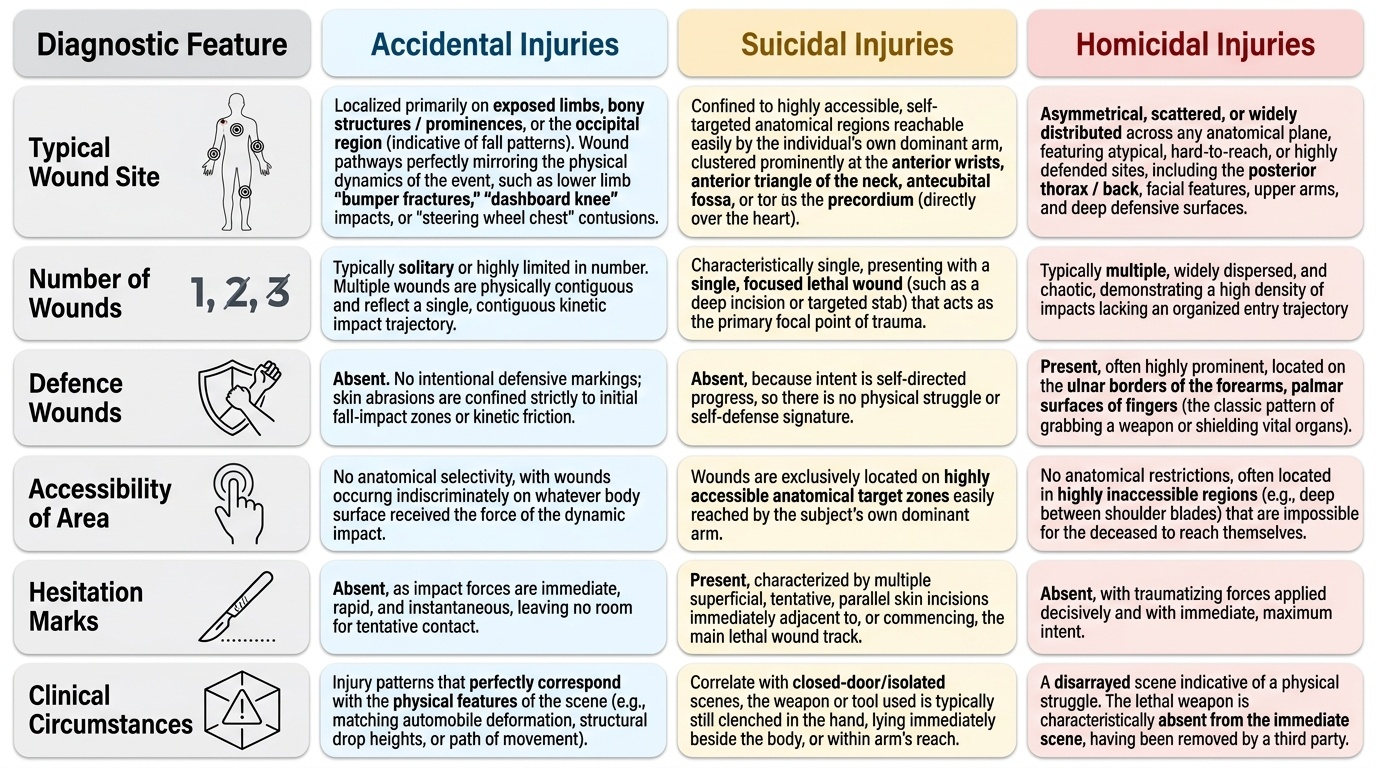
Classifying an injury as accidental, suicidal, or homicidal in origin is among the most high-stakes opinions a forensic physician renders, as it directly determines the direction of the police investigation and prosecution. This classification is based on the convergence of wound characteristics, anatomical site patterns, multiplicity of injuries, and circumstantial features — no single finding is pathognomonic, and the opinion is always probabilistic.
Accidental injuries lack a pattern: they occur at sites consistent with the mechanism of the accident (road traffic injuries on exposed limbs, falls causing occipital lacerations), are typically solitary or few, involve no defence wounds, and the distribution of injuries is mechanistically explicable by the described events. In road traffic accidents, the specific injury patterns (bumper fracture, dashboard knee, steering wheel chest) are characteristic. Accidental injuries do not show the selectivity or accessibility patterns that distinguish self-inflicted wounds.
Suicidal injuries show a characteristic set of features that reflect the psychology and physiology of self-harm. They are located on accessible anatomical sites that the individual can reach with their own dominant hand — the anterior wrist (most common for incised wounds), the neck (anterior triangle for incised wounds), the antecubital fossa, and the precordium (for suicidal stab wounds). They are typically singular and committed with sufficient force to cause serious injury, often preceded by hesitation marks (superficial, tentative incisions alongside the main wound). There are no defence wounds — the individual is acting on themselves, not defending against attack. Suicidal wounds are rarely on the back, the posterior neck, or other inaccessible areas.
Homicidal injuries are characterised by features reflecting an external perpetrator acting against a resisting victim. They show the following pattern: multiple wounds (the attacker strikes repeatedly; a single fatal wound in homicide is less common than multiple injuries); defence wounds on the hands, forearms, and legs as the victim resists; wounds on non-accessible sites (back, posterior neck, multiple limbs); and forced-entry wounds (injuries to the palms from gripping a blade, wounds inflicted from behind). The circumstantial features — evidence of struggle (furniture displaced, blood trails), ligature marks, or restraint marks — complement the wound findings.
Provided image
CLINICAL PEARL
The 8th category of grievous hurt under BNS Section 118 — 'any hurt which endangers life or causes the sufferer to be for 20 days unable to follow ordinary pursuits' — is the most frequently litigated category in practice. Physicians sometimes certify injuries under this category without documenting the basis for the 20-day criterion. This makes the certification legally vulnerable to challenge. When using Category 8, explicitly state in the MLC: the injury type, the expected recovery timeline with its basis, and whether the injury endangers life — do not simply write '8th category grievous hurt' without supporting reasoning.