Page 1 of 17
FM8.1 | Sexual Offences: BNS/BNSS/POCSO Legal Framework — SDL Guide
Learning Objectives
- State the provisions of BNS Section 63 that define rape, including the seven circumstances
- Identify the BNSS sections (397, 184, 52) that govern medical examination of accused, victim, and doctor's reporting duty
- Outline the key provisions of POCSO Act 2012 (Sections 3-12, 27, 41) relevant to medical examination
- Describe the doctor's mandatory duties — medical care, FIR-independent examination, and police information — under BNS and BNSS
- Explain the consequences of non-compliance with these statutory obligations
INSTRUCTIONS
Sexual violence is one of the gravest crimes in civil society, and the law has entrusted the examining doctor with a uniquely dual role: healer and evidence custodian. Understanding exactly what the Bharatiya Nyaya Sanhita (BNS), Bharatiya Nagarik Suraksha Sanhita (BNSS), and the POCSO Act demand of you is not optional — it is an enforceable professional obligation. This module equips you to walk into an emergency situation knowing your legal framework, so that clinical empathy and statutory compliance work together, not at cross-purposes.
References
- KSN Reddy — Essentials of Forensic Medicine & Toxicology (textbook)
- BV Subrahmanyam — Modi's Medical Jurisprudence and Toxicology (textbook)
Version 2.0 | NMC CBUC 2024
CLINICAL SCENARIO
It is 11 pm. A 16-year-old girl is brought to the emergency department by a neighbour. She is tearful, dishevelled, and reports that she was sexually assaulted two hours ago by an acquaintance. There is no police FIR. The registrar on duty asks the nursing staff to 'wait for police clearance before examination.' Meanwhile the girl sits in the waiting area. Across the corridor, a senior resident is wondering whether to call the police first or examine first. In this moment of confusion, three statutes — BNS 2023, BNSS 2023, and POCSO Act 2012 — have already answered every question. The only question is whether the treating team knows those answers.
WHY THIS MATTERS
A doctor who does not know what the law mandates risks three simultaneous harms: the patient is denied timely medical care (which the law demands independently of any investigation), forensic evidence degrades with every passing hour, and the doctor may personally face penal consequences for non-compliance. Since 2023, the legal landscape changed fundamentally with the replacement of the Indian Penal Code by the Bharatiya Nyaya Sanhita (BNS) and the Criminal Procedure Code by the Bharatiya Nagarik Suraksha Sanhita (BNSS). These reforms preserved and strengthened existing medical duties while renumbering the statutes — making it essential that every clinician update their legal reference framework. The POCSO Act 2012, unchanged in its core structure, additionally creates a mandatory reporting duty whenever the victim is a minor. Ignorance of the current section numbers is not a defence in any court or professional conduct proceeding.
RECALL
Before these three statutes, the framework rested on the Indian Penal Code (IPC) 1860 and the Code of Criminal Procedure (CrPC) 1973. IPC Section 375 defined rape across seven circumstances; IPC Section 376 prescribed punishment. CrPC Section 53A governed medical examination of the accused, while CrPC Section 164A governed examination of the victim. The POCSO Act 2012 was an independent legislation that ran alongside these. In 2023, the BNS replaced the IPC and the BNSS replaced the CrPC, renumbering virtually every section — but the substantive content was largely retained and in some areas strengthened. Students using older textbooks (Reddy 10th or earlier, Modi 24th or earlier) will encounter IPC/CrPC section numbers; this module uses the current BNS/BNSS numbering throughout.
BNS 2023 — Section 63: Rape Definition and Seven Circumstances
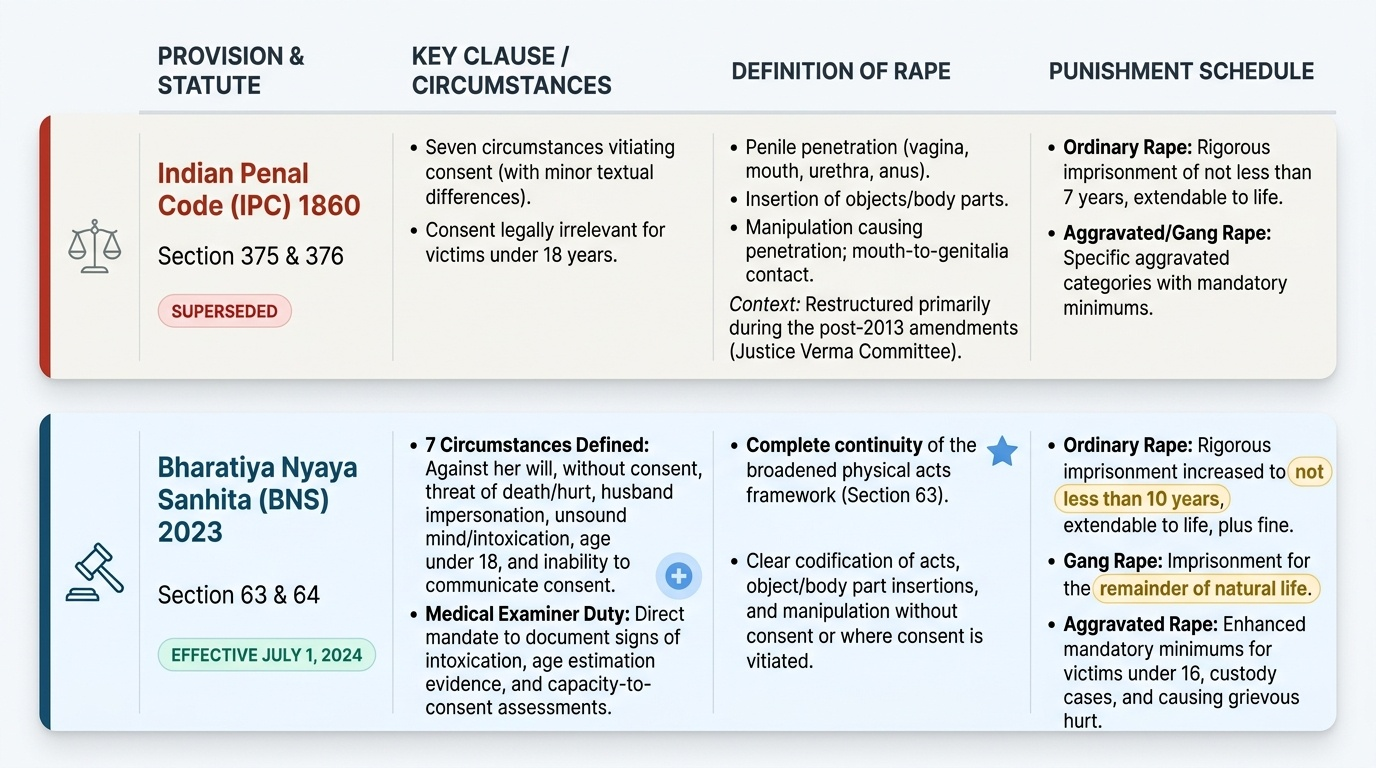
The Bharatiya Nyaya Sanhita (BNS) 2023 replaced the Indian Penal Code 1860 with effect from 1 July 2024. For sexual offences, the pivotal provision is BNS Section 63, which defines rape in terms of both the act and the circumstances. The act is defined as penile penetration of the vagina, mouth, urethra, or anus of a woman, or insertion of any object or body part into those structures, or manipulation of any part of the body causing penetration into vagina, urethra, anus, or mouth, or application of mouth to genitalia — whenever done without consent or in circumstances where consent is vitiated. The definition encompasses a broader range of physical acts than the pre-2013 framework, reflecting the Justice Verma Committee recommendations. The seven circumstances that vitiate consent and therefore constitute rape under BNS Section 63 are: (1) against her will, (2) without her consent, (3) consent obtained under threat of death or hurt to herself or anyone close to her, (4) consent obtained by impersonating her husband, (5) consent given when she is unsound of mind, intoxicated, or incapable of understanding the nature of the act due to administration of any substance, (6) when she is under 18 years of age (consent is legally irrelevant below 18), and (7) when she is unable to communicate consent. The medical significance of these circumstances is direct: the examining doctor must document signs relevant to each possible circumstance — intoxication signs for clause 5, age estimation findings for clause 6, and capacity-to-consent assessment in all cases.
Punishment under BNS: imprisonment not less than 10 years, extendable to life, plus fine (for ordinary rape); gang rape carries imprisonment for the remainder of natural life. Aggravated rape (victim under 16 years, victim in custody, causing grievous hurt, etc.) carries enhanced mandatory minimums. The doctor is not the court — but knowledge of these provisions informs how diligently to document injuries and evidence.
IMPORTENT NOTE on IPC continuity: BNS Section 63 = former IPC Section 375 (renumbered); punishment = former IPC Section 376. Medical examiners must update their pro-forma section citations accordingly.
Provided image
BNSS 2023 — Sections 397, 184, and 52: The Doctor's Procedural Obligations
The Bharatiya Nagarik Suraksha Sanhita (BNSS) 2023 replaced the CrPC and contains three sections of direct medical relevance that every doctor must know with precision. Together they define who examines whom, who reports to whom, and under what authority.
BNSS Section 397 (formerly CrPC Section 53A) governs the medical examination of the accused in cases of rape. It empowers a registered medical practitioner (RMP), acting at the request of a police officer not below the rank of Sub-Inspector, to examine the accused for evidence of sexual assault — injury, seminal staining, DNA material, pubic hair, or other trace evidence. The examination may be conducted only with the written consent of the accused or by order of a magistrate. Notably, the RMP has the power to use reasonable force if the accused resists; the section specifically empowers the police officer who requested the examination to assist. The medical report must be sent directly to the investigating officer.
BNSS Section 184 (formerly CrPC Section 164A) governs the medical examination of the rape survivor. It mandates that the examination be performed by a registered medical practitioner — preferably a woman doctor — employed in a government hospital, and the examination must be conducted with the consent of the survivor or her guardian if she is a minor. Critically, the examination must be conducted within 24 hours of the survivor being brought to the hospital; delay must be documented with reason. The survivor cannot be made to wait for investigation clearance before receiving medical care. The report is a standardised document (per MoHFW guidelines) and must be sent to the investigating officer.
BNSS Section 52 (formerly CrPC Section 25) creates the duty of any person in charge of a medical institution — including admitting doctors — to immediately provide information to the police when a person who appears to have been the victim of an offence is brought to the facility. This is not a discretionary provision: it is a mandatory duty. Failure to report is itself an offence. Importantly, this duty to inform the police is separate from and does not delay the duty to examine and treat — both proceed in parallel.
| BNSS Section | Formerly | Subject Matter | Doctor's Specific Obligation |
|---|---|---|---|
| 52 | CrPC 25 | Information to police | Mandatory report when victim of offence presented |
| 184 | CrPC 164A | Examination of rape survivor | Perform within 24 h; standardised report to IO |
| 397 | CrPC 53A | Examination of accused | At SP-level request; consent or magistrate order required |
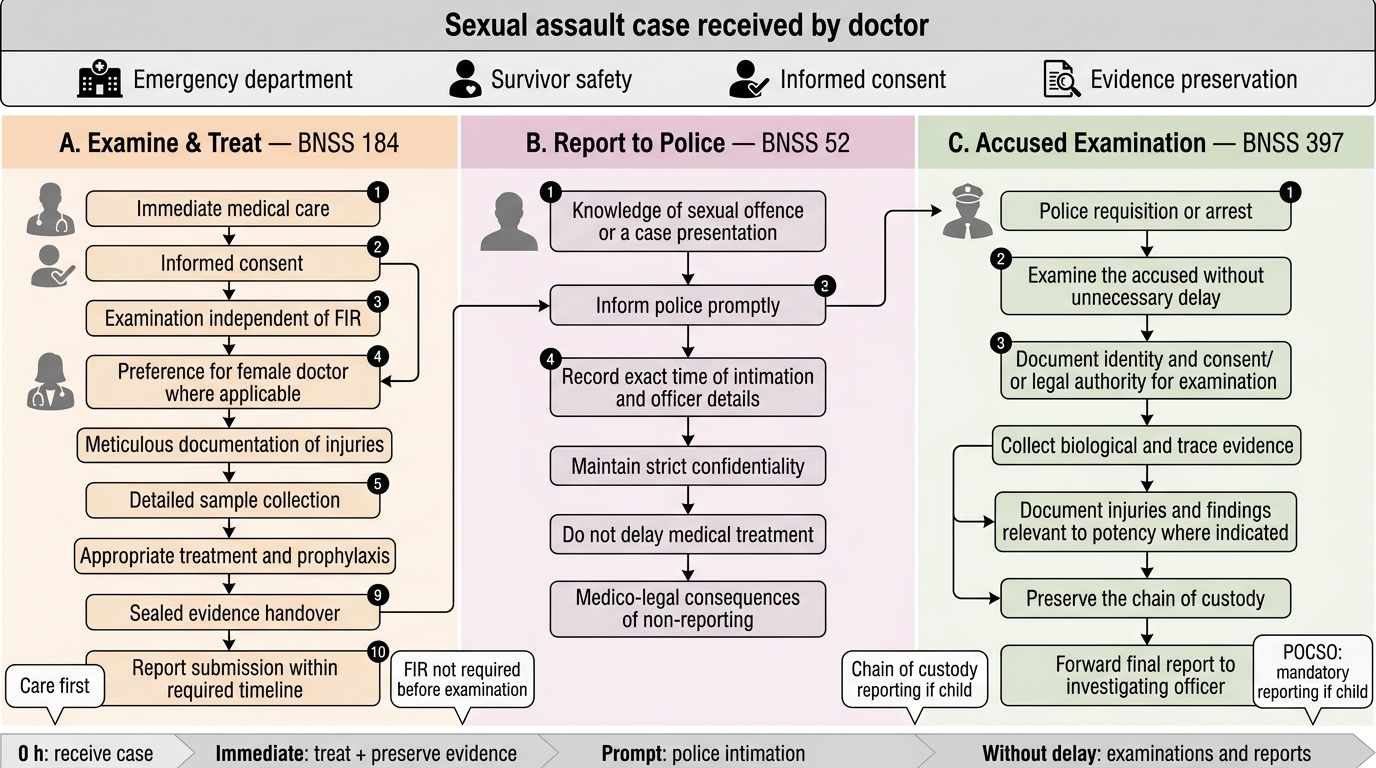
Doctor's Statutory Actions in Sexual Assault Cases under BNSS 2023
SELF-CHECK
Under BNSS 2023, which section mandates that the examining doctor send information to the police when a sexual assault survivor is brought to a medical institution?
A. BNSS Section 184
B. BNSS Section 397
C. BNSS Section 52
D. BNSS Section 200
Reveal Answer
Answer: C. BNSS Section 52
BNSS Section 52 (formerly CrPC Section 25) creates the mandatory duty of persons in charge of medical institutions to inform police when a victim of an offence is brought for treatment. Section 184 governs the victim's medical examination; Section 397 governs examination of the accused.
POCSO Act 2012: Protection of Children from Sexual Offences
The Protection of Children from Sexual Offences (POCSO) Act 2012 is a specialised, gender-neutral statute that applies whenever the victim is under 18 years of age. It operates alongside the BNS and BNSS — it is not superseded by them. Understanding which provisions are most relevant to the examining doctor is essential.
Sections 3-7 define the core sexual offences against children. Section 3 defines penetrative sexual assault: penile penetration of any orifice, insertion of objects, or use of any body part to penetrate. Aggravated penetrative sexual assault (Section 5) applies when the perpetrator is in a position of trust or authority — a doctor, teacher, family member, armed forces member, or repeat offender. Section 7 defines sexual assault (non-penetrative): touching genitalia, buttocks, or breasts with sexual intent, or making the child touch the perpetrator similarly. Sections 8-12 define sexual harassment and use of children for pornographic purposes. The medical examiner's documentation must reflect which category of offence the physical findings are consistent with.
Section 27 — Medical examination: This provision parallels BNSS Section 184 for minor survivors. The medical examination must be conducted in the presence of a trusted adult person — a parent, guardian, or a person trusted by the child — except in cases of emergency. For a girl child, the examination must be performed by a woman doctor. The child must not be made to feel unduly victimised, traumatised, or intimidated during the examination. Crucially, the examination must be conducted regardless of whether a First Information Report (FIR) has been filed.
Section 41 — Child Welfare Committee: The Act mandates that the police produce the victim child before the Child Welfare Committee (CWC) within 24 hours of receiving a report. The doctor plays an important role by ensuring that the child's immediate care and medical needs are documented in a way that facilitates the CWC process.
Mandatory reporting under POCSO: Section 19 creates a mandatory duty on any person — including medical professionals — who has knowledge or apprehension that a child is being sexually abused to report this immediately to the local police or Special Juvenile Police Unit. Failure to report is punishable by imprisonment up to 6 months and/or fine. This is a specific, non-derogable duty.
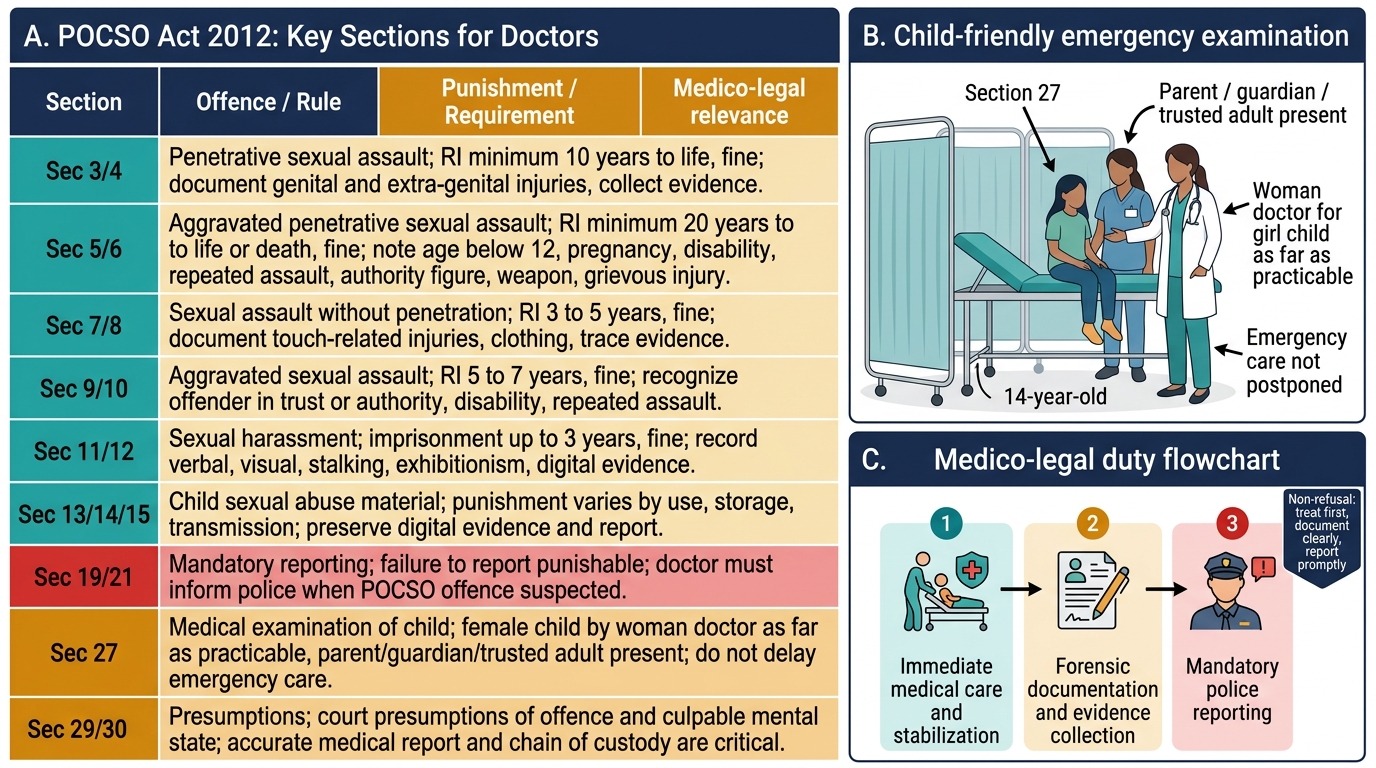
POCSO Act 2012: Key Sections and Doctor's Duties
SELF-CHECK
A 14-year-old girl is brought to the emergency without her parents. The examining doctor cannot locate the parents. Under POCSO Section 27, who should accompany the child during medical examination?
A. Examination must be postponed until a parent or guardian is located
B. Any trusted adult person, including a nurse or social worker known to the child, in the parent's absence
C. The police officer who brought the child
D. The examination can proceed without any accompanying person in emergency
Reveal Answer
Answer: B. Any trusted adult person, including a nurse or social worker known to the child, in the parent's absence
POCSO Section 27 requires the examination in the presence of a trusted adult — a parent, guardian, or person the child trusts. In emergency situations where parents are unavailable, a trusted adult (social worker, child welfare officer, senior nurse known to the child) may serve this role. Examination is not postponed — the child's health takes priority.
Doctor's Duties: Medical Care, Reporting, and Non-Refusal
The consolidated statutory duties of the examining doctor across BNS, BNSS, and POCSO can be grouped into three non-negotiable obligations: (1) the duty to examine and provide immediate medical care, (2) the duty to document forensically and prepare a report, and (3) the duty to inform the police. These duties are independent of each other — they do not have a sequence in the sense that one must precede the other; rather, they run in parallel and reinforce each other.
The duty of non-refusal is perhaps the most critical for emergency practice. A doctor in any government hospital — whether or not a forensic medicine specialist, whether or not a woman doctor is available, whether or not the police have arrived — cannot legally refuse examination and initial medical care to a sexual assault survivor. The Supreme Court of India in multiple decisions (including Lillu alias Rajesh v. State of Haryana, 2013) has affirmed that the right to medical care of a rape survivor is a constitutional right under Article 21, and that no procedural requirement — including absence of an FIR — can be used to delay or deny it.
The duty to examine imposes a standardised procedure: the doctor must follow the MoHFW guidelines for examination of rape survivors (updated 2014, reaffirmed in subsequent orders), which includes consent documentation, general examination, ano-genital examination, collection and sealing of trace evidence (clothing, swabs, hair, fingernail scrapings), documentation of injuries using a body diagram, and completion of the prescribed pro-forma. The report must state findings, not conclusions — the doctor records what is observed, not whether rape occurred (the latter is a legal determination). The express statutory formulation is: the RMP must record findings and submit the report to the police officer who requested the examination, 'within 24 hours.'
The consequences of non-compliance are severe. A doctor who refuses to examine is liable under professional misconduct provisions before the State Medical Council and may also face criminal liability. Under POCSO, failure to report a child sexual assault is explicitly punishable. Under BNSS Section 52, non-reporting of an offence victim presenting at a medical institution is actionable. The professional obligation and the statutory obligation therefore reinforce one another: an ethical doctor and a law-abiding doctor should make the same choices at the emergency gate.
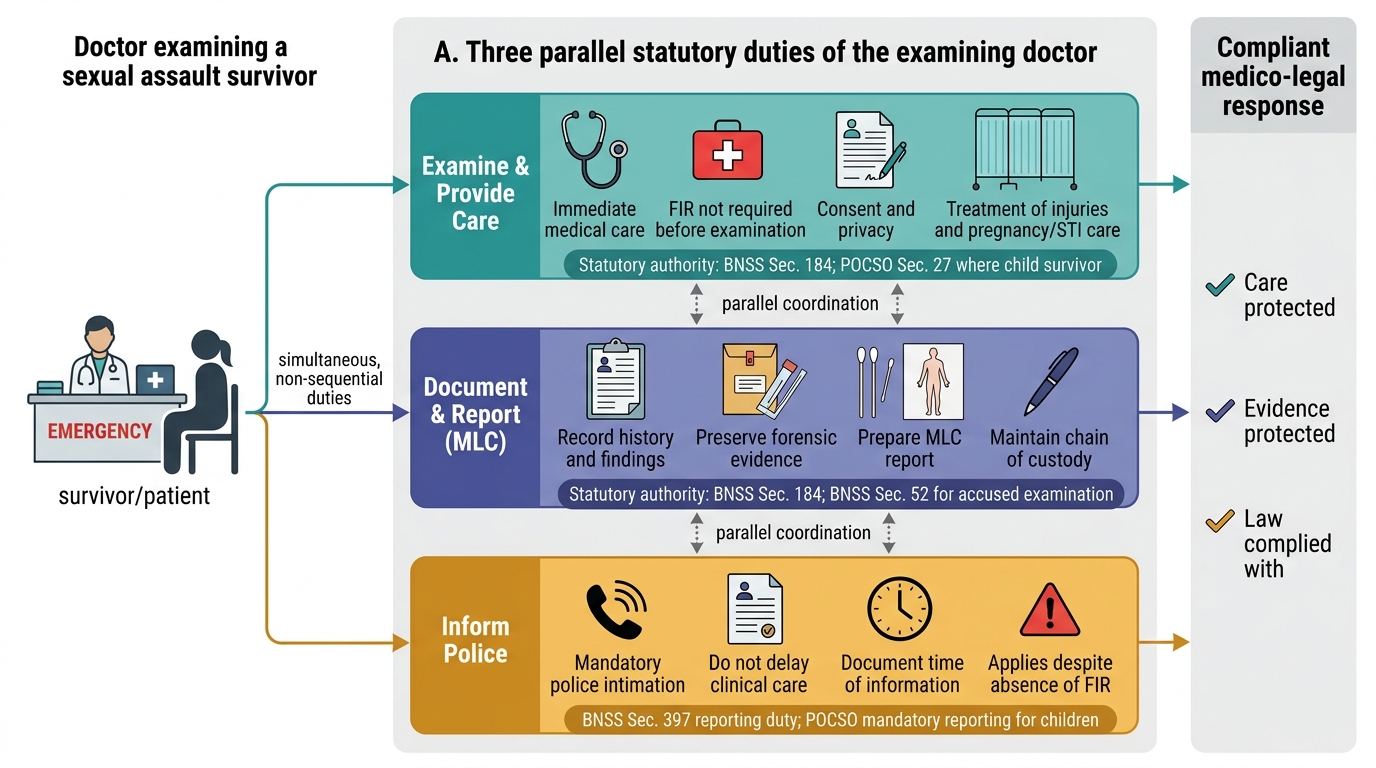
Three Parallel Duties of the Examining Doctor
CLINICAL PEARL
The two most common errors in emergency practice are: (1) waiting for an FIR before examining — this is illegal; examination and initial medical care must proceed immediately and independently of the police investigation, and (2) citing unavailability of a 'lady doctor' as reason to delay examination of a female survivor. The law requires a woman doctor be used 'as far as practicable' — when one is not available, a male doctor must examine and provide care. The obligation to treat never evaporates. Document every reason for any delay.
SELF-CHECK
Which of the following statements about a doctor's duty under BNS/BNSS when a rape survivor presents to a government hospital is CORRECT?
A. Examination must wait until the police officer who accompanied the survivor provides written authorisation
B. The doctor may only examine if the survivor is accompanied by a female guardian
C. The doctor must provide immediate medical care and examination regardless of whether an FIR has been filed
D. Only a forensic medicine specialist can legally perform the examination
Reveal Answer
Answer: C. The doctor must provide immediate medical care and examination regardless of whether an FIR has been filed
The duty of non-refusal is absolute. BNSS Section 184 mandates examination; the Supreme Court has affirmed that no procedural requirement (absence of FIR, absence of police authorisation, absence of specialist) can delay medical care. Any registered medical practitioner in a government hospital must examine and provide care immediately.
KEY TAKEAWAYS
The legal framework for sexual offences rests on three interconnected statutes. BNS Section 63 defines rape across seven circumstances, with the act definition extended beyond penile penetration to include objects, body parts, and oral-genital contact — replacing IPC Section 375. BNSS Section 52 mandates police information by medical institutions; Section 184 governs victim examination (within 24 h, standardised pro-forma, preferable woman doctor); Section 397 governs accused examination (at police request, consent or magistrate order). POCSO Act 2012 applies to all victims under 18, creates mandatory reporting for all persons with knowledge of child sexual abuse, and requires examination in the presence of a trusted adult. The doctor's three core duties — immediate medical care, forensic documentation, and police information — are parallel, non-deferrable, and independent of FIR status. Non-compliance is both professionally actionable and criminally punishable.
REFLECT
Consider a scenario where a 17-year-old girl arrives at your hospital's emergency department after a sexual assault, brought by a friend. No FIR has been filed. The on-call doctor says, 'We need police clearance first.' Applying the framework from this module, what would you say and do? Which statutory provisions would you cite? How would you document the examination and ensure evidence preservation while providing compassionate care to the survivor?