Page 28 of 33
FM14.{2-3,16} | Toxicology Practical Skills: Clinical Exam, Sampling & Specimen Inference — SDL Guide (Part 2)
Applied Practice: Visual Identification of Common Indian Poisons (FM14.16)
FM14.16 is unique among the toxicology competencies: it requires visual identification of actual poison specimens and the ability to draw medicolegal inferences from them. The following are the 16 categories specified in the NMC competency, with their distinguishing features for specimen identification.
1. DHATURA (Datura stramonium — thorn apple, jimsonweed):
- Parts used: seeds (small, dark-brown, kidney-shaped, embedded in a capsule with sharp spines — 'thorny apple' appearance)
- Toxin: hyoscine (scopolamine) + hyoscyamine (atropine-like) — ANTICHOLINERGIC toxidrome
- Forensic: the leading Indian plant used for criminal incapacitation (added to food/drink — the victim becomes confused/stuporous); one of the most common 'thuggee' plant poisons historically
- MLR inference: anticholinergic features + dhatura seeds in gastric contents → criminal administration likely; document autonomic signs precisely
2. CASTOR (Ricinus communis — castor plant):
- Parts: seeds — large, smooth, mottled brown-white-black seeds with a distinctive caruncle (whitish appendage at one end)
- Toxin: ricin — a protein toxin that inhibits protein synthesis by cleaving ribosomal RNA (similar mechanism to amatoxin for RNA/protein synthesis inhibition). Highly potent — as little as 1 mg/kg can kill a human.
- Forensic: ricin has been used in bioterrorism (Markov umbrella assassination, 1978 — ricin pellet injection). The seeds themselves are less toxic than extracted ricin; children who chew seeds are at risk.
3. CANNABIS (Cannabis sativa — ganja, bhang, charas):
- Parts: flowering tops (ganja — dried female plant tops, green/brownish); resin (charas/hashish — dark brown, sticky, compressed blocks); leaf preparation (bhang — green)
- Toxin: THC (delta-9-tetrahydrocannabinol)
- Forensic: all forms are scheduled under NDPS Act 1985; dubia ganja test (Beam test) is a field chemical test — cannabis + KOH → violet-purple colour
4. OPIUM (Papaver somniferum):
- Appearance: raw opium = brown-black, semi-solid, gummy mass; characteristic smell (sweet, heavy, poppy-like)
- Toxin: morphine + codeine + other alkaloids (papaverine, thebaine)
- Forensic: dried opium smear on filter paper + ferric chloride → blue-green colour (morphine test)
5. ACONITE (Aconitum species — monkshood):
- Parts: tuberous root (resembles small potato/radish — dark brown externally, white internally)
- Toxin: aconitine (alkaloid)
- Forensic: the root resembles edible tubers (horseradish, small potato); accidental ingestion possible; the immediate burning/tingling sensation on touching the raw root to skin is a field identification clue
6. COPPER SULPHATE (CuSO₄·5H₂O — blue vitriol):
- Appearance: blue crystalline solid; distinctive brilliant blue colour; aqueous solution is blue
- Forensic: distinctive blue colour is pathognomonic; blue-green vomitus in copper sulphate ingestion
7. PESTICIDES (organophosphates, carbamates — various):
- Appearance: varies widely by formulation (EC — emulsifiable concentrate; WP — wettable powder; granules); characteristic pungent odour; often contains a malodorous marker
- Forensic: the original container (label with active ingredient, concentration, and batch number) is the most important forensic exhibit for identifying the specific agent; note: chlorpyrifos EC has a characteristic petroleum-phenolic smell
8. MARKING NUT (Semecarpus anacardium — bibhitaki, bhilawa):
- Appearance: black, angular nut; acrid oily juice from the pericarp
- Toxin: anacardic acid (related to urushiol — the toxin in poison ivy) — causes severe contact dermatitis and GI irritation
- Forensic: marking nut juice has been used for criminal skin injury (burning/scarring); also used as a traditional household ink marker
9. OLEANDER (Nerium oleander):
- Parts: all parts toxic; leaves — long, narrow, leathery, dark green on top, lighter below; flowers — pink/white/red
- Toxin: oleandrin + neriine (cardiac glycosides)
- Forensic: distinctive leaf morphology; the milky sap on cutting the leaf is characteristic; GI symptoms + cardiac arrhythmia = oleander until proved otherwise in India
10. NUX VOMICA (Strychnos nux-vomica):
- Parts: seeds — flat, grey-green, disc-shaped, with fine silky hairs; very hard
- Toxin: strychnine (blocks glycine receptors in the spinal cord → loss of inhibitory interneuron control → 'lock-jaw' like opisthotonus)
- Forensic: classic 'archaic' poison; opisthotonus and risus sardonicus in fatal cases; seeds are identifiable in gastric contents; the Strychnos seed is one of the most examination-important plant specimens
11. ABRUS SEEDS (Abrus precatorius — jequirity bean, rosary pea):
- Appearance: very distinctive — brilliant red seeds with a black spot at one end (rosary-bead pattern); small, oval, 5–7 mm
- Toxin: abrin — a protein toxin (similar mechanism to ricin — ribosome inactivation); highly toxic even in small amounts; historically used in suicide and homicide in India
- Forensic: the visual appearance (red-and-black rosary bead) is unique and unmistakable; any suspicious death where red-black seeds are found in gastric contents should be investigated for abrin toxicity
12. SNAKES (identification from morphology — forensic context):
- Key morphological features: head shape (triangular = viper; oval = elapid/colubrid), pupil shape (vertical = viper; round = elapid), fang position, scale pattern
- PM: fang mark pattern (spacing ~1–3 cm for most Indian vipers; cobra/krait may leave single/two small punctures)
- Forensic: snake identification from a photograph or physical specimen presented with a bite victim; reference to herpetological identification keys
13. CAPSICUM (Capsicum annuum — chilli/red pepper):
- Parts: the ripe red fruit/powder
- Toxin: capsaicin (TRPV1 agonist) — intense local burning; eye/mucous membrane irritant; not primarily lethal
- Forensic: capsaicin-based pepper spray (OC spray) is a riot control/self-defence agent; pepper spray exposure to eyes/face documented in assault cases; capsaicin cream used in skin torture; trace capsaicin in wound can be demonstrated analytically
14. CALOTROPIS (Calotropis procera — crown flower, madar):
- Parts: the milky sap (latex) from stems/leaves
- Toxin: calotropin + uscharin — cardiac glycoside-like compounds with additional CNS and irritant properties; skin/eye contact causes severe inflammation
- Forensic: calotropis sap injected into cadavers to alter post-mortem appearance (documented in India — 'calotropis injection cases'); can accelerate decomposition; forensic evidence: calotropin detected in PM tissue by LC-MS/MS; the milky sap on the skin/injection site is a clue
15. LEAD COMPOUNDS (lead acetate, lead oxide, lead carbonate):
- Appearance: lead acetate = white crystalline solid, sweet taste ('sugar of lead'); lead oxide = yellow/orange powder; lead carbonate (white lead) = white powder
- Forensic: these are the compounds responsible for chronic lead poisoning in ayurvedic preparations (bhasmas), in traditional pottery glaze, and in battery recycling; identification by heavy metal analysis (AAS/ICP-MS) of exhibit
16. TOBACCO (Nicotiana tabacum):
- Parts: dried leaf (cigarette/bidi tobacco — dark brown-green, shredded); oral tobacco (khaini — unprocessed cured tobacco mixed with lime; gutka — pan masala with tobacco)
- Toxin: nicotine + tobacco-specific nitrosamines (carcinogens)
- Forensic: tobacco exposure in passive smoking cases (compensation claims); forensic pathology of tobacco-related cancers; nicotine poisoning from liquid nicotine (e-cigarettes)
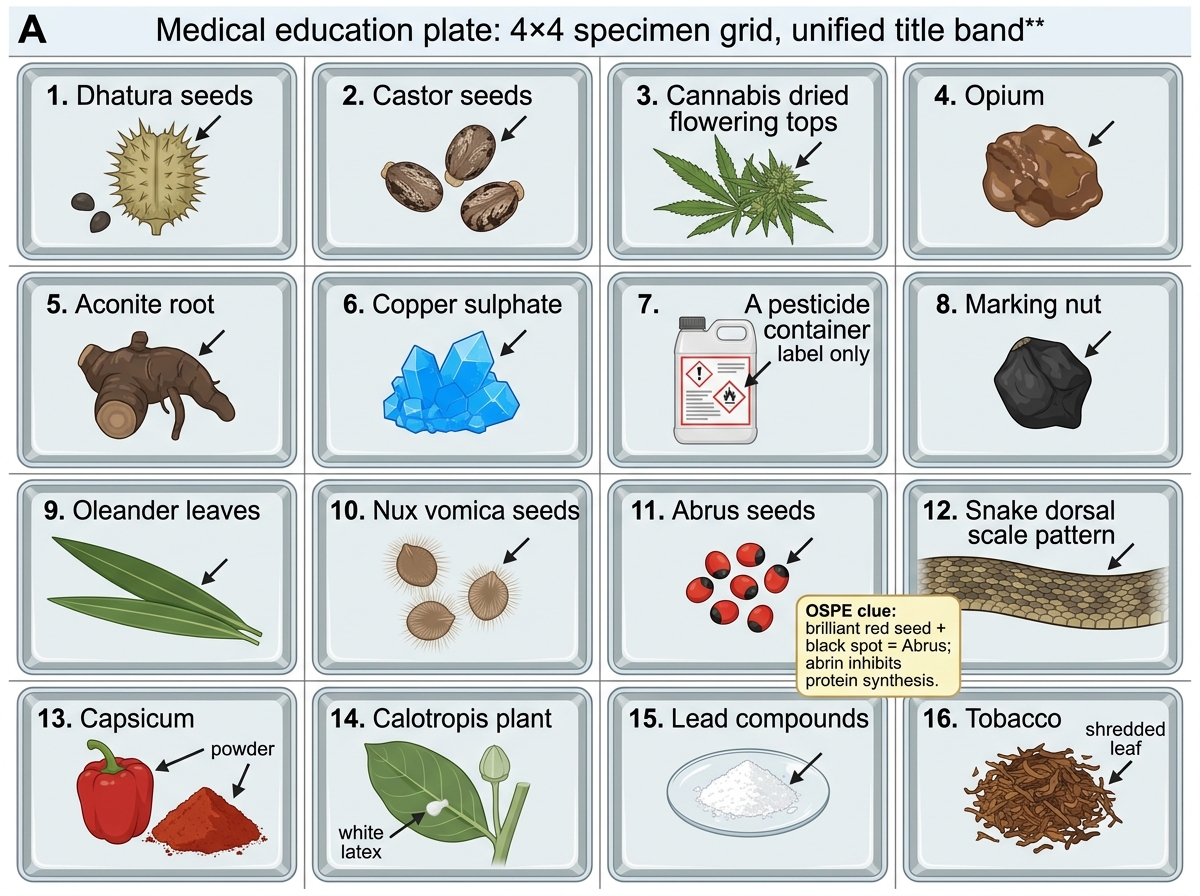
FM14.16 Poison Specimens: Identification Grid
SELF-CHECK
At an OSPE station, you are shown a small, brilliant red seed with a black spot at one end (approximately 6 mm). The station card asks you to identify the poison and its mechanism. Which of the following is CORRECT?
A. Dhatura seed — anticholinergic (hyoscine); contains scopolamine; causes 'dry, hot, red, mad' toxidrome
B. Abrus seed (Abrus precatorius) — abrin; inhibits protein synthesis by ribosome inactivation; toxic mechanism similar to ricin
C. Nux vomica seed — strychnine; blocks spinal glycine receptors; causes opisthotonus
D. Castor seed (Ricinus communis) — ricin; inhibits protein synthesis; large mottled seed with caruncle
Reveal Answer
Answer: B. Abrus seed (Abrus precatorius) — abrin; inhibits protein synthesis by ribosome inactivation; toxic mechanism similar to ricin
The description — brilliant red seed, 6 mm, with a black spot at one end — is unmistakably Abrus precatorius (jequirity bean/rosary pea). The toxin is abrin, a ribosome-inactivating protein (RIP) with the same general mechanism as ricin (A-chain cleaves ribosomal RNA, blocking protein synthesis). Dhatura seeds are dark-brown, kidney-shaped, from a spiny capsule. Nux vomica seeds are flat, grey-green, disc-shaped with silky hairs. Castor seeds are large, mottled, with a distinctive white caruncle — a much larger seed than abrus.
Medicolegal Inference and MLR Preparation in Poisoning Cases
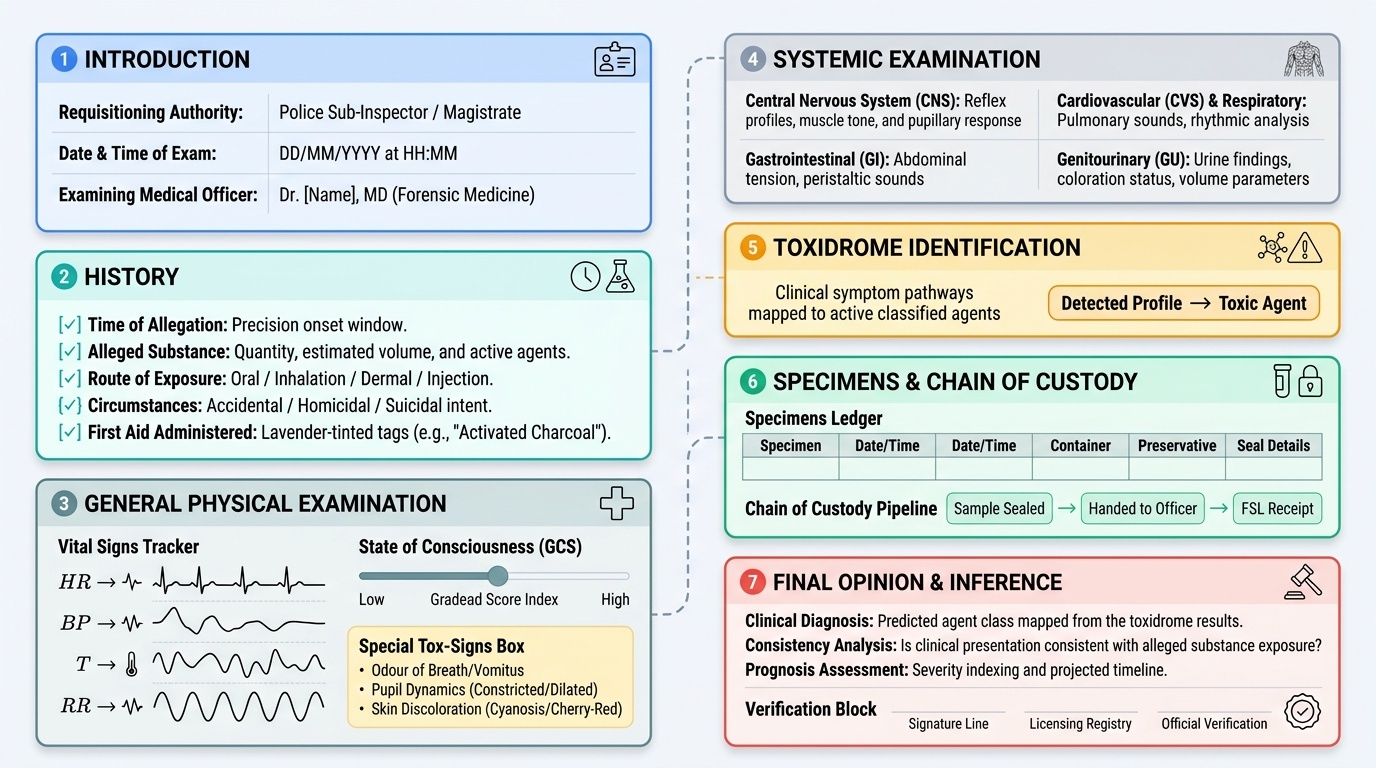
The medicolegal report (MLR) in a suspected poisoning case is the synthesis of all clinical examination, specimen collection, and specimen identification findings into a structured legal document. For FM14.2, 14.3, and 14.16, the MLR must include:
Standard MLR structure for poisoning cases:
Section 1 — Introduction:
- Requisitioning authority (police/magistrate), date/time of examination, name of examining doctor
Section 2 — History:
- Time of alleged poisoning; substance alleged; quantity; route; circumstances; first aid given
Section 3 — General Examination:
- Vital signs; level of consciousness; special signs (odour, skin colour, pupil size)
Section 4 — Systemic Examination:
- CNS, cardiovascular, respiratory, GI, urine findings
Section 5 — Toxidrome Identification:
- Which toxidrome pattern is present and which agents are consistent with it
Section 6 — Specimens Collected:
- Itemised list of specimens; date/time; container; preservative; seal details; chain of custody documentation
Section 7 — Opinion:
- Clinical diagnosis (most likely agent based on available information)
- Whether the clinical features are consistent with the alleged substance
- Prognosis
- Whether this appears to be accidental, suicidal, or homicidal (state the basis for the inference)
Section 8 — Recommendations:
- Investigations required; follow-up toxicology; notification to public health authorities if mass poisoning
Drawing medicolegal inference from specimens:
When a forensic specimen (plant material, chemical, or biological sample) is presented, the inference must address:
- Identity — name of the substance (common name + scientific name if plant)
- Chemical/active constituent — the specific toxin
- Toxic effects — what symptoms/signs does this substance produce
- Forensic significance — how was this substance likely used (suicidal, homicidal, accidental), and what is the typical mode of administration
- Analytical confirmation — what test would confirm the substance in biological material
Example inference (abrus seeds found in gastric contents):
Identity: Abrus precatorius seeds (jequirity bean/rosary pea — distinctive red-black rosary-bead appearance). Toxin: abrin (ribosome-inactivating protein). Effects: multi-organ failure (liver, kidney, GI) with delayed onset (12–24 h). Forensic significance: abrus seeds are not naturally present in food; their presence in gastric contents strongly suggests intentional ingestion (suicidal or homicidal administration). Confirmation: abrin ELISA or LC-MS/MS of blood/urine/liver.
Provided image
CLINICAL PEARL
The two unbreakable rules of forensic specimen collection:
- Label at the bedside, before the specimen leaves the syringe or the cup. A specimen labelled two hours later 'from memory' is legally challenged as unreliable. The label is written — date, time, patient name, specimen type, doctor's signature — before the specimen is sealed.
- Never leave a forensic specimen unattended between collection and handing to the police officer. The chain of custody begins the moment you collect the specimen. A gap in supervision — even five minutes on the nursing station — gives the defence an argument that the specimen could have been tampered with. Seal immediately; document immediately; handover with countersignature.
SELF-CHECK
You have collected a blood specimen for ethanol analysis from a person alleged to be drunk driving. The police officer who brought the patient has stepped away to make a phone call. You leave the sealed tube on the nursing desk and go to attend another patient. Thirty minutes later, you hand the tube to the police officer. What is the forensic problem with this chain of custody?
A. The fluoride-oxalate tube is the wrong container for ethanol analysis
B. The 30-minute gap during which the specimen was unattended and unwitnessed creates a 'tampering possibility' argument that may render the result inadmissible
C. The blood volume is insufficient — 10 mL is too little for ethanol analysis
D. The specimen should have been stored in a refrigerator during the 30 minutes to prevent ethanol degradation
Reveal Answer
Answer: B. The 30-minute gap during which the specimen was unattended and unwitnessed creates a 'tampering possibility' argument that may render the result inadmissible
The fluoride-oxalate tube IS the correct container for ethanol (fluoride inhibits fermentation/microbial ethanol production in the tube). Volume of 10 mL is standard. Refrigeration slows degradation but does not address the legal problem. The core issue is the gap in chain of custody — the 30 minutes during which the specimen was unattended creates a documented opportunity for tampering. Any competent defence lawyer will raise this. The correct procedure: seal the tube in the presence of both the doctor and the police officer immediately after collection; if the officer is unavailable, the doctor should remain with the specimen or have a second witness sign a 'continuous custody' note.