Page 22 of 32
OG19.1 | Normal and Abnormal Puerperium — SDL Guide (Part 3)
Self-Assessment: Puerperium Knowledge Consolidation
You have now covered the full arc of the puerperium — from the clinical presentations that trigger concern, through the physiology, the differential diagnosis of fever and bleeding, the management of the major complications, and the spectrum of psychological disorders. This self-assessment block asks you to test your recall actively rather than passively re-read. The questions below correspond to each section of this module; they represent the kinds of clinical vivas and structured written questions you should expect in your final MBBS examinations and postgraduate entrance assessments.
Work through each question from memory, without referring back to the text. If you cannot answer one confidently, make a note of it, return to the relevant section, and re-attempt before your next clinical posting:
- Involution: What is the expected fundal height on day 5? On day 10? What does a uterus palpable at the umbilicus on day 7 suggest?
- Lochia: Describe the three stages of lochia with their appearance and typical duration. What does a return to bright-red lochia on day 8 suggest?
- Pyrexia: Define puerperal pyrexia. List five causes using the '5 Ws' mnemonic. Which cause requires the most urgent response?
- Sepsis: Name three organisms responsible for puerperal sepsis. Describe the first-line antibiotic regimen. What surgical procedure is indicated if RPOC is present?
- Secondary PPH: Define secondary PPH. Name two common causes. Describe the initial resuscitation steps.
- Psychological: Distinguish postpartum blues, PPD, and puerperal psychosis on three dimensions: onset, duration, and management.
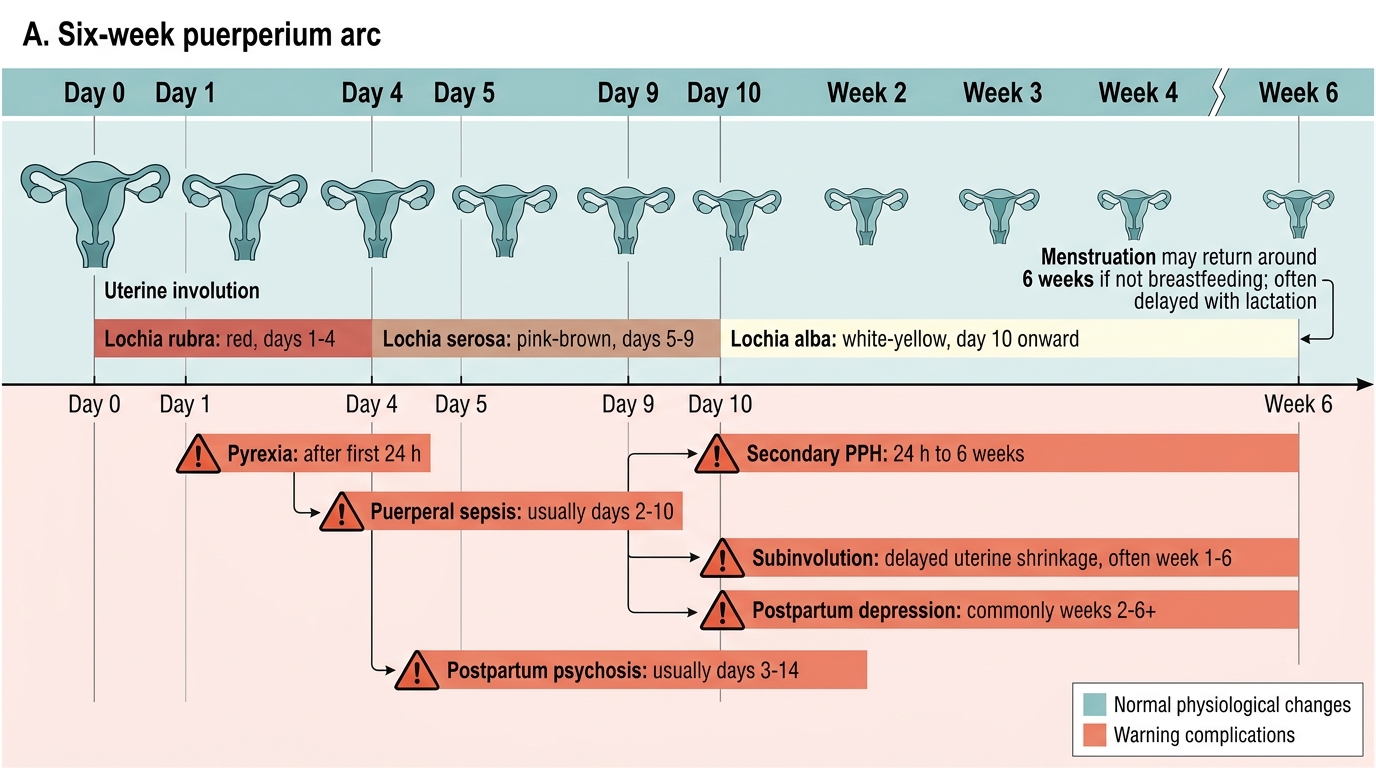
Six-Week Puerperium Arc
SELF-CHECK
Which of the following correctly describes lochia serosa?
A. Red-coloured discharge present from days 1–4, composed mainly of blood
B. Pinkish-brown serosanguineous discharge from approximately days 5–9
C. White or yellow discharge beginning around day 10, composed mainly of leucocytes
D. A foul-smelling discharge on any day indicating infection
Reveal Answer
Answer: B. Pinkish-brown serosanguineous discharge from approximately days 5–9
Lochia serosa is the pinkish-brown, serosanguineous discharge of days 5–9, as the haemorrhagic component diminishes. Lochia rubra is red (days 1–4); lochia alba is white/yellow (day 10+). A foul smell at any stage — regardless of colour — indicates infection and is not a normal lochia stage.