Page 13 of 20
OP7.5 | Glaucoma Treatment Counselling and Prognosis Discussion — SDL Guide
Learning Objectives
- Explain why glaucoma creates unique challenges for patient counselling (silent disease, lifelong treatment, irreversible damage)
- Describe a structured approach to a glaucoma counselling consultation, including assessing understanding and using teach-back
- Counsel a patient with newly diagnosed POAG about treatment options, drop technique, side effects, and the importance of adherence
- Counsel a patient after an acute PACG attack about laser peripheral iridotomy and the need to treat the fellow eye
- Communicate prognosis honestly and compassionately, including the irreversibility of vision already lost and the goal of preserving remaining vision
- Identify common adherence barriers and respond with patient-centred explanations and strategies
INSTRUCTIONS
This module addresses OP7.5 — a Skill Habit (SH) competency assessed in simulated clinical environments. Knowledge of glaucoma treatments (from the POAG and PACG SDLs) is necessary but not sufficient: the clinical skill is translating that knowledge into a conversation that a real patient can understand, engage with, and act on. Glaucoma presents distinct counselling challenges: patients often feel well, the disease is silent, treatment requires daily self-administration for life, and the prognosis depends almost entirely on adherence. This module uses the OP-skills arc (indication → conceptual tools → technique → interpretation → applied practice → self-assessment) to build a practical, patient-centred counselling framework that you can use in OSCE scenarios and real clinical practice.
References
- AK Khurana — Comprehensive Ophthalmology, 7th edition, Chapter: Glaucoma (textbook)
- Parsons' Diseases of the Eye, 23rd edition, Chapter: Glaucoma (textbook)
Version 2.0 | NMC CBUC 2024
CLINICAL SCENARIO
Mr. Ramachandran, a 64-year-old retired engineer, is sitting across from you in the glaucoma clinic. You have just diagnosed him with moderate primary open-angle glaucoma — his IOP is 28 mmHg, his optic cup is significantly enlarged, and his visual field test shows a dense arcuate scotoma in the superior field of his right eye. He has no symptoms whatsoever and tells you, with some impatience, 'Doctor, I drove myself here this morning, I see fine, and my wife's doctor told me these drops cause side effects. Why do I need to take medicines every day for a condition that doesn't bother me?' How would you respond to Mr. Ramachandran — without dismissing his concerns, without alarming him unduly, and in a way that makes him actually take his latanoprost drops tonight?
WHY THIS MATTERS
The challenge of counselling the glaucoma patient is not primarily a knowledge challenge — you know the pharmacology of prostaglandin analogues, the mechanics of laser peripheral iridotomy, and the statistics of optic nerve progression. The challenge is a communication challenge: conveying the urgency of a silent, irreversible disease to a person who feels completely well and is being asked to commit to daily self-administered eye drops for the rest of their life, with no immediate perceptible benefit. Studies consistently show that non-adherence to glaucoma drops is the single most important modifiable predictor of visual field progression and blindness, with adherence rates often cited at 30–70% in real-world populations. In India, the challenge is compounded by the cost of branded prostaglandin analogues, variable health literacy, and the widespread belief that 'if I feel fine, I don't need medicine.' As a clinician, the 10-minute consultation you have with a newly diagnosed glaucoma patient may determine whether they retain functional vision for the next 20 years. This module builds the specific language and structure to make those 10 minutes count.
RECALL
Before practising glaucoma counselling, consolidate the key clinical facts you will need to communicate clearly to patients, because your counselling is only as good as your factual accuracy. Recall: (1) POAG — a chronically open-angle disease; silent and gradually progressive; first-line treatment is prostaglandin analogues (latanoprost 0.005% once daily, in the evening); mechanism = increased uveoscleral outflow; side effects include conjunctival redness, eyelash changes, periorbital skin darkening, and (irreversible) iris colour change in hazel/green eyes; beta-blockers (timolol) are second-line or adjunct and are contraindicated in asthma; (2) PACG — angle-closure mechanism; the definitive treatment for the underlying pupil block is laser peripheral iridotomy (LPI); the fellow eye must be treated prophylactically because it has the same narrow anatomy; precipitants include dark environments and anticholinergic drugs; (3) Prognosis principle: IOP reduction prevents FURTHER vision loss but does NOT restore vision already lost — this is a core message every glaucoma patient must understand. The visual field damage from glaucoma is irreversible.
Why Glaucoma Counselling Is a Distinct Clinical Skill
Glaucoma creates a constellation of features that make counselling more challenging than for most other chronic diseases, and recognising these challenges is the first step to addressing them effectively. The clinical indication for counselling arises at multiple points in the disease journey, each with distinct content and emotional demands. Unlike hypertension — where patients often have some awareness of their cardiovascular risk and may have already been counselled by their GP — glaucoma patients frequently arrive with no prior knowledge of the condition, no symptoms that motivated them to seek care, and no intuitive sense that anything is wrong with their vision. The clinician must therefore build understanding from scratch, often within a 10-minute consultation, while simultaneously managing the patient's emotional response to being told they have a chronic, incurable, potentially blinding condition. Compounding this is the treatment burden: glaucoma drops must be instilled correctly, at the right time of day, every day for life, with nasolacrimal occlusion to minimise systemic absorption — a regimen that demands both manual dexterity and unwavering motivation in a patient who notices no benefit from the drops whatsoever. Studies demonstrate that adherence rates in real-world glaucoma populations range from 30% to 70%, and that non-adherence is the single most important modifiable predictor of progression to blindness. Every element of the counselling encounter must therefore be designed to build durable adherence, not just immediate compliance.
The four main occasions for glaucoma counselling are:
- At diagnosis: the patient has no symptoms and must be educated about what glaucoma is, why treatment is necessary despite feeling well, what the treatment involves, and what the prognosis is.
- At initiation of drops: the patient must learn correct instillation technique, understand the schedule (latanoprost ONCE in the evening; beta-blockers TWICE daily), be prepared for expected side effects (conjunctival redness, eyelash hypertrichosis), and understand why they should not stop drops if they feel no benefit.
- Before surgery or laser: the patient must give truly informed consent — understanding the procedure, its risks (trabeculectomy: hypotony, infection, cataract; LPI: transient IOP spike, halos, possible need to repeat), and its benefits in the context of their disease stage.
- When vision loss is confirmed or progressive: this is the hardest conversation — acknowledging damage that cannot be reversed, refocusing on preserving what remains, and managing the emotional impact of a diagnosis that progresses despite treatment.
Why glaucoma is uniquely challenging for patient communication:
- No symptoms = no perceived need: the patient who feels perfectly well has no visceral motivation to start drops. This is unlike diabetes (they feel the effects) or hypertension (they have been told about stroke risk clearly). Glaucoma's silence is its biggest barrier.
- Irreversibility of damage: unlike many treated conditions, the lost vision NEVER comes back. This must be communicated — but without inducing panic that causes the patient to disengage from care.
- Lifelong daily treatment: asking a 55-year-old to use eye drops every day for the next 30+ years requires a level of motivation that requires sustained, empathetic explanation rather than a one-time instruction.
- Fear of blindness: the word 'glaucoma' often evokes fear of blindness. Calibrating this fear — 'yes, this can cause blindness if untreated, but with treatment you have an excellent chance of preserving your vision' — is a delicate balance.
The Conceptual Toolkit: What to Know Before You Counsel
Effective counselling is grounded in a set of conceptual tools that help clinicians structure their communication and adapt to individual patients. These are not scripts — they are frameworks that enable responsive, patient-centred conversations.
1. The Disease Model (Biomedical facts in patient-accessible language):
Before counselling begins, you must be able to explain glaucoma in plain language, without jargon. A working patient-accessible explanation: 'The eye is constantly making a small amount of fluid inside it. This fluid normally drains away, keeping the pressure inside the eye at a normal level. In glaucoma, the drain gets blocked or less efficient, so the pressure builds up slowly. This raised pressure damages the nerve at the back of the eye — the nerve that carries your sight to your brain. The damage is very slow, and you don't notice it until a lot of the nerve is already gone. Once nerve cells are damaged, they cannot recover. The treatment lowers the pressure to prevent more damage — but it cannot fix the damage that has already happened.'
2. Shared Decision-Making:
Shared decision-making (SDM) is an evidence-based approach to clinical consultations in which the clinician provides information about options and their consequences, and the patient expresses their values and preferences, so that together they reach a decision that is both clinically appropriate and concordant with the patient's life. In glaucoma, SDM might involve discussing: SLT (laser) vs drops as first-line; branded vs generic latanoprost; the timing of surgery. Presenting options respectfully increases patient ownership of the treatment plan and adherence.
3. Health Literacy:
Health literacy is a patient's ability to obtain, understand, and use health information to make informed decisions. In India, health literacy is highly variable — a patient with postgraduate education may want detailed pharmacology; a farmer may need a single memorable rule ('one drop in the right eye every night before sleep'). Assess literacy informally through the language the patient uses and the questions they ask. Adapt accordingly — use simple words, visual aids (a diagram of the eye, a calendar for drops), and family inclusion where appropriate.
4. The Prognosis Communication Framework:
For chronic incurable conditions, communication of prognosis should follow three principles:
- Honesty: do not minimise the disease ('it's nothing serious') or over-catastrophise ('you'll go blind soon').
- Hope grounded in evidence: 'With treatment, most patients with early to moderate glaucoma preserve good vision throughout their lives.'
- Focus on agency: 'The most important thing in your prognosis is how consistently you use your treatment — this is where you have real control.'
The Glaucoma Counselling Consultation: Technique
A structured technique for the glaucoma counselling consultation improves consistency and ensures that all essential content is covered, while maintaining flexibility to respond to the individual patient. The following structure applies to the initial (diagnosis) consultation, with modifications for follow-up and surgical contexts.
Step 1 — Assess what the patient already knows (Elicit):
Begin by finding out what the patient has already understood or been told: 'Before I explain your results, can you tell me what you already know about glaucoma?' or 'What brings you most concern today?' This prevents you from repeating information the patient knows and reveals misconceptions that need correcting. It also signals respect — you are listening, not lecturing.
Step 2 — Explain the diagnosis in accessible language (Provide):
Use the plain-language disease model (above): what glaucoma is, what has been found in this patient's eye, and what it means. Use the term 'raised eye pressure damaging the nerve' rather than 'elevated IOP causing optic neuropathy.' Pause after each sentence and check for understanding.
Step 3 — Explain the treatment options:
For POAG: 'I want to start you on one eye drop — it's called latanoprost. You use it once every evening, in both eyes. It lowers the pressure inside your eye by helping fluid drain more efficiently through a different pathway. It is the most effective drop we have for this purpose, and most patients tolerate it well.' For PACG: 'I am recommending a small laser treatment — laser peripheral iridotomy — which makes a tiny hole in the outer part of your iris. This creates an alternate pathway for the fluid inside your eye, so the pressure can no longer build up suddenly the way it did during your attack.'
Step 4 — Discuss complications and side effects honestly:
Prostaglandin drops (POAG patients): common side effects include mild redness of the eye (usually settles after a few weeks), slightly longer and thicker eyelashes (some patients find this cosmetically acceptable), and a gradual darkening of the iris in patients with hazel or blue-green eyes (this is irreversible — worth mentioning before starting, especially to younger patients). Rare: reactivation of cold sores around the eye in patients with herpes simplex history.
Timolol/beta-blockers: must ask about asthma/COPD/heart rate before prescribing; may cause wheezing, slow heart rate, fatigue; use betaxolol if mild asthma.
Trabeculectomy: low eye pressure (hypotony) can cause blurred vision post-operatively; bleb-related infection (blebitis) is a long-term risk; surgery commonly accelerates cataract formation.
LPI: a transient IOP spike 1–4 hours after laser is common and managed with pre-treatment drops; some patients notice a new arc of light or halo (from the iridotomy hole) — usually adapts within weeks.
Step 5 — Teach drop instillation technique:
Demonstrate and ask the patient to demonstrate back. Key points: wash hands, tilt head back, pull lower lid down, instil ONE drop into the lower fornix (not directly onto the cornea), close the eye gently (do not blink hard), and press the inner corner of the eyelid (nasolacrimal occlusion) for 1–2 minutes to reduce systemic absorption. Confirm the patient can open the bottle and is physically capable of self-instillation — elderly patients with arthritis may need a drop dispenser aid or family assistance.
Step 6 — Check comprehension (Teach-back):
Ask the patient to repeat back the key points in their own words: 'Just to make sure I've explained this clearly — can you tell me what you're going to do with this bottle tonight, and why it's important even though your eye feels fine?' Teach-back is the most evidence-supported method for confirming understanding and identifying gaps.
Step 7 — Agree on a follow-up plan:
Set clear expectations: 'I'll see you in 4–6 weeks to check whether your eye pressure has come down with the drops. At that visit we'll check the pressure and make sure you have no side effects. We will need to keep checking your eye pressure and the nerve at regular intervals for the rest of your life — typically every 3–6 months.' Provide a written summary or take-home leaflet if available.
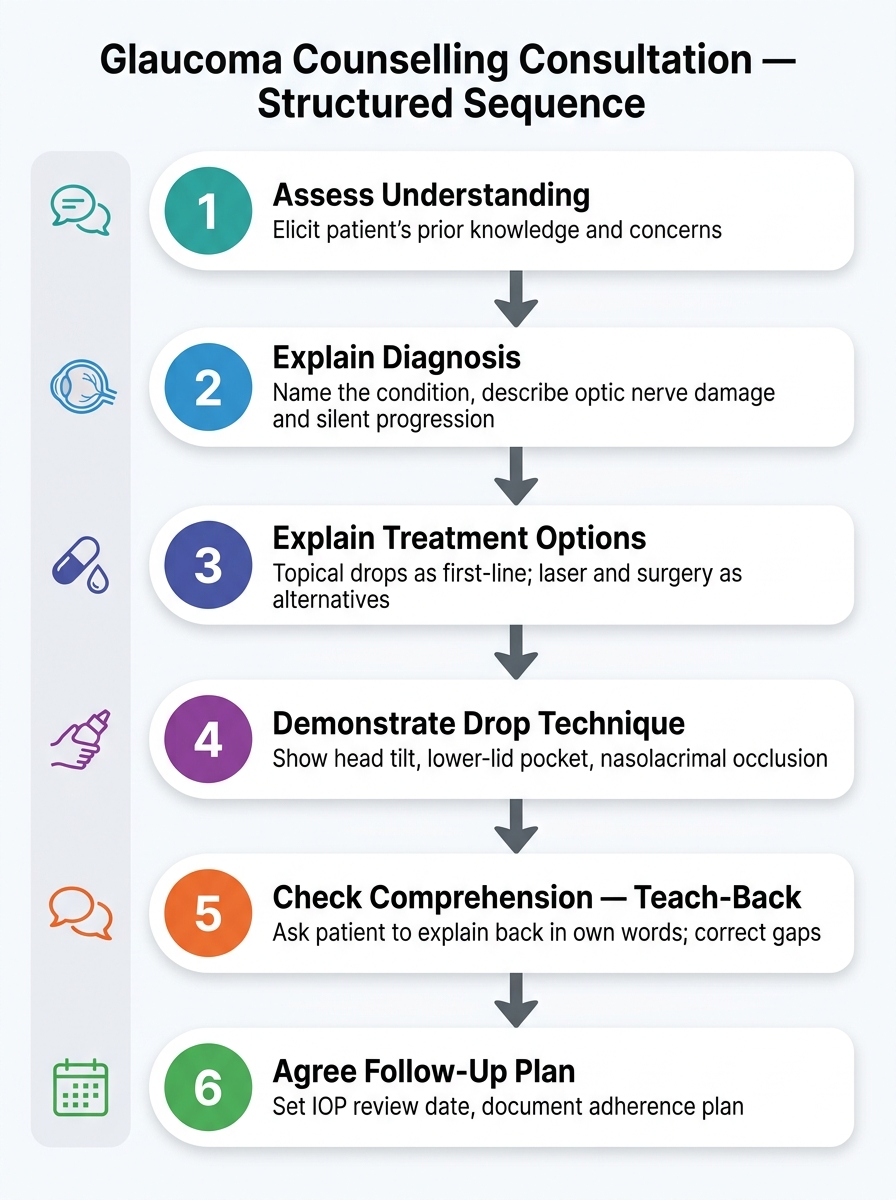
Structured Sequence for Glaucoma Counselling Consultation
SELF-CHECK
A 60-year-old woman with newly diagnosed POAG says: 'I feel completely fine — do I really need to take drops every day?' Which response BEST demonstrates patient-centred communication combined with accurate disease education?
A. 'If you don't take the drops you will go blind within 5 years, so you have no choice.'
B. 'I understand it feels strange to treat something you can't feel. Glaucoma damages the nerve so slowly that you won't notice until a great deal is already gone — by then it's too late to recover. These drops lower the pressure to stop further damage. The good news is that most patients preserve their vision with treatment.'
C. 'The drops are optional — you can wait and see if your pressure comes down by itself.'
D. 'Don't worry about it — just use the drops and stop asking questions.'
Reveal Answer
Answer: B. 'I understand it feels strange to treat something you can't feel. Glaucoma damages the nerve so slowly that you won't notice until a great deal is already gone — by then it's too late to recover. These drops lower the pressure to stop further damage. The good news is that most patients preserve their vision with treatment.'
Option B validates the patient's concern ('I understand'), accurately explains the disease mechanism and its silent nature, conveys the key prognosis message (treatment prevents further loss but lost vision is irreversible), and ends with realistic hope ('most patients preserve their vision with treatment'). Option A is accurate but coercive and fear-inducing without being empowering. Option C is factually incorrect — watchful waiting without treatment accelerates nerve damage. Option D is dismissive and violates patient autonomy.