Page 8 of 20
PE30.5 | Ambiguous Genitalia — SDL Guide (Part 2)
Interpretation of Findings and Differential Diagnosis
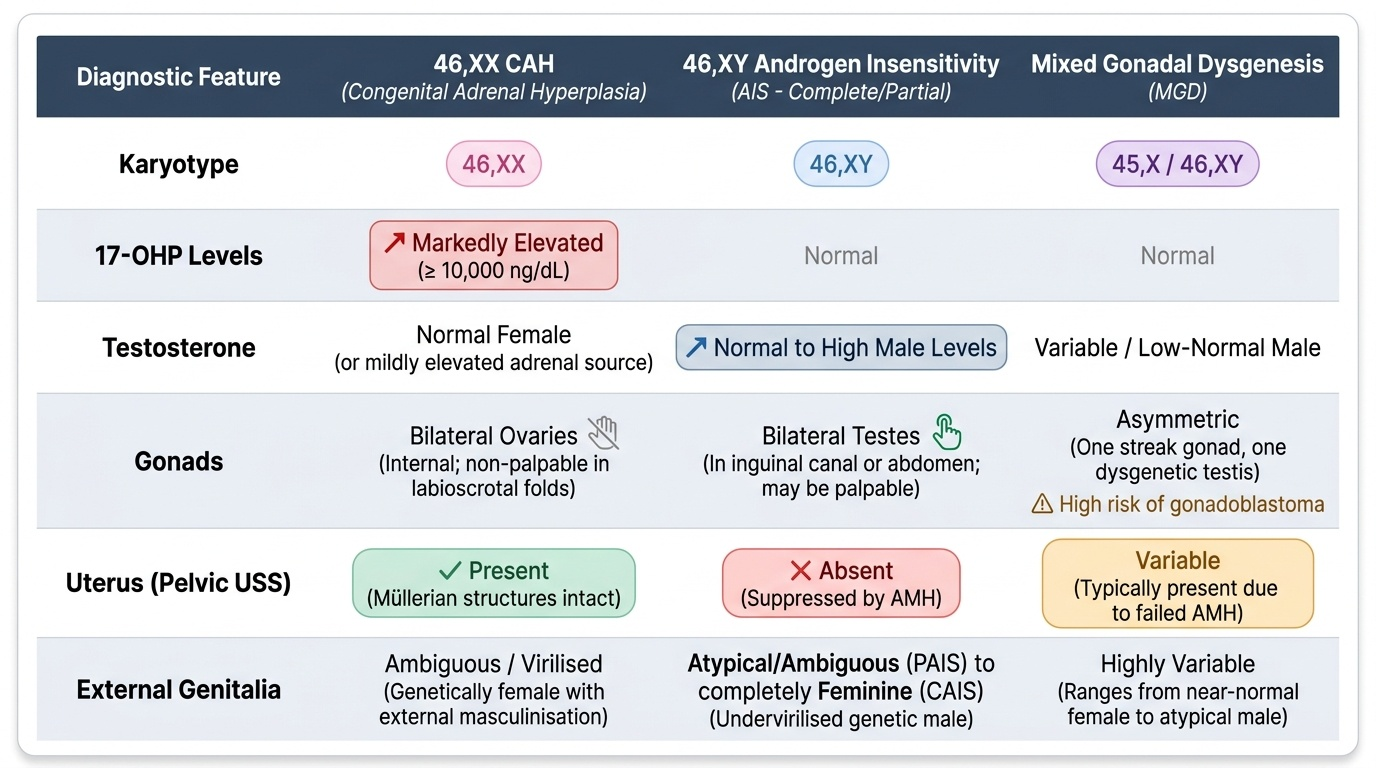
Interpreting the combined findings from examination, karyotype, 17-OHP, electrolytes, and imaging allows a specific diagnosis to be reached in the majority of cases. The key interpretive framework is built around the karyotype result, which arrives within 48–72 hours of the sample being sent.
Provided image
46,XX with ambiguous genitalia: In the great majority of cases this is 21-hydroxylase deficiency (CAH). The 17-OHP will be markedly elevated (>10,000 ng/dL); electrolytes may show salt-wasting (Na↓, K↑); pelvic ultrasound confirms uterus and ovaries present; no gonads are palpable in the labioscrotal folds. This child is a genetic female with ovaries — the virilisation is purely external and due to excess androgens. Management: glucocorticoid + mineralocorticoid (if salt-wasting) + gender assignment as female (the child is genetically and gonadally female).
46,XY with atypical or ambiguous genitalia: This represents undervirilisation of a genetic male. Possible causes: androgen insensitivity syndrome (AIS) — complete (CAIS: 46,XY, female external genitalia, no uterus, testes in inguinal canal; testosterone normal-high, no androgenisation) or partial (PAIS: partial virilisation); 5α-reductase deficiency (cannot convert testosterone to DHT, which mediates external virilisation — external genitalia are feminine at birth but virilise at puberty); Leydig cell hypoplasia (deficient testosterone production). Pelvic USS: no uterus (no Müllerian structures because AMH was produced from testes). Gonadal palpation: gonads may be palpable in inguinal canal.
Mixed gonadal dysgenesis (45,X/46,XY): Variable genital appearance; one streak gonad and one dysgenetic testis; risk of gonadoblastoma in the dysgenetic gonad.
Key interpretive principles: (1) Palpable gonad = testicular tissue — it is in a 46,XX DSD only if there is testicular tissue (rare). (2) 17-OHP elevated = CAH until proved otherwise. (3) Hyponatraemia + hyperkalaemia = mineralocorticoid deficiency (salt-wasting CAH or other adrenal insufficiency). (4) Uterus present on USS = Müllerian structures intact = functional AMH was absent = 46,XX (or 46,XY with failed AMH production — very rare).
SELF-CHECK
On examination of a 2-day-old with ambiguous genitalia, you palpate a firm gonadal structure in the right labioscrotal fold. The karyotype result is pending. What does this finding MOST likely indicate?
A. The baby is definitely 46,XX with CAH
B. The palpable gonad is testicular tissue — this is most likely a 46,XY DSD with undervirilisation
C. The finding is a normal variant and no further investigation is needed
D. The palpable structure is an enlarged clitoris, not a gonad
Reveal Answer
Answer: B. The palpable gonad is testicular tissue — this is most likely a 46,XY DSD with undervirilisation
Ovaries do not descend into the labioscrotal fold — a palpable gonad in this location contains testicular tissue. This is therefore almost certainly a 46,XY individual with undervirilisation (e.g. androgen insensitivity syndrome, 5α-reductase deficiency, or other 46,XY DSD). This finding completely changes the diagnostic pathway — the karyotype will confirm, and a different hormonal and imaging workup (testosterone, DHT, AMH, pelvic USS for uterus absence) applies.
Counselling the Family and Referral
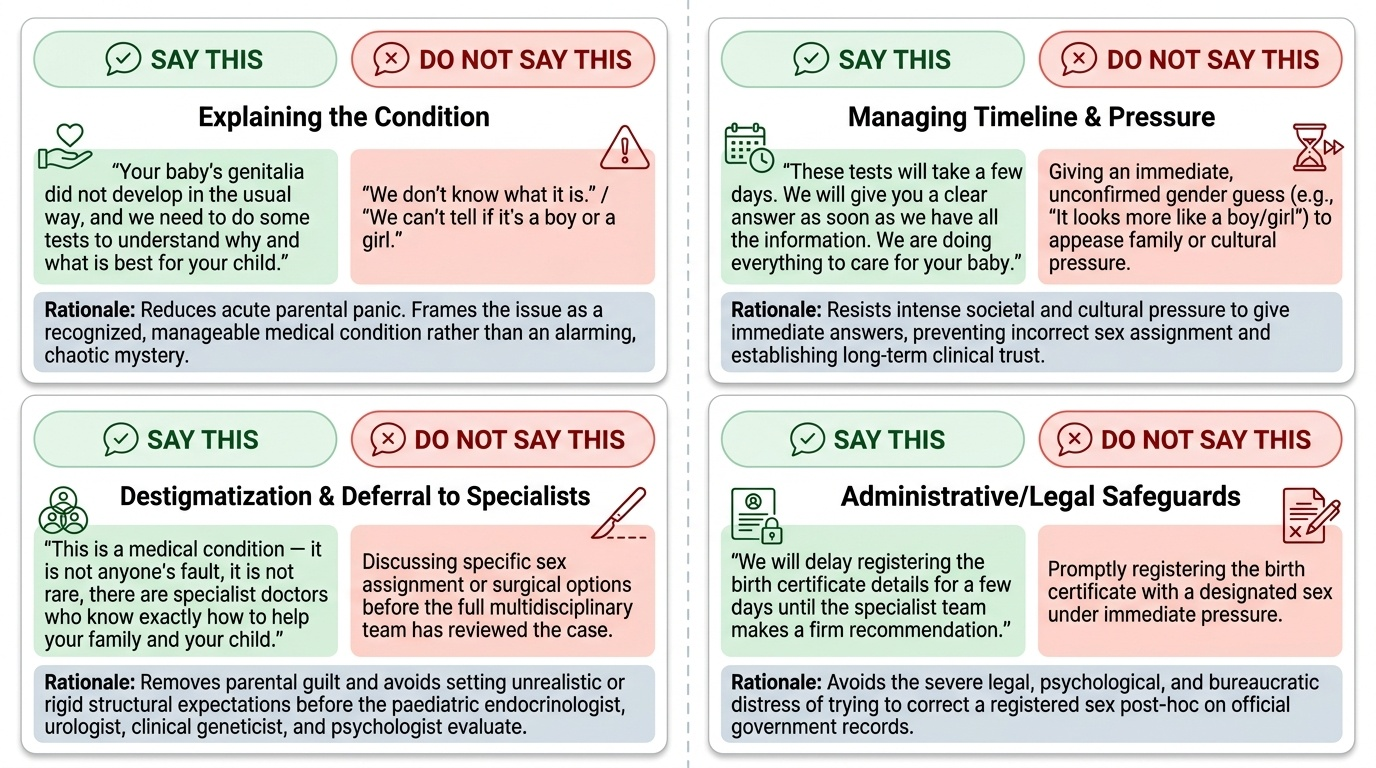
Counselling the family of a baby with ambiguous genitalia is one of the most sensitive communication challenges in paediatrics. The principles are guided by both ethics (respect for the child's future autonomy, truth-telling) and practicality (preventing a hasty, potentially incorrect sex assignment). The following framework is essential for every clinician to internalise, regardless of specialty. In India, the cultural weight of this moment is enormous: the family has been waiting to announce the birth of a son or daughter, the naming ceremony may already be planned, and social expectations create intense pressure on the clinician to give an immediate answer. Resisting this pressure — gently but firmly — is a professional and ethical imperative. The clinician must simultaneously manage the family emotional state, ensure the baby is medically safe, initiate investigations, and prepare the referral, all while communicating in a way that does not further distress the family. This section provides the exact language and framework for that conversation.
Provided image
What to SAY to the family:
• 'Your baby's genitalia did not develop in the usual way, and we need to do some tests to understand why and what is best for your child.'
• 'These tests will take a few days. We will give you a clear answer as soon as we have all the information. We are doing everything to care for your baby.'
• 'This is a medical condition — it is not anyone's fault, it is not rare, and there are specialist doctors who know exactly how to help your family and your child.'
• Acknowledge the family's distress, their cultural expectations about the baby's sex, and offer support (social worker, psychologist).
What NOT to say:
• Do NOT say 'It's a boy' or 'It's a girl' — this must be deferred until the MDT review.
• Do NOT say 'We don't know what it is' — this is terrifying; use 'we need more information to give you the right answer'.
• Do NOT discuss sex assignment or surgical options until the full multidisciplinary team (paediatric endocrinologist, urologist/surgeon, clinical geneticist, psychologist) has reviewed the case.
• Do NOT register the birth certificate with a sex until the DSD team has made a recommendation.
Immediate referral pathway:
• All cases of suspected DSD require referral to a centre with a multidisciplinary DSD team (paediatric endocrinologist + paediatric urologist/surgeon + clinical geneticist + psychologist).
• If the baby has signs of adrenal crisis (vomiting, hyponatraemia, hyperkalaemia), treat the crisis immediately and arrange emergency transfer.
• At the primary care or peripheral hospital level: draw urgent bloods (karyotype, 17-OHP, electrolytes, glucose), stabilise if in crisis, and transfer with a complete referral note documenting the examination findings, investigations sent, and what was and was not told to the family.
Applied Practice and Self-Assessment
Consolidate your learning through this case scenario: A 4-day-old baby is brought in by anxious parents who were told at birth 'We are not sure about the sex.' On examination: apparent phallus 2.5 cm, fused scrotal-like folds with hyperpigmentation, no palpable gonads bilaterally, a single perineal opening. The baby is now vomiting and refusing feeds, and appears lethargic. Vital signs: HR 168, BP 55/30 mmHg, capillary refill 4 seconds.
Serum results: Na 119 mEq/L, K 7.8 mEq/L, glucose 1.8 mmol/L. 17-OHP is pending. Work through this case in the same disciplined sequence you would use in the clinical setting: first, stabilise the infant (ABC, vascular access, bloods); second, perform the genital examination; third, interpret the available findings; fourth, initiate emergency treatment for the adrenal crisis while simultaneously arranging referral; fifth, speak to the family. Resist the temptation to handle these steps in a different order — in a critically ill neonate, resuscitation always comes before examination refinement.
Systematic clinical interpretation:
• External genitalia: consistent with a virilised 46,XX female (no palpable gonads, single perineal opening, Prader Grade III–IV) or a severely undervirilised 46,XY male — karyotype will distinguish
• The acute presentation (vomiting + hyponatraemia + hyperkalaemia + hypoglycaemia at day 4) = salt-wasting adrenal crisis from 21-hydroxylase deficiency CAH — this is the most likely and immediately life-threatening diagnosis
Immediate management (do all of these simultaneously):
• IV access: fluid resuscitation with 0.9% NaCl 20 mL/kg bolus over 30 minutes
• IV hydrocortisone: 25 mg/m2 (stress dose for crisis) IV immediately
• 10% dextrose IV for hypoglycaemia (2 mL/kg)
• Cardiac monitor (hyperkalaemia may cause arrhythmia)
• Send: karyotype, 17-OHP, cortisol, ACTH, aldosterone, testosterone, pelvic USS
• Arrange emergency transfer to paediatric tertiary centre with DSD team
• Counsel parents: 'Your baby has an adrenal gland problem that needs emergency treatment. We are treating it now. We will answer your questions about your baby's sex once your baby is stable and we have more test results.'
This case illustrates the life-saving importance of recognising the adrenal crisis component of CAH before it kills the baby in the first two weeks of life.
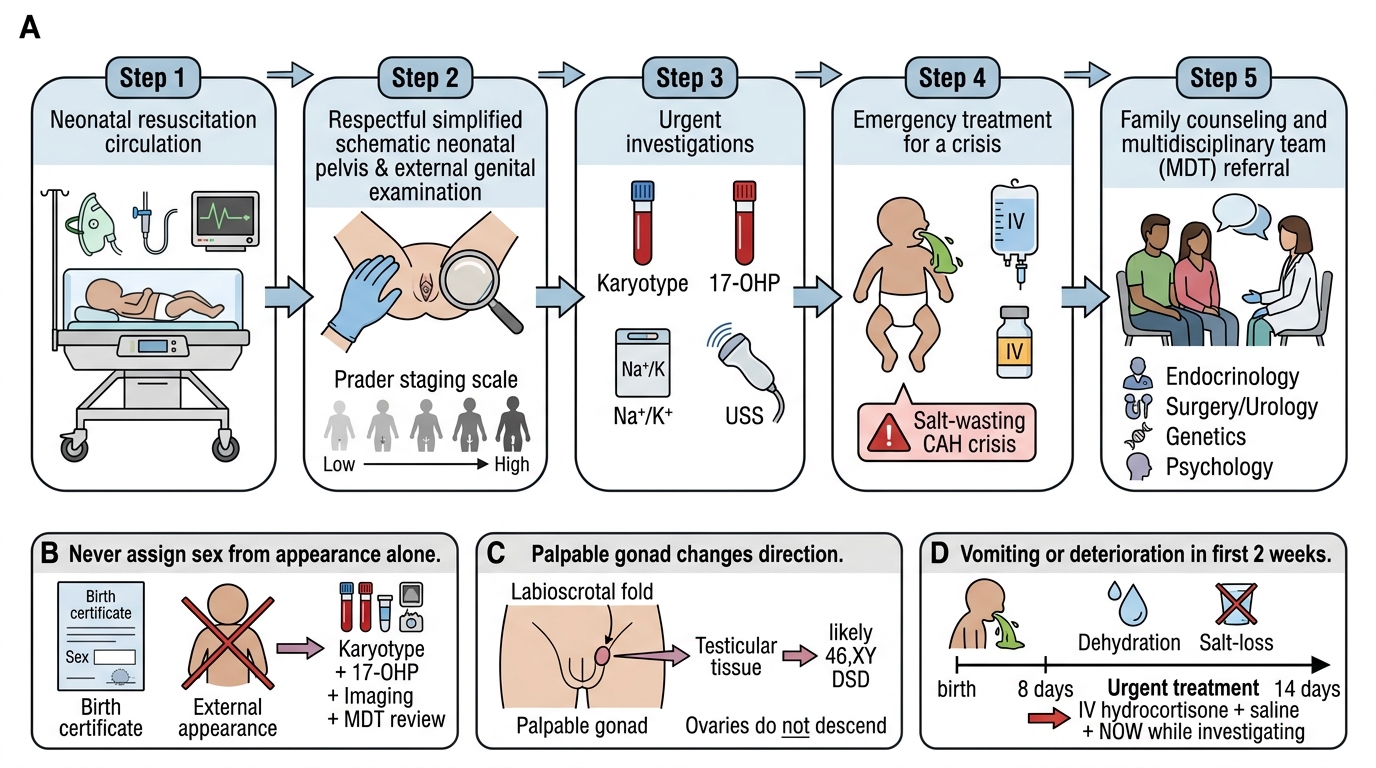
Initial Management of Ambiguous Genitalia
CLINICAL PEARL
The three rules of ambiguous genitalia that will guide your practice:
1. Never assign sex at birth based on external appearance alone. Wait for karyotype + 17-OHP + imaging + multidisciplinary team review. A hasty 'boy' or 'girl' can cause lifelong harm.
2. Palpable gonad in the labioscrotal fold = testicular tissue = likely 46,XY DSD. Ovaries do not descend. This single finding flips the entire diagnostic direction.
3. Any baby with ambiguous genitalia who is vomiting or deteriorating in the first 2 weeks = salt-wasting CAH crisis until proved otherwise. Treat with IV hydrocortisone + saline NOW, investigate simultaneously.