Page 20 of 32
PE31.12 | Typhoid — SDL Guide (Part 2)
Complications of Typhoid
The complications of typhoid reflect the pathological processes occurring in the gut and other organs as the disease progresses through its weekly stages. While modern antibiotic treatment has markedly reduced complication rates, inadequately treated or late-presenting cases — still common in resource-limited settings — remain at high risk. The clinician must actively monitor for these complications, particularly the surgical emergency of intestinal perforation, throughout the illness. The temporal relationship between disease stage and complication type is an essential framework: complications in the first week are rare; systemic toxaemia peaks in the second week; the third week carries the greatest risk of structural gut failure. Any child with typhoid who appears to be 'worsening after initial improvement' — particularly with new abdominal signs — must be evaluated urgently for perforation, not reassured with a diagnosis of relapse or inadequate antibiotic dosing without excluding the surgical emergency first.
Intestinal perforation — the most feared complication:
Perforation occurs in the third week of illness as necrotic Peyer's patches slough through the full thickness of the ileal wall. It manifests as:
- Sudden worsening of abdominal pain, often preceded by a period of apparent improvement
- Rigidity and guarding — signs of peritoneal irritation
- Abdominal distension and absent bowel sounds
- Free air under the diaphragm on erect chest X-ray (pneumoperitoneum)
- Clinical deterioration: worsening fever, tachycardia, and septic shock
Management requires emergency surgical consultation — primary closure of the perforation with peritoneal lavage; mortality remains 10–30% in resource-limited settings even with surgery.
Intestinal haemorrhage:
Occurs in week 2–3 as ulcerated Peyer's patches erode blood vessels. Presents as frank rectal bleeding or melaena. Massive haemorrhage can cause haemodynamic instability. Management is conservative (fluid resuscitation, transfusion) in most cases; surgical intervention is rarely needed for haemorrhage alone.
Typhoid hepatitis:
Mild elevation of liver enzymes (2–3× normal) is common; occasionally frank jaundice occurs. Distinguish from viral hepatitis — in typhoid, hepatitis resolves with antibiotic treatment and is rarely severe.
Neurological complications — typhoid encephalopathy:
Alteration of consciousness, seizures, and psychosis can occur in severe typhoid. Thought to be endotoxin-mediated. Dexamethasone (adjunctive, high-dose) has been shown to reduce mortality in severe typhoid with encephalopathy.
Myocarditis and cardiovascular complications:
Toxin-mediated myocarditis can cause arrhythmias and cardiac failure; relative bradycardia may progress to frank bradycardia or heart block.
Relapse:
Occurs in 5–10% of cases, typically 2–3 weeks after apparent recovery, with a milder second episode. More common with chloramphenicol treatment than with cephalosporins or azithromycin.
Other complications: Typhoid osteomyelitis (particularly in sickle cell disease), pneumonia, cholecystitis, nephritis, and haemolytic anaemia (especially in G6PD deficiency) are rare but recognised.
CLINICAL PEARL
Intestinal perforation in typhoid occurs in the THIRD week — not the first or second. A child who has had typhoid for 14–21 days and develops sudden-onset acute abdomen with peritoneal signs must be presumed to have perforation until proven otherwise. Request an erect chest X-ray immediately to look for free air under the diaphragm (pneumoperitoneum). Surgical consultation should be called before X-ray results return if the clinical picture is compelling. Do NOT attribute worsening abdominal pain to antibiotic side effects or 'typhoid abdomen' without excluding perforation.
SELF-CHECK
You are about to order a Widal test for a 7-year-old with 8 days of stepladder fever in an area where typhoid is endemic. The test returns O titre 1:160 and H titre 1:160. Which of the following BEST describes the interpretation of this result?
A. Confirms active typhoid infection — start treatment immediately based on this result
B. The result is uninterpretable without a convalescent sample; a single Widal in an endemic area is unreliable due to background titres, cross-reactions, and prior vaccination
C. The result is negative — titres below 1:320 are not significant
D. The H titre confirms recent typhoid vaccination rather than active infection
Reveal Answer
Answer: B. The result is uninterpretable without a convalescent sample; a single Widal in an endemic area is unreliable due to background titres, cross-reactions, and prior vaccination
In endemic areas like India, the Widal test is notorious for false positives: many healthy individuals have elevated baseline titres from prior exposure or subclinical infection, and numerous other febrile illnesses (malaria, dengue, hepatitis, brucellosis) cross-react with the test antigens. A single positive Widal in an endemic area cannot confirm typhoid — it requires clinical correlation and, ideally, a fourfold rise between paired acute and convalescent sera. Blood culture remains the gold standard. Most experts recommend NOT relying on a single Widal test result for treatment decisions in endemic populations.
Management and Prevention
Management of typhoid fever is shaped by two critical variables: the severity of illness (complicated vs uncomplicated) and the local antibiotic sensitivity pattern (particularly the prevalence of multidrug-resistant and extensively drug-resistant strains). Empirical antibiotic choice must account for these factors while awaiting culture sensitivity results, as delays in effective treatment carry serious complication risk. The therapeutic logic is straightforward: use azithromycin for the ambulatory child who can take oral medication and has no warning signs; escalate to IV ceftriaxone for the child who is severely ill, hospitalised, or has developed a complication. In India, the older first-line agents — chloramphenicol, ampicillin, and cotrimoxazole — are no longer reliable empirical choices because most circulating strains are multidrug-resistant; knowing this prevents a dangerous treatment failure while awaiting culture and sensitivity results.
Antibiotic therapy — choice by severity and resistance pattern:
For uncomplicated typhoid (fever without perforation, haemorrhage, encephalopathy, or shock):
- Azithromycin is the preferred oral agent: 20 mg/kg/day (maximum 1 g/day) as a single daily dose for 7 days
- Azithromycin achieves high intracellular concentrations in macrophages, where S. Typhi resides
- Effective against most MDR strains
- Well tolerated orally, allowing outpatient management of mild/moderate uncomplicated disease
- Oral cefixime (20 mg/kg/day in 2 divided doses for 14 days) is an alternative but less reliably effective than azithromycin
For severe or complicated typhoid (perforation, haemorrhage, encephalopathy, septic shock, or inability to take oral medication):
- Ceftriaxone IV: 75–100 mg/kg/day (maximum 4 g/day) as a single daily IV infusion for 10–14 days
- Drug of choice for hospitalised patients
- Effective against MDR strains
- Alternative: IV cefotaxime, or IV ampicillin + cotrimoxazole (only if sensitivity confirmed — most MDR strains are resistant)
Multidrug-resistant (MDR) typhoid:
MDR S. Typhi is resistant to ampicillin, chloramphenicol, and cotrimoxazole (the older first-line agents). Treatment: ceftriaxone or azithromycin. Extensively drug-resistant (XDR) typhoid (resistant to cephalosporins and fluoroquinolones) has emerged in Pakistan and parts of South Asia: treatment with azithromycin (if susceptible) or carbapenems.
Fluoroquinolones (ciprofloxacin): resistance is widespread in India; fluoroquinolones should NOT be used empirically without sensitivity confirmation.
Adjunctive therapy — dexamethasone for severe typhoid:
In severe typhoid with encephalopathy (altered consciousness), high-dose dexamethasone (3 mg/kg loading dose, then 1 mg/kg 6-hourly for 48 hours) has been shown in a randomised trial (Indonesia population, high-mortality setting) to reduce mortality significantly. Not routinely used for uncomplicated disease.
Supportive care:
- Hydration: adequate oral fluid intake; IV fluids if unable to take orally
- Antipyretics: paracetamol for fever
- Nutrition: soft, easily digestible diet; avoid high-roughage foods (risk of perforation)
- Monitoring: daily clinical review for abdominal signs (early perforation detection); watch for haemorrhage (stools)
- Isolation: enteric precautions (hand hygiene, separate sanitation) until stool cultures are negative
Intestinal perforation management:
- Emergency surgery (primary closure + peritoneal lavage + continued IV ceftriaxone)
- Preoperative resuscitation, nasogastric decompression, broad-spectrum antibiotic cover
Prevention:
- Vaccination:
- Vi polysaccharide vaccine (ViPs): single dose SC or IM for children ≥2 years; protective efficacy 50–80%; duration 3 years; revaccinate every 3 years
- Typhoid Conjugate Vaccine (TCV — Typbar-TCV): approved from ≥6 months; single-dose, superior immunogenicity, longer and more robust protection; included in India's NIS
- WASH interventions (safe Water, sanitation, Hygiene): boiling drinking water, safe food handling, handwashing — the backbone of typhoid prevention at community level
- Treatment of chronic carriers: prolonged antibiotic course (ciprofloxacin 6 weeks or ampicillin 6 weeks if susceptible); cholecystectomy occasionally needed for gallbladder carrier state
⚑ AI image — pending faculty review (auto-QA score 4/10; best of 3 attempts)
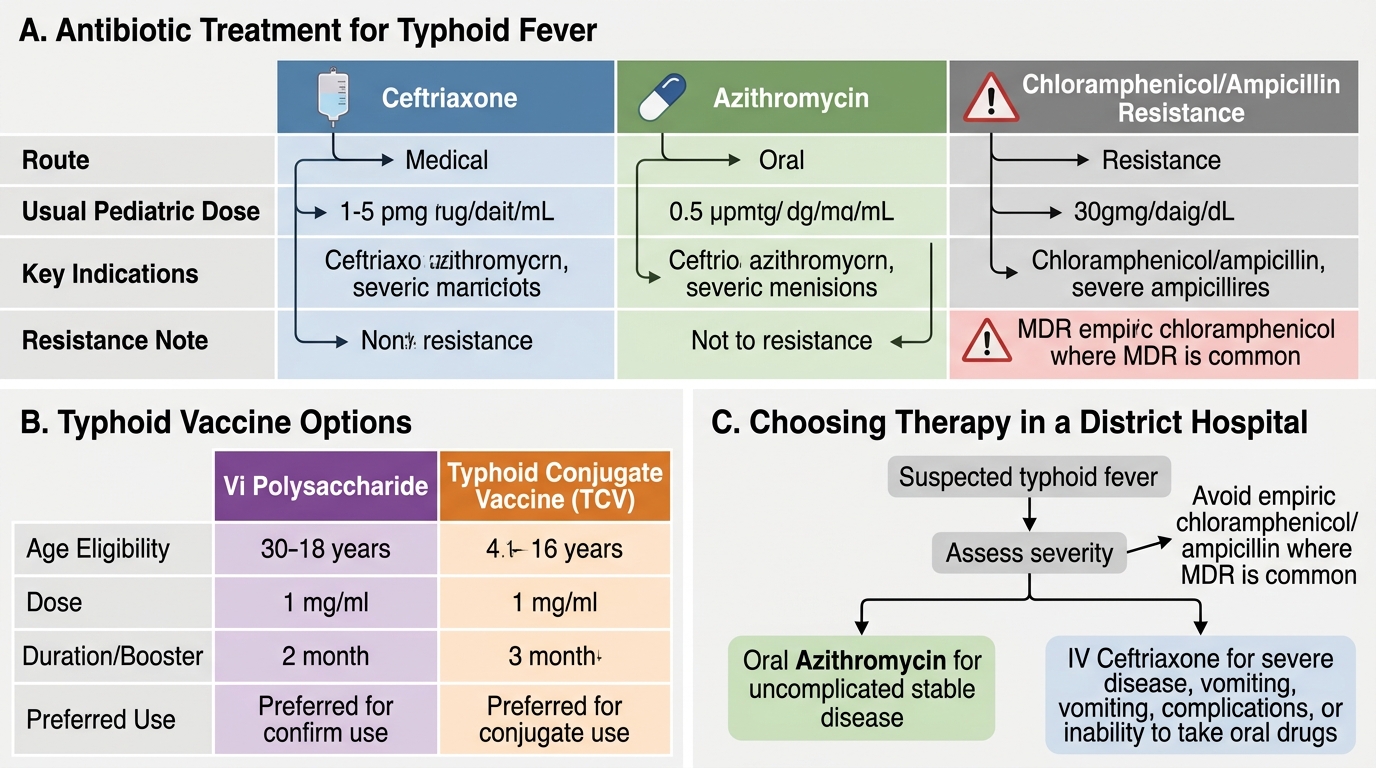
Typhoid Fever: Antibiotic and Vaccine Comparison
Self-Assessment — Typhoid
The following clinical scenarios are designed to test your integration of typhoid diagnosis, complication recognition, and antibiotic selection. For each case, apply the clinical reasoning framework from this module: correlate the week of illness with the expected pathophysiological stage, critically evaluate the available tests rather than accepting laboratory results at face value, and justify your antibiotic choice based on severity and local resistance patterns. These cases reflect the real clinical dilemmas you will encounter in a district hospital setting where blood culture is available but takes days to return, and where Widal test misinterpretation leads to both over-treatment and missed complications.
Case 1: A 10-year-old presents with 14 days of progressively rising fever, constipation initially now loose stools, and weight loss. Temperature 39.5°C, pulse 80/min. Hepatosplenomegaly on examination. Blood count: WBC 4,200/µL, 65% lymphocytes. Widal test: O 1:160, H 1:320.
Questions:
- How do you interpret the Widal test result in this endemic-area child? What test is the gold standard?
- What week of illness is this child in? What complication must you actively monitor for over the next week?
- What is your antibiotic choice and dose if the child can take oral medication?
Case 2: An 8-year-old with known typhoid fever (diagnosed by blood culture 15 days ago, started on ceftriaxone) develops sudden severe generalised abdominal pain, rigidity, and board-like abdomen. He was improving until today.
Questions:
- What complication has occurred, and in which week of typhoid does it typically occur?
- What emergency investigation confirms your diagnosis?
- What are the next management steps?
Case 3: A 6-year-old with 9 days of fever is brought in from a rural area. Blood cultures are not available locally. Widal test is negative. The child has hepatosplenomegaly, rose spots on the trunk, leucopenia (WBC 3,800/µL), and relative bradycardia.
Questions:
- Can typhoid be excluded based on the negative Widal test? Why or why not?
- How confident are you in a clinical diagnosis of typhoid, and what is your management?
SELF-CHECK
A child with typhoid fever who was improving suddenly develops severe abdominal pain and boardlike rigidity on day 19 of illness. An erect chest X-ray shows free air under the right hemidiaphragm. What is the diagnosis and the MOST appropriate immediate management?
A. Typhoid hepatitis — start dexamethasone
B. Intestinal perforation — emergency surgical referral with IV ceftriaxone and fluid resuscitation
C. Typhoid relapse — restart a second course of azithromycin
D. Mesenteric adenitis — conservative management with analgesics
Reveal Answer
Answer: B. Intestinal perforation — emergency surgical referral with IV ceftriaxone and fluid resuscitation
Intestinal perforation is the most feared complication of typhoid, occurring in the third week of illness as necrotic Peyer's patches slough through the bowel wall. Free air under the diaphragm (pneumoperitoneum) on erect chest X-ray confirms gastrointestinal perforation. This is a surgical emergency requiring: immediate IV fluid resuscitation to correct haemodynamic instability, continuation of IV antibiotics (ceftriaxone), nasogastric decompression, and urgent surgical consultation for exploratory laparotomy (primary closure of perforation + peritoneal lavage). Delay significantly worsens prognosis; mortality is 10–30% even with surgery in resource-limited settings.