Page 5 of 11
PS6.1 | Mania in Primary Care — SDL Guide (Part 2)
Management of Mania at the Primary-Care Level
The management of an acute manic episode at the primary-care level follows a clear three-step framework: safety first, stabilise acutely, then refer for definitive specialist-supervised management of bipolar disorder. The primary-care doctor's role is not to independently manage bipolar disorder long-term — that requires a specialist. It is to safely bridge the patient from crisis to specialist care.
Provided image
Step 1 — Safety. Assess for immediate risk behaviours: reckless spending, driving while manic, sexual disinhibition, aggression, or self-harm through lack of self-care. Enlist the family as a safety net. Remove access to means of harm where possible (e.g. car keys, financial accounts, internet access). Under the Mental Healthcare Act 2017, if the patient is acutely disturbed and lacks insight but is at imminent risk, the physician is empowered to initiate an emergency assessment and, if necessary, detention for assessment without the patient's consent, in the patient's best interest. Document your reasoning clearly.
Step 2 — Acute behavioural stabilisation. A severely agitated manic patient who is aggressive, threatening, or in immediate danger may need rapid tranquillisation. Haloperidol (a first-generation antipsychotic) given IM is the most widely available agent in primary care settings in India for this purpose, and can provide rapid calming. Oral olanzapine or haloperidol are alternatives where the patient will take oral medication. Second-generation antipsychotics (SGAs) such as quetiapine, aripiprazole, and olanzapine have FDA-approved indications for acute mania and are increasingly available. For the primary-care physician, the key decision is not which specific antipsychotic but whether to use one at all — reserve it for significant agitation or danger, use the lowest effective dose, and document the clinical rationale.
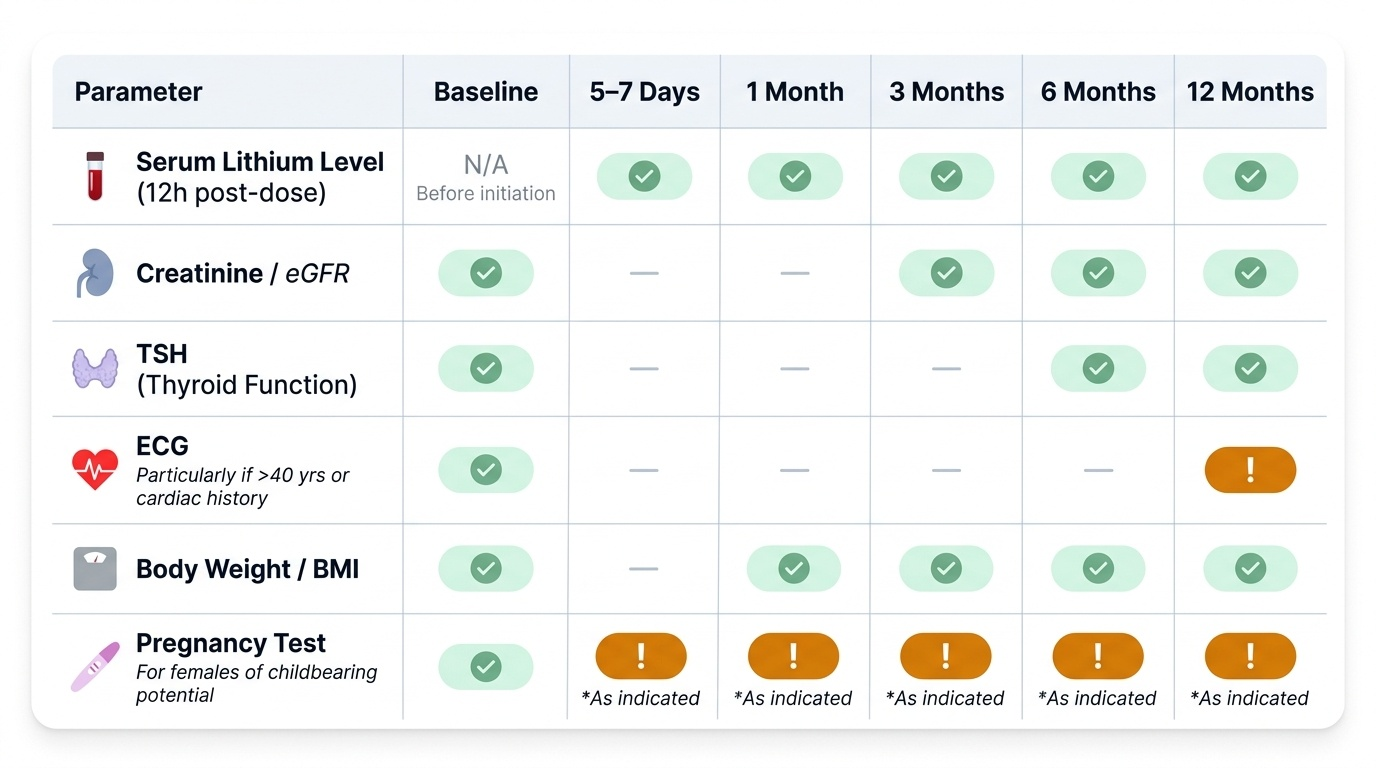
Step 3 — Mood stabiliser initiation and specialist referral for bipolar disorder. Lithium is the prototypical and most evidence-supported mood stabiliser for bipolar disorder. It is effective for acute mania, for prevention of depressive episodes, and for long-term prophylaxis of both poles. However, lithium has a narrow therapeutic index — one of the narrowest of any commonly used drug in medicine — and its initiation and maintenance require specialist supervision and regular monitoring. The therapeutic serum level range is 0.6–1.2 mEq/L: for prophylaxis (maintenance), levels of 0.6–0.8 mEq/L are typically targeted; for acute mania, levels up to 1.0–1.2 mEq/L may be needed. Levels above 1.5 mEq/L are considered toxic. Lithium toxicity presents with nausea, vomiting, diarrhoea (early signs), followed by coarse tremor, ataxia, confusion, and seizures at higher levels (>2.0 mEq/L).
Before initiating lithium, a baseline assessment is mandatory: serum creatinine and eGFR (lithium is renally excreted and contraindicated in severe renal failure), TSH and T4 (lithium causes hypothyroidism in 20–40% of long-term users), ECG (particularly in older patients — lithium can flatten or invert T-waves), serum electrolytes, body weight, and pregnancy test in women of reproductive age. Once established, monitoring includes serum lithium levels (12 hours after the last dose, once stable then every 3–6 months), TSH every 6–12 months, and creatinine every 6–12 months. Drugs that raise lithium levels to toxic range include NSAIDs, ACE inhibitors/ARBs, and thiazide diuretics — the primary-care physician must be aware of these interactions because they are prescribed frequently.
Alternative mood stabilisers include valproate (sodium valproate; highly effective for acute mania and prophylaxis; teratogenic — absolute contraindication in women of childbearing potential without adequate contraception), carbamazepine (effective for mania; significant enzyme-induction drug interactions), and quetiapine (effective for both poles of bipolar disorder).
A critical prescribing principle — do NOT use antidepressant monotherapy in bipolar depression. When a patient with bipolar disorder presents with a depressive episode, prescribing an antidepressant without a concurrent mood stabiliser or antipsychotic carries a significant risk of precipitating a switch to mania or hypomania, or accelerating cycle frequency. This is one of the most dangerous prescribing errors a primary-care physician can make in psychiatry. If a depressed patient's history reveals any prior episode of elevated mood, grandiosity, or reduced sleep with energy, consider bipolar disorder before starting an antidepressant, and refer for specialist assessment before prescribing.
SELF-CHECK
A 34-year-old woman with bipolar I disorder on lithium carbonate comes to your clinic with nausea, vomiting, coarse hand tremor, and unsteady gait. Her last lithium level taken 3 months ago was 0.9 mEq/L. She recently started ibuprofen for knee pain. What is the most likely explanation and the correct immediate action?
A. This is a lithium dose that needs to be increased to 1.5 mEq/L for better mood stability; continue lithium and increase the dose
B. Ibuprofen has raised her serum lithium into the toxic range by reducing renal lithium clearance; stop the NSAID, withhold lithium, and check the serum lithium level urgently
C. These are expected initial side effects of lithium that resolve with time; reassure and continue current treatment
D. Lithium toxicity is confirmed by clinical features alone; no need to check a serum level before stopping
Reveal Answer
Answer: B. Ibuprofen has raised her serum lithium into the toxic range by reducing renal lithium clearance; stop the NSAID, withhold lithium, and check the serum lithium level urgently
NSAIDs (including ibuprofen) reduce renal clearance of lithium by inhibiting prostaglandin-mediated renal blood flow, thereby raising serum lithium levels. The combination of NSAID use and a previously therapeutic lithium level is a classic scenario for iatrogenic lithium toxicity. Coarse tremor (not the fine tremor of therapeutic levels), ataxia, and GI symptoms in this context indicate toxicity (likely >1.5 mEq/L). The correct action is to stop the NSAID, withhold lithium, and urgently check the serum level to guide further management. Levels >1.5 mEq/L are toxic; the target is NOT 1.5 mEq/L. Side effects of therapeutic lithium are fine tremor and polyuria — not ataxia and coarse tremor.
Self-Assessment & Consolidation
You have now worked through the clinical presentation, psychopathology, diagnostic assessment, and primary-care management of a manic episode. Use these structured consolidation prompts to test your retention actively and identify gaps before your clinical placement.
Begin with diagnostic criteria. Can you state, without hesitation, the duration threshold for a manic episode (≥1 week, or any duration if hospitalised) and contrast it with hypomania (≥4 days)? Can you name the two classification systems and confirm this criterion is shared by both ICD-11 and DSM-5? Can you expand DIG FAST and explain why each feature represents pathological elevation rather than normal happiness? Which two features of the manic episode — marked functional impairment and presence of psychotic features — automatically exclude hypomania as the diagnosis?
Move to the mental status examination. What is the specific speech abnormality in mania (pressured speech), and how does it differ from tangential thinking? How does flight of ideas differ from loosening of associations? What is the significance of absent insight in the context of treatment consent and the Mental Healthcare Act 2017?
Test your pharmacological precision on lithium. State from memory: the full therapeutic range (0.6–1.2 mEq/L); the prophylactic target (0.6–0.8 mEq/L); the acute mania range (up to 1.0–1.2 mEq/L); the toxicity threshold (>1.5 mEq/L). Name three classes of drugs that raise lithium to toxic levels (NSAIDs, ACE inhibitors/ARBs, thiazide diuretics). Name the three organ systems that require baseline and monitoring assessment before and during lithium therapy (renal: creatinine/eGFR; thyroid: TSH/T4; cardiac: ECG). What is the correct timing for a lithium serum level sample (12 hours after the last dose)?
Apply your safety prescribing knowledge. A 40-year-old man presents with a first depressive episode. His wife mentions that 'about two years ago he went through a phase where he didn't sleep for a week, spent a lot of money, and seemed full of energy.' How does this history change your management? (Answer: this history suggests a prior manic or hypomanic episode, indicating possible bipolar disorder; prescribing antidepressant monotherapy risks switching to mania or cycling acceleration; specialist referral before any antidepressant prescription is required.)
Consolidate your primary-care management framework. The three-step framework is: safety assessment and immediate risk mitigation → acute behavioural stabilisation (haloperidol IM or oral antipsychotic if significantly agitated) → referral to psychiatry for confirmed diagnosis and specialist-supervised long-term management. Lithium initiation belongs to specialist care, not primary-care initiation. The primary-care physician understands what lithium is, its monitoring requirements, its interactions, and its toxicity — so they can counsel, identify adverse effects, and support adherence — but does not start it independently in a newly diagnosed patient.
Finally, confirm your knowledge of the Mental Healthcare Act 2017: can you describe two specific provisions relevant to the acutely manic patient with absent insight? (Decriminalisation of suicide attempts; framework for emergency assessment and admission without consent in the patient's best interest.)
CLINICAL PEARL
The first depressive episode after a manic episode is the highest-risk period for suicide in bipolar disorder. After the manic 'high' collapses — often abruptly, sometimes within days — the patient may plunge into profound depression with insight now partially restored (so they are aware of the damage done during the manic episode: debts, broken relationships, occupational consequences) but with mood too low to cope. This 'post-manic crash' is a well-recognised high-risk window. Any patient being discharged or stepped down after a manic episode should have an explicit safety plan, a close follow-up appointment within one week, a named contact they can reach in a crisis, and their family educated about the warning signs of both depression and relapse.