Page 1 of 25
CM1.1-2 | CM1.1-2 | Public Health and Holistic Health — SDL Guide
Learning Objectives
- Define public health and describe its scope and goals as distinct from individual clinical medicine
- Define health using the WHO definition and articulate its dimensions including spiritual health
- Explain the concept of relativeness of health and its cultural, geographic, and temporal dimensions
- Enumerate the major determinants of health using a recognized framework
- Explain how public health acts on these determinants to improve population well-being
INSTRUCTIONS
This module introduces two foundational pillars of Community Medicine: what public health is (as a science and social practice) and what health itself means. As a future doctor, you will simultaneously care for individual patients AND serve as a community resource. Understanding why populations fall ill, what shapes their well-being, and how society organizes responses to health challenges is the intellectual foundation for everything in Community Medicine. Begin here; this conceptual map will orient every topic that follows.
References
- Park's Textbook of Preventive and Social Medicine, 26th edition — Ch 1 (Concept of Health and Disease) (textbook)
- WHO Constitution Preamble, 1948 — definition of health (document)
Version 2.0 | NMC CBUC 2024
CLINICAL SCENARIO
In 1994, a plague outbreak in Surat, India, triggered an exodus of half a million people in 48 hours. Thousands of doctors treated individual patients — but it took epidemiologists mapping spread, sanitarians enforcing quarantine, and health communicators reaching communities to stop the epidemic. No single clinician, however brilliant, could have done this alone. This is the story of public health: the organised effort of society to protect and promote the health of populations, not just individuals. Today, you begin learning the discipline that turns that organised effort into science.
WHY THIS MATTERS
Every doctor in India is simultaneously a primary-care clinician and a first-responder for their community. The NMC mandates Community Medicine precisely because individual excellence in diagnosis and treatment is necessary but not sufficient for national health goals. Mastering the concepts in this module — what public health is, how health is defined and measured, and what determines it — will help you understand why India's disease burden persists despite advances in medical science, and what your role beyond the clinic can be. These concepts recur in every subsequent Community Medicine topic.
RECALL
You have already learned, in your basic sciences, that the human body maintains homeostasis through coordinated physiological systems — and that disease arises when this balance is disrupted. In Community Medicine, we extend that lens outward: just as the body is a system, so is the community. Recall that disease causation involves more than a single pathogen or genetic defect; factors from the environment, behaviour, and social context all interact. Keep those introductory principles in mind as we now define, more precisely, what 'health' means and how public health approaches its protection.
The Burden of Disease and the Need for Public Health
The sheer scale of preventable suffering in any population makes the case for public health most compellingly. In India, non-communicable diseases now account for over 60% of total deaths, while communicable diseases — most of them preventable — continue to claim hundreds of thousands of lives each year, particularly among the poor and the young. Infant mortality, maternal mortality, and child malnutrition rates in many Indian states remain far higher than in countries with comparable per-capita income, pointing to structural and social determinants that individual clinical care cannot address.
Individual clinical medicine, however excellent, is reactive: it responds to disease once it has occurred. A physician can cure a child's diarrhoea, but unless the contaminated water source is fixed, another child falls ill the next day. Population health — the study and improvement of the health of defined groups — requires a different set of tools: epidemiology, biostatistics, environmental science, social policy, and health communication. The scale of impact is equally different: a single vaccine programme can prevent disease in millions simultaneously, a leverage impossible for individual clinical care. Recognising this limitation of the purely clinical model is the intellectual starting point for all of public health.
Public health is thus complementary to, not competitive with, clinical medicine. Both are necessary; neither alone is sufficient. As a medical student, appreciating this partnership is the first conceptual step.
Defining Public Health — Concept and Scope
Public health is formally defined by C.E.A. Winslow (1920) as 'the science and art of preventing disease, prolonging life, and promoting physical health and efficiency through organised community efforts.' This definition, though a century old, captures the essential character of the discipline: it is both science (epidemiology, biostatistics, environmental sciences) and art (communication, policy advocacy, social mobilisation); it focuses on prevention rather than cure; and it operates through organised community or societal structures, not individual practitioners acting in isolation.
Park's Textbook, the canonical Indian reference, further emphasises that public health's unit of concern is the community or population, not the individual patient. Its methods therefore include surveillance of disease in populations, identification of risk factors through epidemiological studies, design and evaluation of preventive programmes, and advocacy for health-promoting social policies. The scope of public health spans communicable disease control, maternal and child health, nutrition, environmental sanitation, mental health, non-communicable disease prevention, and health systems strengthening.
| Dimension | Clinical Medicine | Public Health |
|---|---|---|
| Unit of care | Individual patient | Population / community |
| Primary focus | Diagnosis and treatment | Prevention and health promotion |
| Approach | Curative, rehabilitative | Preventive, promotive |
| Core tools | Clinical examination, investigations, therapeutics | Epidemiology, surveillance, health education, policy |
| Encounter | Patient-initiated (clinic/hospital) | Population-directed (programme, surveillance) |
Both models are necessary and mutually reinforcing; in India, the doctor is expected to practice both — serving individual patients and contributing to community health programmes.
SELF-CHECK
Winslow's 1920 definition of public health describes it as the science and art of preventing disease and promoting health through:
A. Individual clinical intervention and pharmacotherapy
B. Organised community efforts focused on prevention and promotion
C. Hospital-based curative services funded by the government
D. Epidemiological research published in peer-reviewed journals
Reveal Answer
Answer: B. Organised community efforts focused on prevention and promotion
Winslow's definition explicitly emphasises 'organised community efforts' — public health operates through coordinated societal and community structures, not through individual clinical encounters or research alone. Prevention and promotion (not cure) are its primary goals.
Determinants of Health — The Roots of Well-being
Why are some people and communities healthier than others? The answer lies not only in biology but in a complex web of social, economic, environmental, and behavioural forces collectively called the determinants of health. The most influential framework for understanding these determinants was articulated in the Lalonde Report (Canada, 1974), which identified four broad categories: human biology, environment, lifestyle/behaviour, and health-care organisation. This was a landmark departure from the biomedical model's exclusive focus on biological causation.
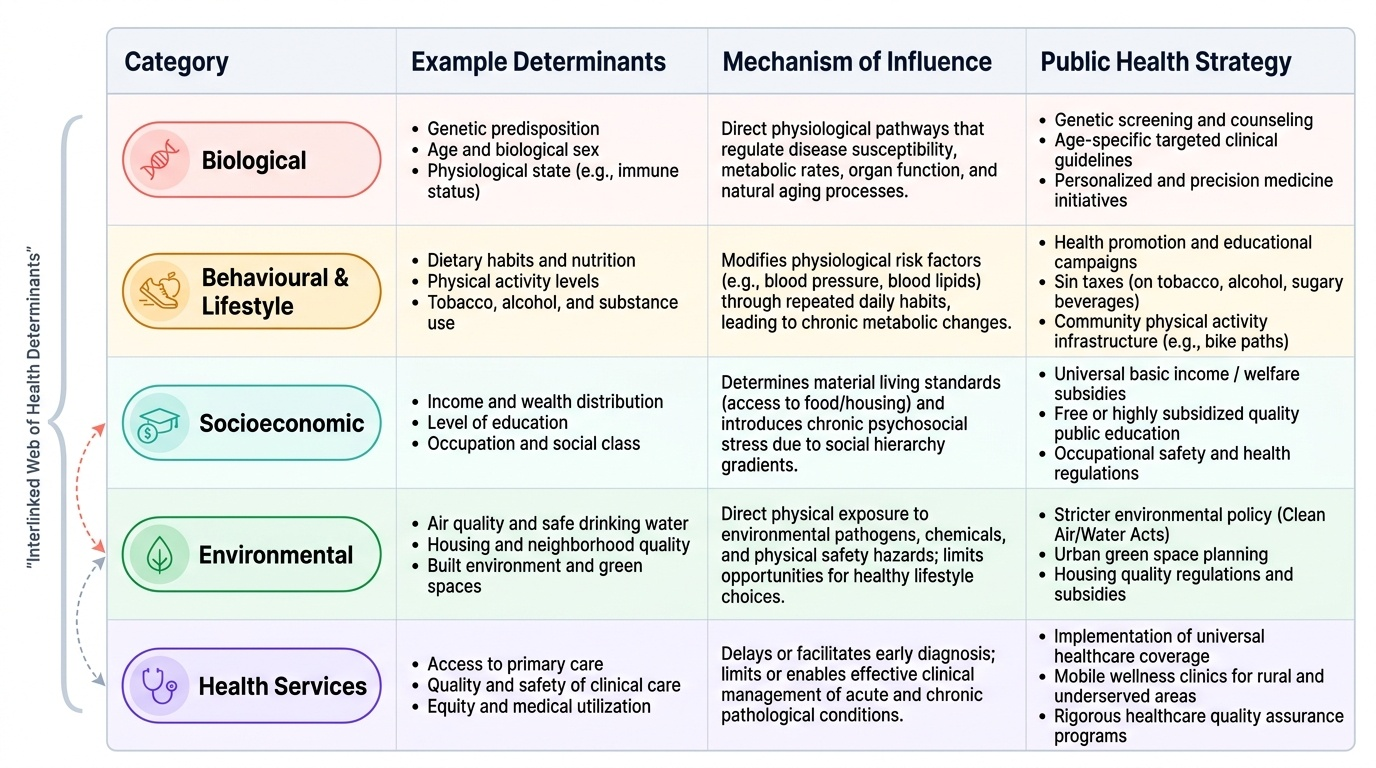
In the Indian context, Park's categorises the determinants broadly as: (1) biological determinants — genetics, age, sex, and physiological state; (2) behavioural and lifestyle determinants — diet, physical activity, tobacco use, alcohol, sexual behaviour; (3) socioeconomic determinants — income, education, occupation, social class, and social support networks; (4) environmental determinants — quality of air, water, soil, housing conditions, and the physical built environment; and (5) health-service determinants — access, quality, utilisation, and equity of health care. These categories overlap and interact; poverty, for instance, simultaneously restricts access to nutrition (biological), clean water (environmental), health care (service), and education (socioeconomic).
Provided image
Understanding determinants is crucial because public health interventions act primarily at the determinant level — improving water quality, raising incomes through policy, reducing tobacco use through taxation and education — rather than treating downstream disease in individuals. The social determinants of health (SDH), emphasised by the WHO Commission on Social Determinants of Health (Marmot, 2008), particularly highlight that the conditions in which people are born, grow, live, work, and age are the most powerful predictors of health outcomes — and the most actionable targets for equity-focused public health.