Page 2 of 14
CM17.1-2 | CM17.1-2 | Community Health Care and Community Diagnosis — SDL Guide (Part 2)
Conducting Community Diagnosis — Steps and Tools
A systematic community diagnosis follows a logical sequence of six steps. Each step uses specific tools and produces outputs that feed the next step.
Step 1: Define the community. Specify the geographic area, population size, and relevant subgroups (tribal, urban, occupational). Without a clear definition, data cannot be meaningfully compared or attributed.
Step 2: Collect data. Use existing records (PHC registers, civil registration, HMIS) and, where gaps exist, conduct primary surveys — household surveys, key informant interviews, focus group discussions, school health records, nutritional assessments. A pilot-tested, structured questionnaire administered to a representative sample (typically 5–10% of households) is the standard approach.
Step 3: Analyse health indices. Calculate the following for the community:
- Birth rate and death rate (crude, age-specific)
- Infant mortality rate (IMR) — under-1 deaths per 1,000 live births; a sensitive indicator of maternal and child health services
- Under-5 mortality rate (U5MR) — child health overall
- Maternal mortality ratio (MMR) — per 100,000 live births
- Morbidity rates — disease-specific incidence and prevalence
- Nutritional indices — stunting, wasting, underweight proportions (using WHO z-scores)
Step 4: Identify health problems. Rank conditions by: (a) frequency (high burden diseases), (b) severity (case fatality, disability-adjusted life years), (c) vulnerability of affected groups (under-5s, pregnant women, elderly).
Step 5: Prioritise problems. Apply a priority-setting matrix (e.g., PEARL — Propriety, Economics, Acceptability, Resources, Legality) or a quantitative scoring approach weighting magnitude × severity × community concern × feasibility of control.
Step 6: Plan interventions. Translate prioritised problems into specific programme objectives, resource requirements, and monitoring indicators.
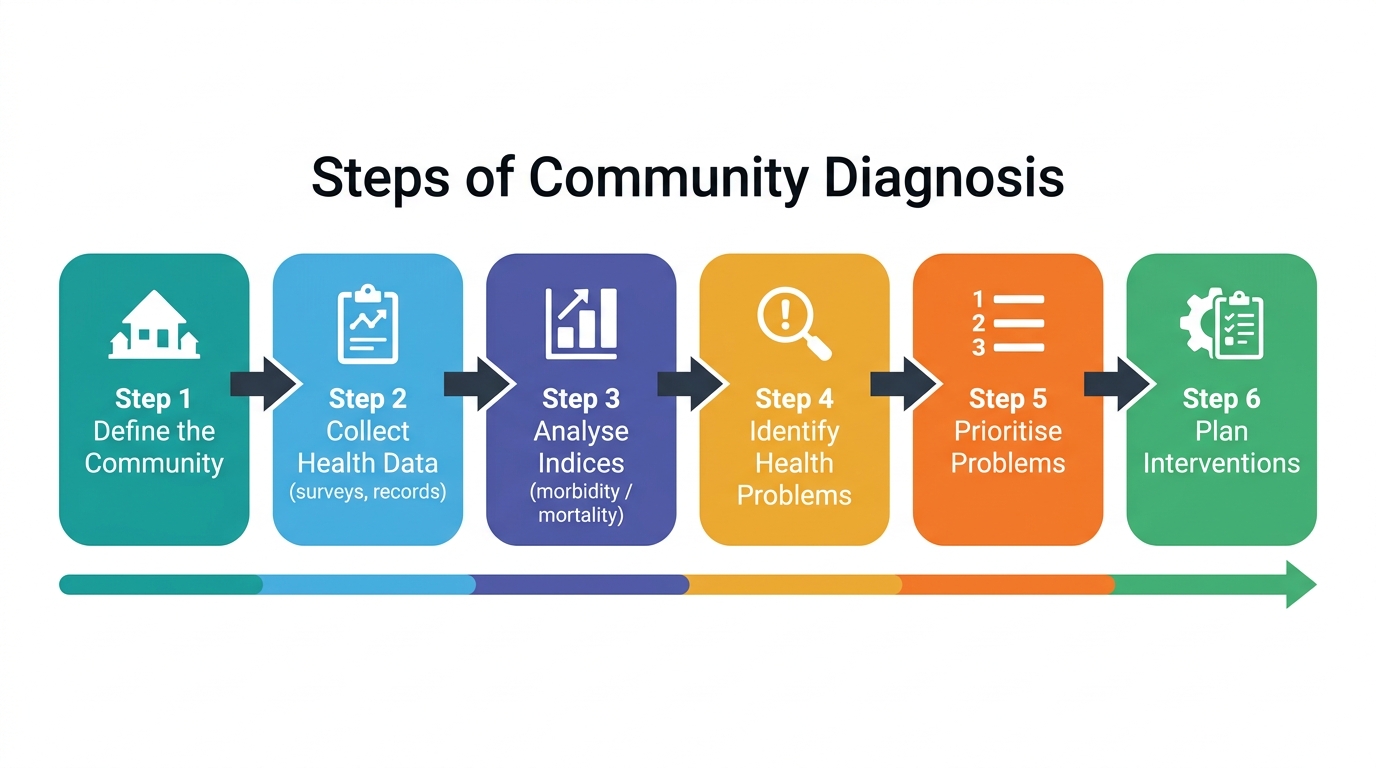
Six Steps of Community Diagnosis
SELF-CHECK
A medical officer conducting community diagnosis in a tribal village finds the following data: IMR = 68 per 1,000 live births, malaria incidence = 45 per 1,000, open defecation = 70% of households, anaemia prevalence in under-5s = 55%. Which health index is MOST useful as a summary indicator of the overall maternal and child health services quality in this community?
A. Malaria incidence rate
B. Open defecation prevalence
C. Infant mortality rate (IMR)
D. Anaemia prevalence in under-5s
Reveal Answer
Answer: C. Infant mortality rate (IMR)
The Infant Mortality Rate (IMR) is widely accepted as the single most sensitive summary indicator of the overall health status of a community, reflecting the quality of maternal care, nutrition, immunisation coverage, sanitation, and healthcare access. While all the listed indicators are important, IMR integrates multiple dimensions of maternal and child health services quality and is the primary index used in community diagnosis for priority-setting and programme evaluation in India.
Using Community Diagnosis to Plan Interventions
Community diagnosis is not an academic exercise — it is the evidence base for action. Once priorities are established, the medical officer must translate them into a Health Action Plan: a document specifying the health problem, the intervention (what will be done), the responsible agency, the timeline, the resource requirement, and the monitoring indicator.
Priority-setting frameworks widely used in India include:
- PEARL criteria (Propriety: is the intervention appropriate for the setting? Economics: is it affordable? Acceptability: will the community accept it? Resources: are they available? Legality: is it within the law?)
- Hanlon's Basic Priority Rating System: magnitude × severity × effectiveness of intervention — yields a priority score for comparison across problems
Monitoring indicators link the community diagnosis baseline to measurable targets. For each priority problem, at least one process indicator (e.g., vaccination coverage %) and one outcome indicator (e.g., IMR decline at 3-year re-assessment) should be pre-specified. This closes the loop: community diagnosis at baseline → programme implementation → re-diagnosis at follow-up → assess whether indicators improved.
The role of intersectoral coordination: most priority health problems identified in community diagnosis have determinants outside the health sector — sanitation is under Panchayati Raj Institutions, nutrition programmes are under the ICDS (Women and Child Development), water supply is under the Public Works Department. The medical officer must function as a coordinator across sectors, not merely a health services provider. This is why community medicine graduates are uniquely positioned for district administration roles.
Community participation is an essential element: communities that are involved in diagnosis (e.g., through Village Health Sanitation and Nutrition Committees — VHSNCs) are more likely to accept and sustain health interventions. This is a core principle of the National Rural Health Mission (NRHM) / Ayushman Bharat framework.
CLINICAL PEARL
Pearl: IMR as the community health thermometer. The Infant Mortality Rate is often called the 'thermometer' of a community's health because it reflects maternal health, nutrition, immunisation coverage, sanitation, and healthcare access in a single number. When setting up a community diagnosis in any field posting, the first number to benchmark is the IMR — compare it to the national average (approximately 28 per 1,000 live births, NFHS-5 2019-21), state average, and WHO Sustainable Development Goal target (≤12 by 2030). Any community with an IMR above the national average has a priority gap that must be diagnosed and addressed.
Applying Community Diagnosis — A Field Scenario
Consider the following field scenario, which integrates all five CM arc steps.
Scenario: You are the medical officer of PHC Rampur, serving 25,000 people across 8 revenue villages. Your PHC data for the last year shows: IMR = 58/1,000 (national average 28/1,000), malaria incidence = 30/1,000, open defecation = 60%, full immunisation coverage = 42% (national target 90%), anaemia in pregnant women = 65%, MMR (local estimate) = 250/100,000.
Step 1 — Define the community: 25,000 population, 8 villages, rural, predominantly agricultural, tribal population 30%.
Step 2 — Collect data: PHC registers confirm the above. ASHA health surveys reveal that 3 of 8 villages have broken hand-pumps (no safe water). VHSNC records show low ICDS attendance in tribal hamlets.
Step 3 — Analyse indices: IMR (58) is double the national average. Immunisation coverage (42%) is far below target. These two indicators together strongly suggest failures in maternal and child health services delivery.
Step 4 — Identify problems: (a) High IMR driven by poor immunisation and neonatal infection from unsafe water/delivery conditions; (b) malaria burden in tribal villages; (c) maternal anaemia contributing to adverse neonatal outcomes.
Step 5 — Prioritise: Using magnitude × severity: IMR/maternal anaemia → highest priority (high magnitude, high severity, modifiable). Malaria → second priority. Open defecation → third (environmental, needs Panchayat coordination).
Step 6 — Plan interventions: Intensify ANM outreach to tribal hamlets for immunisation; repair hand-pumps (coordinate with PWD); increase IFA supplementation and ANC attendance; coordinate with Revenue Department for ODF programme; re-assess IMR at 2 years.
This field application demonstrates how community diagnosis transforms raw data into a prioritised, actionable health plan — the core skill of a community medicine practitioner.
SELF-CHECK
In the PEARL priority-setting framework used in community diagnosis, which criterion asks whether the proposed intervention is within the legal authority of the health department?
A. Propriety
B. Economics
C. Acceptability
D. Legality
Reveal Answer
Answer: D. Legality
In the PEARL framework: P = Propriety (is the intervention appropriate/suitable for the health agency?), E = Economics (is it economically justifiable?), A = Acceptability (will the community and authorities accept it?), R = Resources (are adequate resources available?), L = Legality (is it within legal boundaries?). The 'L' criterion specifically checks whether the intervention is legally permissible for the health department to carry out — for example, actions requiring civil authority (demolishing buildings for sanitation) would not meet the 'L' criterion for a medical officer acting alone.