Page 1 of 14
FM1.1-2 | Forensic Medicine: Definitions & History — SDL Guide
Learning Objectives
- Define Forensic Medicine, Clinical Forensic Medicine, Forensic Pathology, State Medicine, Legal Medicine, and Medical Jurisprudence, distinguishing their scope and primary practitioners
- Describe the historical development of forensic medicine from ancient civilisations through the founding of modern forensic science to contemporary Indian statutory frameworks
- Explain how the doctor's role as a medicolegal practitioner has been shaped by statutory evolution, culminating in the BNS/BNSS 2023 reform
INSTRUCTIONS
Medicine has always existed at the intersection of science and law. Every time a doctor signs a death certificate, examines an injured patient for a police report, or testifies in court, they are practising forensic medicine — whether they know it or not. This module provides the conceptual map of the entire discipline: what each branch is called, why the distinctions matter, and how the field arrived at its current form. Understanding these definitions and this history is not merely academic; it tells you exactly what legal responsibilities you carry every time you pick up a pen in a medico-legal context.
References
- KSN Reddy — Essentials of Forensic Medicine & Toxicology (textbook)
- BV Subrahmanyam — Modi's Medical Jurisprudence and Toxicology (textbook)
Version 2.0 | NMC CBUC 2024
CLINICAL SCENARIO
A 28-year-old woman is brought to the casualty department by police at 11 PM with multiple bruises and a laceration on her forearm. The constable hands you a requisition slip: 'Examine and report injuries for medico-legal case.' You must examine her, document every wound precisely, issue a wound certificate, and preserve the clothing as potential evidence — all before you treat her. Later that week, you receive a summons to appear in court as a witness. In the witness box, the defence lawyer challenges your use of the term 'grievous hurt' and asks you to define it under current law. Two weeks later, the hospital receives a complaint: a patient alleges your colleague was negligent, and you are asked to give an expert opinion. Each of these events — the examination, the certificate, the court appearance, the expert opinion — falls under a different sub-discipline of forensic medicine. Knowing which branch governs which duty is the first step to fulfilling those duties without legal jeopardy.
WHY THIS MATTERS
Forensic medicine is not a specialty confined to mortuaries and criminal investigations. As a physician in any clinical setting — emergency room, outpatient clinic, rural health centre — you will regularly encounter patients with injuries, deaths of unknown cause, alleged sexual assaults, or questions of professional negligence. The Indian legal system has specific expectations of the doctor in each of these situations, expectations that are enforceable through the courts. A doctor who does not understand the disciplinary map of forensic medicine risks missing critical documentation steps, making statements in court that are inadmissible, or confusing the standards of one branch with another. In addition, the 2023 overhaul of India's criminal statutes — the Bharatiya Nyaya Sanhita (BNS), Bharatiya Nagarika Suraksha Sanhita (BNSS), and Bharatiya Sakshya Adhiniyam (BSA) — has changed the precise legal framework doctors operate within. Understanding this historical evolution is not optional; it is part of professional competence.
RECALL
Before proceeding, activate what you already know. From your Year-1 introduction to professional studies, recall: What does 'jurisprudence' mean in a general sense? You may remember it as the theory or philosophy of law. From anatomy and physiology, recall the body systems you examined — those same systems become the subject of forensic examination after trauma or death. From your community medicine orientation, recall what 'State Medicine' or public health encompasses — vital statistics, disease surveillance, mortality data — these overlap significantly with one forensic sub-discipline. Also bring to mind the term 'negligence' from your ethics sessions — in legal medicine, negligence has a precise statutory definition that differs from its everyday meaning. These anchors will help you connect the formal definitions in this module to knowledge you already possess.
Core Definitions: The Family of Forensic Disciplines
Forensic Medicine is the branch of medicine that applies the principles and knowledge of medicine to the purposes of law. It is the parent discipline that encompasses every situation in which a physician's expertise is required to assist the legal system — whether that involves examining a living injured patient, performing a post-mortem examination, advising on professional standards, or testifying in court. The word 'forensic' derives from the Latin forensis — meaning 'of the forum' or 'of the marketplace,' the Roman public assembly where legal cases were argued. In its broadest sense, forensic medicine is medicine placed in the service of justice.
Within this parent discipline, several distinct sub-disciplines have evolved to handle different types of legal questions. Each has a defined scope, a characteristic type of practitioner, and specific documentation requirements.
Clinical Forensic Medicine (also called Clinical Forensic Practice) focuses on living patients. It involves the examination, documentation, and interpretation of injuries in living individuals for legal purposes — assault victims, survivors of sexual violence, road traffic accident victims whose injuries must be formally recorded for police or insurance proceedings, and intoxicated individuals. The clinical forensic physician must balance the duty of care to the patient with the duty to produce a legally defensible medical report. The output is always a formal medicolegal certificate or report, not merely a treatment record.
Forensic Pathology is the branch that deals with death. It involves post-mortem examination (autopsy) to determine the cause of death, the manner of death (natural, accidental, suicidal, homicidal, or undetermined), and the time since death. The forensic pathologist works closely with the police, the courts, and the coroner or magistrate. Their primary output is a post-mortem certificate and, where required, an expert report for trial proceedings.
State Medicine (also called Public Health Medicine or Preventive and Social Medicine in some classifications) is the branch that applies medical knowledge to the health of communities rather than individuals. It encompasses vital statistics (recording births and deaths), disease notification, epidemic investigation, environmental health standards, and occupational health regulation. Its intersection with forensic medicine arises whenever the state's regulatory functions require medical certification — for example, in certifying deaths for national mortality registers or in investigating disease outbreaks that may have criminal or negligence dimensions.
Legal Medicine is a broad term that encompasses all aspects of medicine that have legal implications. It includes not only the examination of injuries and death but also the medico-legal aspects of clinical practice — consent, confidentiality, professional negligence, the registration of medical practitioners, and the regulation of medical practice under statute. In many countries 'legal medicine' and 'forensic medicine' are used interchangeably, but in the Indian tradition, as codified in Reddy's and Modi's, Legal Medicine tends to emphasise the regulatory and professional aspects of medical law.
Medical Jurisprudence is the science that deals with the rights and duties of medical practitioners in relation to the law. It is concerned with the legal rights of patients and doctors, the law of consent, professional secrecy, medical negligence, the law relating to registration and practice, and the ethical obligations that medical practitioners carry. The term has ancient roots — it was used by the earliest systematic writers on medicine and law. In contemporary Indian medical education, Medical Jurisprudence is treated as the theoretical foundation from which all practical medicolegal duties derive.
A useful way to remember the distinctions is by asking: Who is being examined, and for what purpose? Clinical Forensic Medicine examines living patients for evidence. Forensic Pathology examines the dead to determine cause and manner of death. State Medicine examines populations for public health and vital statistics. Legal Medicine and Medical Jurisprudence examine the legal framework within which all of the above operate.
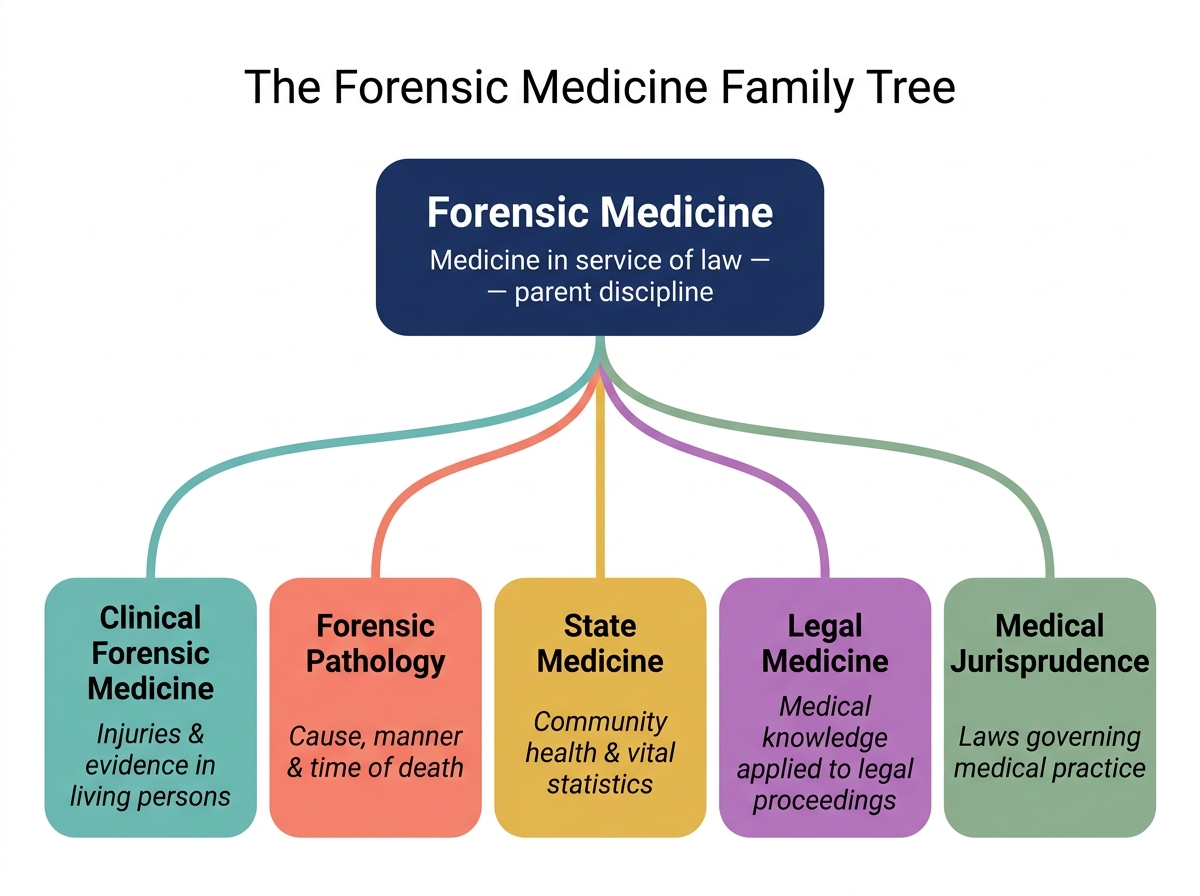
The Five Sub-disciplines of Forensic Medicine
| Discipline | Primary Focus | Who Is Examined | Typical Output |
|---|---|---|---|
| Forensic Medicine | Medicine in service of law (parent discipline) | Living patients or deceased | Any medicolegal document |
| Clinical Forensic Medicine | Injuries and evidence in living persons | Living patients | Wound certificate, medicolegal report |
| Forensic Pathology | Cause, manner, and time of death | Deceased | Post-mortem certificate, autopsy report |
| State Medicine | Community health, vital statistics | Populations | Mortality/morbidity data, public health orders |
| Legal Medicine | Medico-legal aspects of clinical practice | Patients + practitioners | Expert opinion, regulatory compliance |
| Medical Jurisprudence | Rights, duties, ethics of medical practitioners | Practitioners | Ethical guidance, legal standards |
SELF-CHECK
A doctor examines a rape survivor at the emergency department, documents her injuries, collects forensic samples, and issues a formal medicolegal report for police. Under which sub-discipline of forensic medicine does this work primarily fall?
A. Forensic Pathology
B. Clinical Forensic Medicine
C. Medical Jurisprudence
D. State Medicine
Reveal Answer
Answer: B. Clinical Forensic Medicine
Clinical Forensic Medicine specifically covers the examination and documentation of living patients for legal purposes, including injury assessment and evidence collection in assault and sexual violence cases. Forensic Pathology deals with the dead; Medical Jurisprudence focuses on the legal rights and duties of practitioners; State Medicine addresses community and population health.
Historical Milestones: From Ancient Texts to Modern Forensics
Provided image
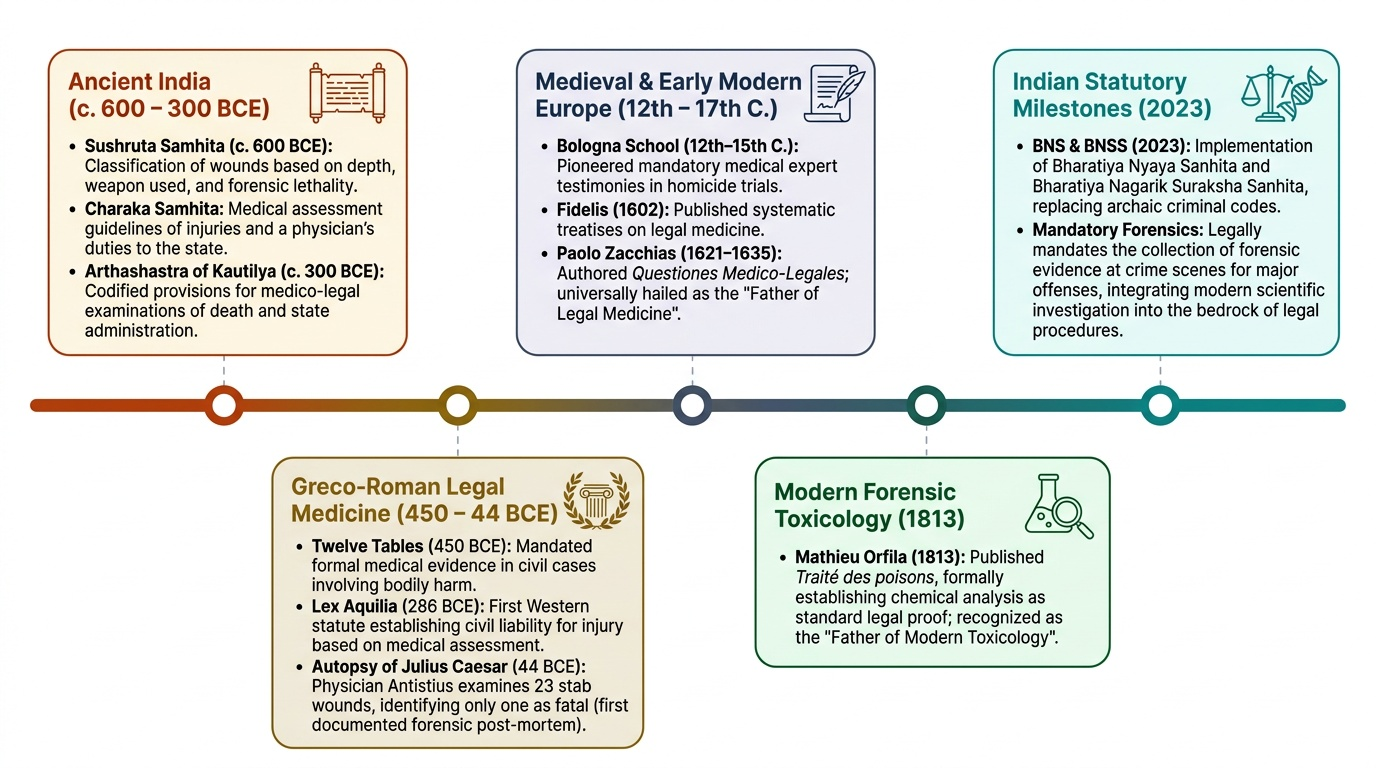
The history of forensic medicine is essentially the history of the relationship between organised society and the medical profession — a relationship as old as written civilisation. Understanding this history helps explain why current statutes are structured as they are, and why certain concepts (such as the distinction between criminal and civil liability, or the role of the doctor as an expert rather than an ordinary witness) are enshrined in law.
Ancient Foundations
The earliest recorded intersection of medicine and law appears in ancient India. The Arthashastra of Kautilya (c. 300 BCE) contains provisions about medico-legal examinations of the dead and prescribes the duties of physicians in state administration. The Sushruta Samhita (c. 600 BCE) describes the classification of wounds in terms that have medico-legal relevance — distinguishing wounds by their depth, their weapon, and their likely lethality. The Charaka Samhita similarly discusses the medical assessment of injury and the doctor's obligations to the king's court.
In ancient Rome, the Twelve Tables (450 BCE) contained provisions requiring medical evidence in cases involving bodily harm. The lex Aquilia (286 BCE) was the first Roman statute to establish civil liability for bodily injury, requiring medical assessment to determine the extent of damage — making Roman physicians the earliest documented forensic witnesses in the Western tradition. Julius Caesar's autopsy (44 BCE), reportedly performed by the physician Antistius, is often cited as the first documented post-mortem examination for forensic purposes. Antistius reportedly identified 23 stab wounds and concluded that only one was fatal — a finding that was submitted to the Roman Senate.
Medieval and Early Modern Developments
The systematic application of medicine to legal investigation developed significantly in medieval Europe. The Bologna school in Italy (12th–15th century) pioneered the formal use of medical experts in legal proceedings; Bologna was the first European city to require medical testimony in homicide trials. Fortunatus Fidelis (1602) and Paolo Zacchias (1621–1635, Questiones Medico-Legales) produced the first systematic treatises on legal medicine in the modern sense. Zacchias in particular is recognised as the 'Father of Legal Medicine' in the Western tradition — his seven-volume work addressed every aspect of the physician's legal obligations.
In 1597, Codronchi published Methodus Testificandi, one of the earliest practical manuals for physicians appearing as witnesses. The 17th and 18th centuries saw increasing formalisation of medicolegal practice across European legal systems.
The Founding of Modern Forensic Science
Mathieu Joseph Bonaventure Orfila (1787–1853) is universally recognised as the 'Father of Modern Forensic Toxicology.' His landmark work Traité des Poisons (1813) established toxicology as a scientific discipline with legal applications, providing systematic methods for detecting poisons in body tissues. Orfila's testimony in the Lafarge case (1840) — in which he used chemical analysis to prove arsenic poisoning — became a defining moment in the use of scientific evidence in courts.
Rudolf Virchow (1821–1902) transformed forensic pathology through his insistence on microscopic histological examination of tissues at autopsy. His cellular pathology framework provided forensic pathologists with tools to determine cause of death at a tissue level — distinguishing, for example, antemortem from postmortem injuries, or natural disease from traumatic death.
In India, the British administration formalised medico-legal practice through codified statutes. The Indian Penal Code 1860 (IPC) introduced specific provisions on injury, homicide, sexual assault, and negligence. The Code of Criminal Procedure 1973 (CrPC) governed the procedural framework for medical evidence, including provisions for inquest and post-mortem. These two instruments governed forensic medical practice in India for over 150 years.
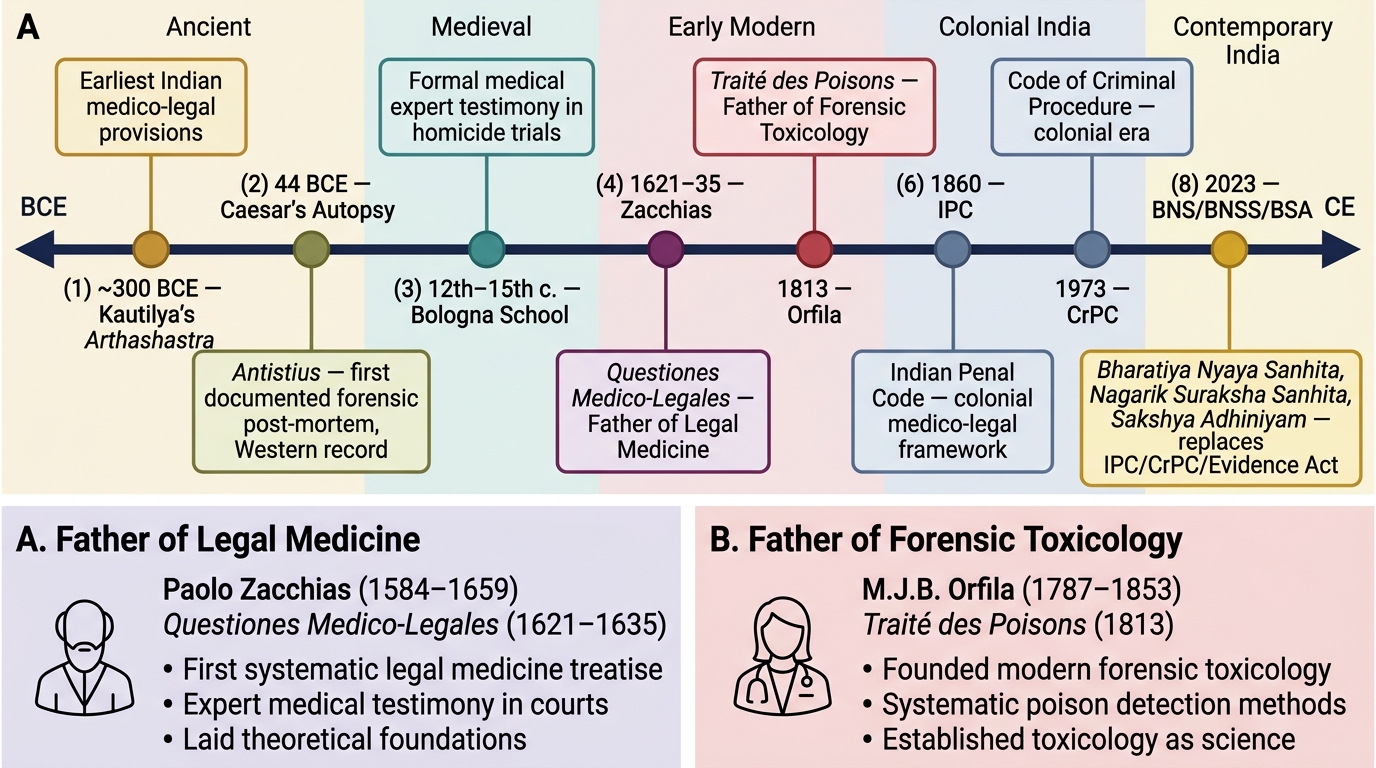
History of Forensic Medicine: Ancient Roots to Modern Indian Statutes
Key Historical Milestones in Summary:
- Kautilya's Arthashastra (c. 300 BCE): earliest Indian medico-legal provisions
- Caesar's autopsy by Antistius (44 BCE): first documented forensic post-mortem, Western record
- Bologna school (12th–15th century): formal medical expert testimony in homicide trials
- Zacchias, Questiones Medico-Legales (1621–1635): first systematic legal medicine treatise; Zacchias = 'Father of Legal Medicine'
- Orfila, Traité des Poisons (1813): founding of modern forensic toxicology; Orfila = 'Father of Forensic Toxicology'
- IPC 1860, CrPC 1973: India's colonial-era medico-legal statutory framework
- BNS, BNSS, BSA 2023: India's current criminal statutes replacing IPC/CrPC/Evidence Act
SELF-CHECK
Who is recognised as the 'Father of Modern Forensic Toxicology,' and what landmark work established this recognition?
A. Paolo Zacchias — Questiones Medico-Legales (1621)
B. Rudolf Virchow — Cellular Pathology (1858)
C. Mathieu Joseph Bonaventure Orfila — Traité des Poisons (1813)
D. Fortunatus Fidelis — De Relationibus Medicorum (1602)
Reveal Answer
Answer: C. Mathieu Joseph Bonaventure Orfila — Traité des Poisons (1813)
Orfila is universally recognised as the Father of Modern Forensic Toxicology. His 1813 treatise Traité des Poisons systematically established the science of detecting poisons in biological tissues for legal purposes. Zacchias is the Father of Legal Medicine (Western tradition); Virchow transformed forensic pathology through histology; Fidelis was an early systematiser but not the founding figure of toxicology.
The Doctor as Medicolegal Practitioner: Roles and Documentation
The definitions and history discussed above are not merely academic — they translate directly into concrete roles and documentation duties that every practising physician carries. In the Indian medicolegal system, the doctor operates in at least three distinct capacities, each governed by a different body of law and requiring a different type of documentation.
As a clinical examiner, the doctor is called upon to examine living patients who have been involved in trauma, assault, or other circumstances with legal implications. This role is governed by the provisions of the BNSS 2023 (which replaced the CrPC 1973) relating to the examination of persons accused or victims of offences. The key documentation outputs here are the wound certificate (describing injuries in precise medicolegal language), the drunkenness certificate, the assault examination report, and — in sexual violence cases — the standardised examination proforma mandated by national protocols. The examiner must record findings in real time, with contemporaneous notes that can later be produced in court. A finding recorded hours after the examination, or reconstructed from memory, is legally vulnerable.
As an expert witness, the doctor is expected to bring scientific knowledge to bear on questions that the court cannot resolve without specialised training. In this role, the physician is not a partisan witness for either prosecution or defence — their duty is to the court and to scientific truth. The qualification to serve as an expert witness under the Bharatiya Sakshya Adhiniyam (BSA) 2023 (formerly the Indian Evidence Act 1872) depends on the doctor's demonstrable expertise in the relevant field. Expert evidence most commonly arises in cases involving cause of death, nature of injuries, sexual assault, intoxication, age estimation, and professional negligence. The key documentation output is the expert opinion report, which must be logically structured, factually grounded, and clearly distinguish what the doctor observed from what they infer.
As a professional practitioner accountable under law, the doctor operates under the NMC Act 2020 (which replaced the IMC Act 1956), the Consumer Protection Act 2019 (which replaced the 1986 Act and brought medical services within its purview), and the Indian Medical Council (Professional Conduct) Regulations 2002. In this capacity the doctor's documentation — patient records, consent forms, operation notes, discharge summaries — is simultaneously a clinical tool and a legal document. Every entry in a medical record is potentially discoverable in litigation; every omission is a potential liability.
The practical implication of this three-fold role is that doctors need to maintain a 'medicolegal mindset' as a continuous professional habit, not only when called to examine a formal MLC case. The discipline of forensic medicine, as a subject in the medical curriculum, exists precisely to build this mindset before the doctor enters practice. Knowing which sub-discipline governs which scenario — and which statute sets the standard — is the foundation of safe, legally defensible medical practice.
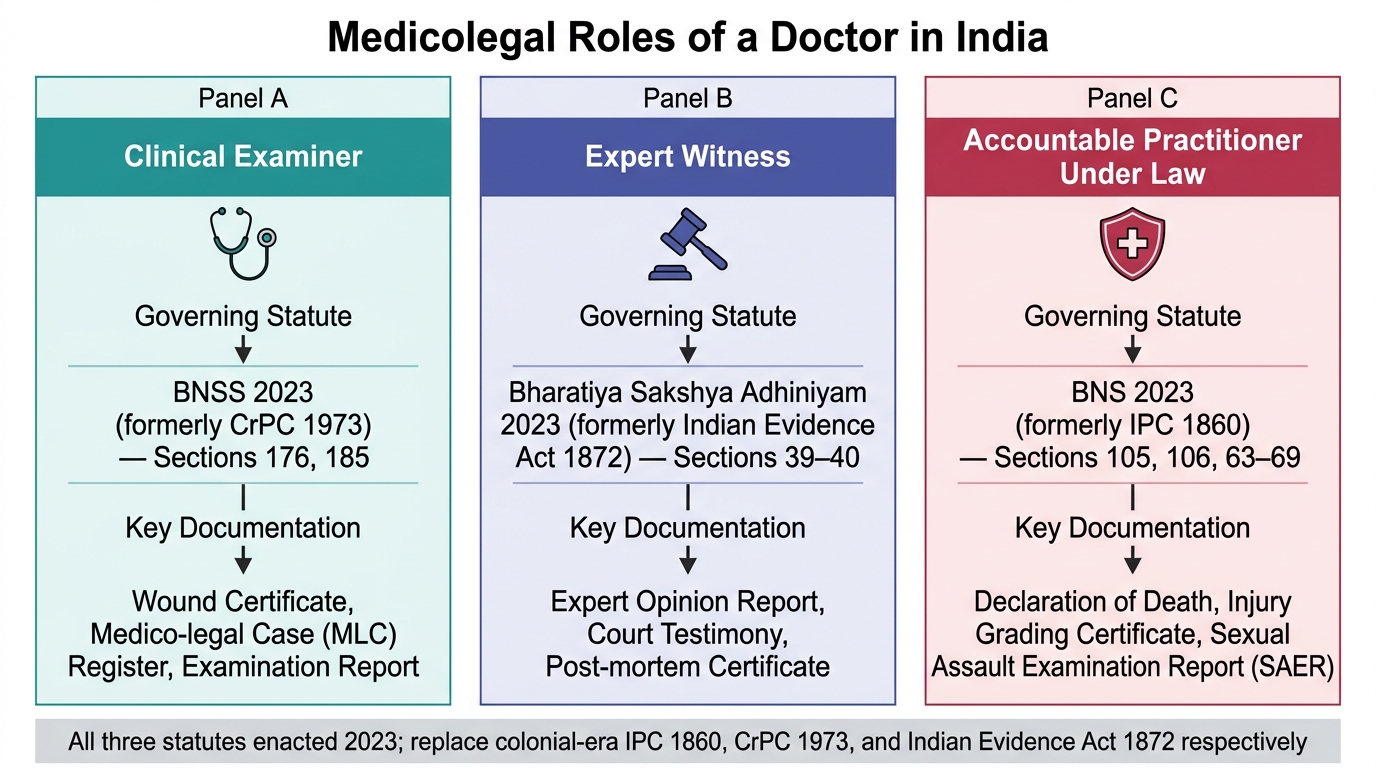
Three Medicolegal Roles of a Doctor: Governing Statutes and Documentation Outputs
The Indian Forensic Framework: Statutes and Their Evolution
India's forensic medical practice has been governed by a succession of statutes, the most important of which have recently undergone a fundamental revision. Understanding this statutory evolution is essential because references in older textbooks, court judgements, and institutional protocols may cite repealed legislation, and a doctor who applies superseded law in court exposes themselves to challenge.
The Colonial Era Framework (Pre-2023)
The foundation of Indian criminal law was the Indian Penal Code 1860 (IPC), enacted during British rule and modelled on the English criminal law of the time. The IPC contained the provisions most directly relevant to forensic medicine: sections defining culpable homicide (IPC 299) and murder (IPC 300), the gradations of hurt (simple hurt, IPC 319; grievous hurt, IPC 320), sexual assault (IPC 375, with its seven clauses), causing death by negligence (IPC 304A), and so forth. The Code of Criminal Procedure 1973 (CrPC) governed how criminal investigations and trials were conducted, including provisions for inquest (Section 174, CrPC), police requisition for medical examination, and the production of medical evidence. The Indian Evidence Act 1872 governed what kinds of evidence were admissible in court, including expert evidence from physicians.
The 2023 Reform: BNS, BNSS, and BSA
In 2023, the Indian Parliament enacted three new statutes that replaced the entire colonial-era criminal law framework:
- The Bharatiya Nyaya Sanhita (BNS) 2023 replaced the IPC 1860. It retains and renumbers the major offence categories relevant to forensic medicine. Doctors practising forensic medicine must now use BNS section numbers rather than the old IPC numbers in their reports and court testimony.
- The Bharatiya Nagarika Suraksha Sanhita (BNSS) 2023 replaced the CrPC 1973. It governs all matters of criminal procedure, including provisions for inquest, medical examination of accused and victims, and the conduct of trials involving medical evidence.
- The Bharatiya Sakshya Adhiniyam (BSA) 2023 replaced the Indian Evidence Act 1872. It governs the admissibility and weight of evidence, including expert medical testimony.
Other Key Statutes in the Indian Forensic Framework
Beyond the criminal law triad, forensic medicine in India is shaped by several domain-specific statutes:
- NMC Act 2020: Governs the registration, qualification standards, and professional conduct of medical practitioners. It replaced the IMC Act 1956 entirely — references to the 1956 Act in any current medicolegal context are outdated.
- Consumer Protection Act 2019: Brought medical services within the ambit of consumer protection, enabling patients to approach Consumer Disputes Redressal Commissions for compensation in medical negligence cases. It replaced the Consumer Protection Act 1986.
- POCSO Act 2012: The Protection of Children from Sexual Offences Act applies to any sexual offence against a person below 18 years of age, without exception. It imposes mandatory reporting obligations on doctors.
- MTP Act 1971 (amended 2021): Governs termination of pregnancy; the 2021 amendment extended the gestational limit from 20 to 24 weeks for certain categories including rape survivors and foetal anomalies.
- Mental Healthcare Act 2017: Governs the rights of persons with mental illness and replaced the Mental Health Act 1987.
A critical practical rule: always verify the current statute and its current section numbers before preparing any medicolegal report intended for court. Textbooks go out of date; statutes do not. When in doubt, consult the bare text of the Act as published on the Government of India's e-Gazette.
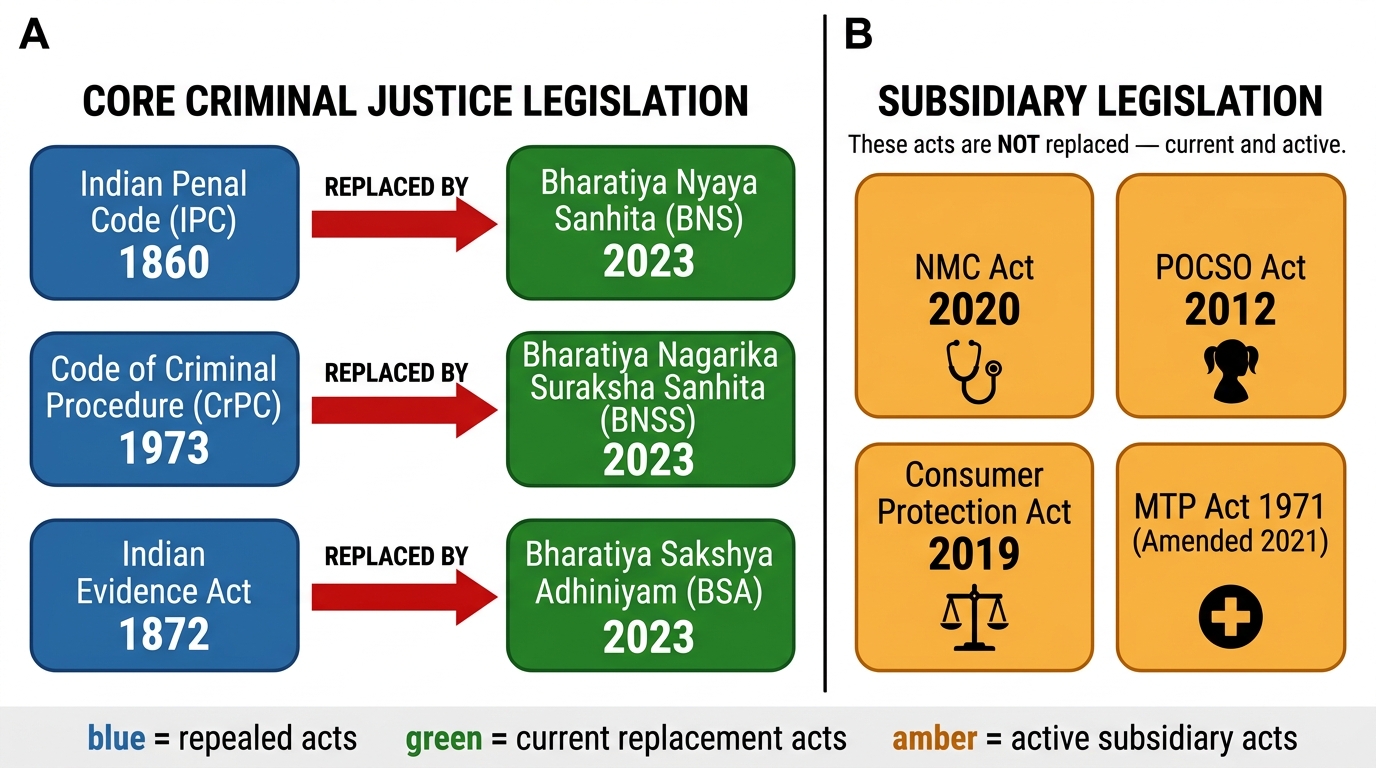
Indian Forensic Statutory Framework: Legislative Evolution and Current Acts
SELF-CHECK
Which statute enacted in 2023 replaced the Indian Penal Code 1860 and now governs the definition of offences such as culpable homicide, grievous hurt, and sexual assault in India?
A. Bharatiya Nagarika Suraksha Sanhita (BNSS)
B. Bharatiya Sakshya Adhiniyam (BSA)
C. Bharatiya Nyaya Sanhita (BNS)
D. NMC Act 2020
Reveal Answer
Answer: C. Bharatiya Nyaya Sanhita (BNS)
The Bharatiya Nyaya Sanhita (BNS) 2023 replaced the Indian Penal Code 1860. It defines criminal offences including culpable homicide, murder, hurt, grievous hurt, and sexual assault. The BNSS replaced the CrPC 1973 (criminal procedure); the BSA replaced the Evidence Act 1872 (evidence admissibility); the NMC Act 2020 governs medical registration and professional conduct.
CLINICAL PEARL
In your forensic medicine reports, always state the statute you are referencing and its year — not just the section number. Writing 'Section 304A' without specifying 'BNS 2023' or 'IPC 1860 (now repealed)' will cause confusion in court, because the section numbers have changed and the same number may refer to a different provision in the new statute. The safest practice is to write: 'In my opinion, the injury is consistent with grievous hurt as defined under the Bharatiya Nyaya Sanhita (BNS) 2023.' This specificity protects both the integrity of your report and your credibility as an expert.
KEY TAKEAWAYS
Forensic Medicine is the parent discipline applying medical knowledge to legal purposes. Its six recognised branches each occupy a distinct domain: Clinical Forensic Medicine (living patients and injury evidence), Forensic Pathology (cause and manner of death), State Medicine (community health and vital statistics), Legal Medicine (medico-legal aspects of clinical practice), and Medical Jurisprudence (the legal rights and duties of medical practitioners).
Historically, the discipline evolved from ancient Indian texts (Arthashastra, Sushruta Samhita) and Roman legal precedents through medieval Italian scholarship (Zacchias — Father of Legal Medicine), to the founding of modern forensic toxicology by Orfila (1813, Traité des Poisons) and the histopathological revolution of Virchow (19th century).
In India, the legal framework governing forensic medical practice has undergone its most significant reform in over a century with the enactment of the BNS, BNSS, and BSA in 2023, replacing the IPC 1860, CrPC 1973, and Indian Evidence Act 1872 respectively. Other critical statutes include the NMC Act 2020 (replacing IMC Act 1956), the Consumer Protection Act 2019, POCSO Act 2012, and the MTP Act 1971 (amended 2021).
Every doctor operates in three medicolegal capacities: as a clinical examiner, as an expert witness, and as a professional practitioner accountable under law. These roles are not incidental — they are part of the core duty of every registered medical practitioner.
REFLECT
You have just seen how forensic medicine maps onto your everyday clinical world — not as an exotic specialty but as a set of legal obligations embedded in every clinical encounter. Before you close this module, take a moment to consider: In the past month of clinical exposure (OPD, casualty, or ward), have you observed any situation that had a medicolegal dimension — a patient with unexplained injuries, a death requiring certification, a request from police, a consent issue? Which sub-discipline of forensic medicine would have governed that situation? And under which statute? Identifying these moments, even retrospectively, builds the 'medicolegal mindset' that will protect both your patients and your practice throughout your career.