Page 2 of 14
FM1.3-4 | Indian Legal System: Statutes & Courts — SDL Guide
Learning Objectives
- Describe the three principal criminal statutes of India (BNS 2023, BNSS 2023, BSA 2023) and their medicolegal significance, including their relationship to the earlier IPC/CrPC/Evidence Act framework
- Define and distinguish civil and criminal cases, and cognizable and non-cognizable offences, with examples relevant to medical practice
- Describe Police Inquest and Magistrate's Inquest — the governing statute, circumstances for each, and the doctor's documentation duties
- Describe the hierarchy of courts in India — Supreme Court, High Court, Sessions Court, Magistrate's Court, Labour Court, Family Court, Executive Magistrate Court, and Juvenile Justice Board — with their jurisdiction and powers relevant to forensic medicine
INSTRUCTIONS
When you receive a police requisition for a medicolegal examination, or when you are summoned to give evidence in court, the legal machinery behind that document involves multiple statutes and at least one of eight different types of court or tribunal. A doctor who cannot navigate this machinery is professionally vulnerable — they may give evidence in the wrong format, fail to appear before the right authority, or be found in contempt for not understanding the court's powers. This module provides the structural map of India's legal system as it applies to medical practice, with particular focus on the 2023 statutory reforms that have changed the landscape every practitioner must navigate.
References
- KSN Reddy — Essentials of Forensic Medicine & Toxicology (textbook)
- BV Subrahmanyam — Modi's Medical Jurisprudence and Toxicology (textbook)
Version 2.0 | NMC CBUC 2024
CLINICAL SCENARIO
It is 2 AM and you are the duty medical officer at a government hospital. A patient who was brought in following a road traffic accident dies in your casualty department within an hour of arrival. Within minutes, the duty police constable arrives and asks you to hand over the body for a 'panchanama.' The station house officer calls to ask whether this is a case requiring a 'Magistrate's Inquest' or if he can proceed with the routine police inquest. The next morning, a different police officer brings a requisition asking you to examine a 22-year-old woman who alleges sexual assault — you note she is accompanied by her 15-year-old younger sister who may also have been assaulted. The following week, you receive a summons addressed to 'The Medical Officer' from the Sessions Court, directing you to appear and produce documents. And two weeks later, the Labour Court sends a notice in connection with an occupational disease claim by a former factory worker your hospital treated. Four cases. Four different legal contexts. Four different courts or authorities. Each governed by a different statute. This module provides the framework to navigate all four — correctly, legally, and with professional confidence.
WHY THIS MATTERS
The legal system is not a distant, abstract institution — for a practising physician in India, it is an ever-present professional environment. Every medicolegal case, every death certificate, every injury report, and every patient with POCSO implications touches a specific statute and a specific court or authority. Since 2023, the three new criminal statutes (BNS, BNSS, BSA) have completely replaced the colonial-era framework that most existing textbooks describe — meaning that every forensic medicine reference citing IPC sections or CrPC provisions now requires translation to the new statutory language. Learning the current framework from the outset prevents the professional embarrassment of citing repealed law in court, and more importantly, ensures that your clinical documentation meets the legal standards of admissibility under the BSA 2023.
RECALL
From your previous SDL on definitions and history, you learned that India's criminal law framework was overhauled in 2023 with the BNS, BNSS, and BSA replacing the IPC, CrPC, and Evidence Act respectively. You also know from general knowledge that India has a hierarchical judicial system with the Supreme Court at the apex. From your community medicine orientation, you will be familiar with the term 'inquest' in the context of unexplained deaths — now we will give it a precise legal definition. Bring to mind also your understanding of 'minors' and 'consent' from your medical ethics sessions — the concept of age as a legal threshold will be directly relevant when we discuss the Juvenile Justice Board and POCSO.
Statutes Governing Criminal Medico-legal Practice
Provided image
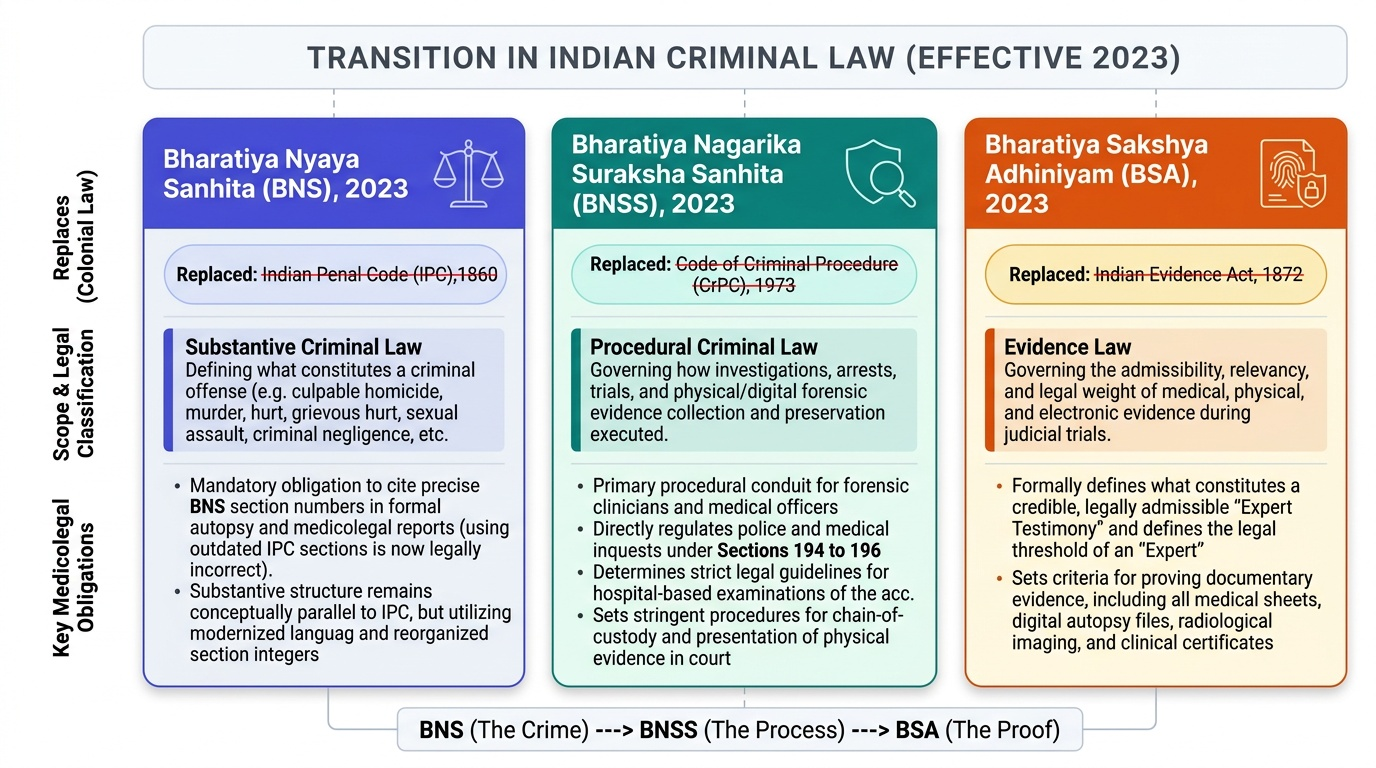
India's criminal legal framework, which directly governs the doctor's medicolegal obligations, now rests on three foundational statutes enacted in 2023, which together replaced the entire colonial-era criminal law architecture. Understanding each statute's scope — and recognising that they are complementary, not overlapping — is the starting point for all forensic medical practice.
The Bharatiya Nyaya Sanhita (BNS) 2023 is the substantive criminal law statute. It defines what constitutes a criminal offence in India — the elements of culpable homicide, murder, hurt, grievous hurt, sexual assault, criminal negligence, and so on. The BNS replaced the Indian Penal Code (IPC) 1860. Forensic physicians must now cite BNS section numbers in their medicolegal reports; using IPC section numbers is formally incorrect, though courts will understand the reference during the transition period. The BNS retains the essential structure of the IPC but modernises language and reorganises sections.
The Bharatiya Nagarika Suraksha Sanhita (BNSS) 2023 is the procedural criminal law statute. It governs how criminal investigations and trials are conducted — how police investigate an offence, how a case reaches court, how suspects are arrested and produced, and how evidence is collected and preserved. The BNSS replaced the Code of Criminal Procedure (CrPC) 1973. For forensic medicine, the BNSS is particularly important because it contains the provisions governing inquest (Sections 194–196), requisition for medical examination of accused persons, and the procedures for producing medical evidence before courts.
The Bharatiya Sakshya Adhiniyam (BSA) 2023 is the evidence statute. It governs what types of evidence are admissible in Indian courts and how they are weighed. For physicians, the BSA is the statute that defines what makes expert testimony credible and admissible, how documentary evidence (medical records, certificates) is proved, and what an 'expert' means in the legal sense. The BSA replaced the Indian Evidence Act 1872.
Civil Cases versus Criminal Cases
A fundamental distinction the forensic physician must grasp is the difference between civil and criminal cases, because the doctor's role differs substantially between the two.
A criminal case involves an act that the state considers an offence against society as a whole. The state (through the prosecution) is one party; the accused is the other. The standard of proof is 'beyond reasonable doubt.' In a criminal case involving a medicolegal question — a homicide, an assault, a sexual offence — the doctor is typically called as an expert witness to assist the court in understanding the medical evidence. The proceedings are governed by the BNSS and the BNS.
A civil case involves a dispute between private parties — typically seeking compensation or remedy rather than punishment. Medical negligence claims, personal injury claims, and breach of contract in healthcare are civil matters. In a civil case, the standard of proof is 'balance of probabilities' (i.e., is it more likely than not?). The doctor may be called as a witness of fact (about what they did or observed) or as an expert (to opine on the standard of care). Consumer protection cases against doctors under the Consumer Protection Act 2019 are civil proceedings.
Cognizable versus Non-Cognizable Offences
Another critical distinction concerns the police's authority to act. A cognizable offence is one for which the police have the authority to arrest a suspect without obtaining a warrant from a magistrate, and to investigate without requiring a magistrate's order. Most serious offences relevant to forensic medicine — murder, culpable homicide, rape, grievous hurt — are cognizable. When a police officer brings you a requisition for a medicolegal examination in a cognizable case, the investigation is already underway under police authority.
A non-cognizable offence is one for which the police cannot arrest without a warrant and cannot investigate without a magistrate's direction. These are generally less serious offences — defamation, minor assault where the injury does not amount to grievous hurt. The practical forensic significance is that for non-cognizable offences, the impetus for a formal medicolegal examination may come from a private complaint rather than a police requisition, and the procedural pathway through court is different.
POCSO Act 2012
The Protection of Children from Sexual Offences (POCSO) Act 2012 is a special statute that applies to all sexual offences committed against persons below 18 years of age, with no exceptions. It is the statute that governs the examination and documentation of child victims of sexual assault. POCSO imposes a mandatory reporting obligation on doctors: any person (including a physician) who has knowledge of a sexual offence against a child must report it to the Special Juvenile Police Unit or local police under Section 19 of the Act. Failure to report is itself an offence under POCSO. When a child victim presents to a doctor, the examination must follow a standardised forensic protocol and the documentation must conform to POCSO requirements.
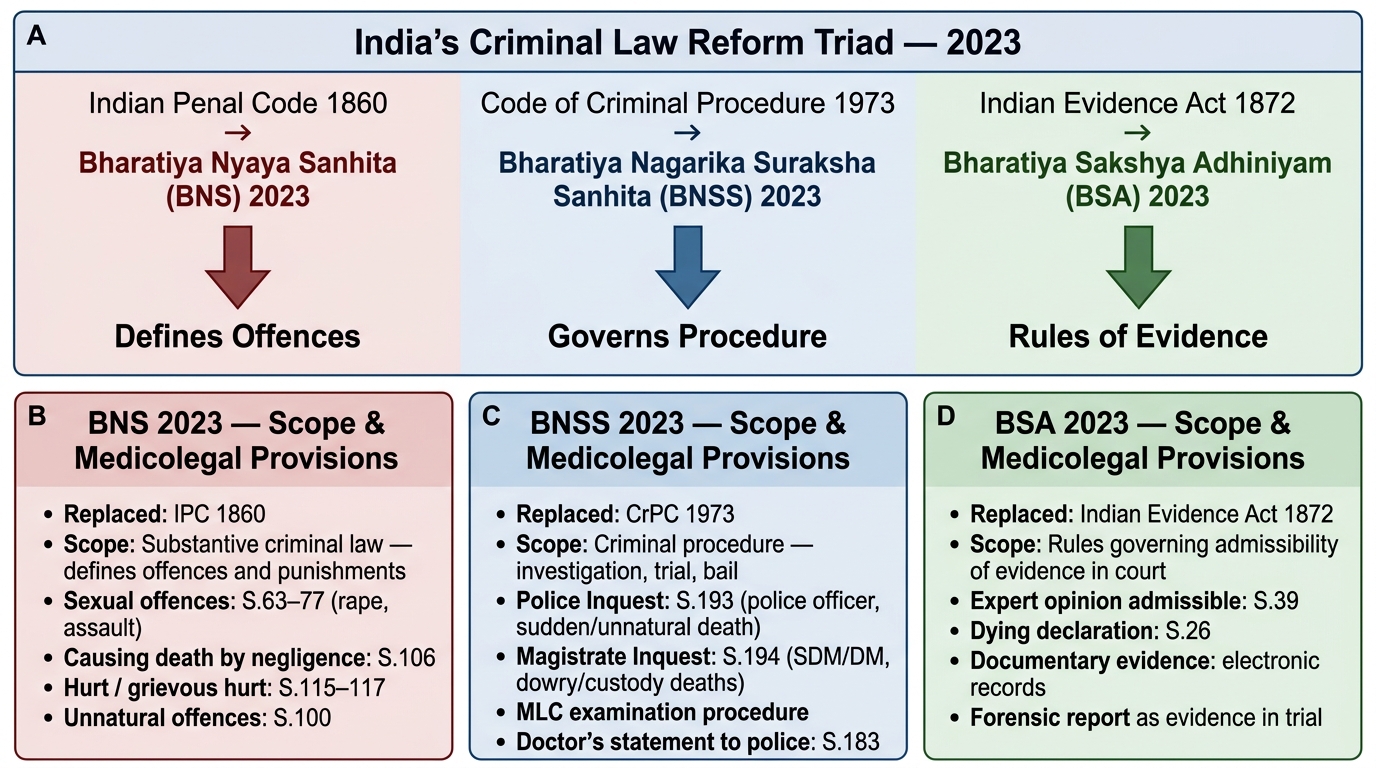
India's Criminal Law Triad 2023: BNS, BNSS & BSA — Replacement, Scope, and Medicolegal Provisions
SELF-CHECK
A 16-year-old girl presents to your hospital with injuries consistent with sexual assault. Her mother requests that the matter be kept confidential. Under which statute does the doctor have a mandatory obligation to report this case to police, regardless of the family's wishes?
A. Bharatiya Nyaya Sanhita (BNS) 2023
B. Bharatiya Nagarika Suraksha Sanhita (BNSS) 2023
C. Protection of Children from Sexual Offences (POCSO) Act 2012
D. Consumer Protection Act 2019
Reveal Answer
Answer: C. Protection of Children from Sexual Offences (POCSO) Act 2012
POCSO Act 2012 applies to all sexual offences against persons under 18, and Section 19 imposes a mandatory reporting obligation on any person — including doctors — with knowledge of such an offence. The family's request for confidentiality does not override this statutory duty. The BNS defines the offences; the BNSS governs procedure; POCSO creates the mandatory reporting obligation specific to child victims.
Inquest: Types, Authority, and the Doctor's Role
An inquest is a formal inquiry into the cause of a sudden, unnatural, suspicious, or violent death. In India, two types of inquest are legally recognised, governed by different sections of the BNSS 2023 and conducted by different authorities. The forensic physician's role differs at each type, and confusing them — or failing to appear when summoned for one — carries legal consequences.
The distinction between the two types of inquest is fundamentally about who conducts the inquiry and in what circumstances it is triggered. Both types may involve the doctor as an examiner and/or as a witness, but the legal weight of the proceedings and the doctor's formal obligations are different.
Police Inquest (BNSS Section 194)
The Police Inquest — formerly governed by Section 174 of the CrPC 1973, now by Section 194 of the BNSS 2023 — is conducted by a police officer (not below the rank of sub-inspector) when a death occurs that is sudden, unexplained, or in circumstances suggesting violence, self-harm, or accident. The police inquest is initiated by the police on their own authority; it does not require a magistrate's order. Its purpose is primarily to determine whether the death requires further criminal investigation — that is, whether a First Information Report (FIR) should be registered and a criminal case opened.
At the Police Inquest, the doctor is typically called upon to examine the body at the scene or at the mortuary and to give a preliminary opinion on the probable cause of death. This examination is distinct from a formal post-mortem autopsy — it is a surface examination intended to inform the initial police investigation. The doctor must record findings contemporaneously and issue a preliminary opinion on an official form. Crucially, the doctor cannot perform the definitive post-mortem until properly authorised; if the police inquest findings suggest unnatural death, the body is sent to the mortuary for a formal autopsy under BNSS provisions.
Magistrate's Inquest (BNSS Section 196)
The Magistrate's Inquest — formerly Section 176 of the CrPC, now Section 196 of the BNSS 2023 — is conducted by an Executive Magistrate (not a Judicial Magistrate) and is mandatory in four specific circumstances:
1. Death of a person in police custody or in prison
2. Death of a woman within seven years of marriage (where dowry death is alleged)
3. Death of a woman where the circumstances suggest rape or unnatural death
4. Death involving any other specified circumstance that requires independent magisterial scrutiny
The Magistrate's Inquest carries greater legal formality than the Police Inquest. The Executive Magistrate summoning it has the authority to examine witnesses on oath, call for medical evidence, and record findings as an official judicial document. The doctor's involvement here may include both the performance of the post-mortem examination and appearance before the magistrate to give formal evidence. The doctor's report must be prepared to the standard of a court document — accurate, legible, signed, and dated — because the findings may be directly used in subsequent criminal proceedings.
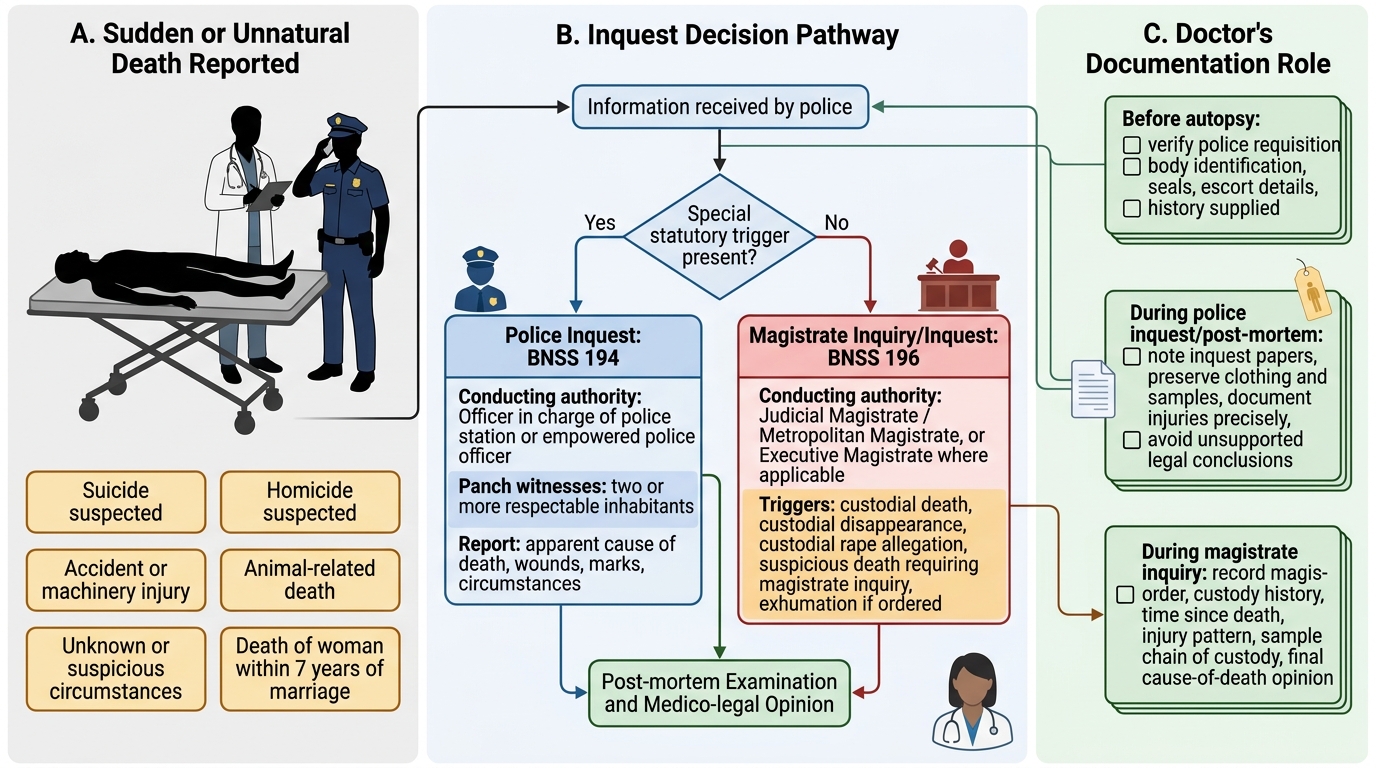
Inquest Decision Process in Sudden or Unnatural Death
| Feature | Police Inquest | Magistrate's Inquest |
|---|---|---|
| Governing section (BNSS 2023) | Section 194 | Section 196 |
| Authority | Police officer (≥ Sub-Inspector) | Executive Magistrate |
| Trigger | Any sudden/unexplained/violent death | Custody death, dowry death, woman's death in specified circumstances |
| Purpose | Determine need for FIR and criminal investigation | Independent judicial inquiry; findings used in criminal proceedings |
| Doctor's role | Preliminary surface examination, preliminary cause-of-death opinion | Post-mortem + formal evidence on oath before magistrate |
| Legal weight | Preliminary; can be superseded by subsequent proceedings | High — findings recorded as official judicial document |
SELF-CHECK
A 32-year-old woman is found dead in her matrimonial home three years after her marriage. Her parents allege dowry harassment. Which type of inquest is mandatorily required, and under which BNSS section?
A. Police Inquest under BNSS Section 194
B. Magistrate's Inquest under BNSS Section 196
C. Judicial Magistrate's Inquest under BNSS Section 198
D. Either type, at the discretion of the District Collector
Reveal Answer
Answer: B. Magistrate's Inquest under BNSS Section 196
Death of a woman within seven years of marriage where dowry death is alleged is one of the specific circumstances that mandates a Magistrate's Inquest under BNSS Section 196 (formerly CrPC Section 176). This is conducted by an Executive Magistrate, not police. The Police Inquest under Section 194 is for general unexplained deaths; there is no BNSS Section 198 inquest provision.
The Hierarchy of Courts in India
India's judicial system is organised as a hierarchy, with each level having defined jurisdiction and powers. Understanding this hierarchy is essential for the forensic physician because the type of court in which a case is heard determines the format of evidence required, the powers the court can exercise over the doctor as a witness, and the seriousness of the proceedings. A doctor who confuses a Sessions Court with a Magistrate's Court, or fails to recognise that a Labour Court is an entirely different tribunal, may commit procedural errors with professional and legal consequences.
The hierarchy runs from the highest constitutional court at the apex to specialised tribunals at the base, and a case may move upward through the hierarchy on appeal.
Supreme Court of India
The Supreme Court is the apex court of India, established under Articles 124–147 of the Constitution. It exercises three categories of jurisdiction: original jurisdiction (in disputes between States or between a State and the Union), appellate jurisdiction (hearing appeals from High Courts in civil, criminal, and constitutional matters), and advisory jurisdiction (providing opinions to the President on constitutional questions). The Supreme Court's decisions bind all courts and tribunals in India. In the forensic medicine context, landmark Supreme Court judgements have shaped the standards for DNA evidence, the rights of rape survivors, the admissibility of narco-analysis, and the liability of hospitals in negligence cases.
High Court
Each State (and certain Union Territories) has a High Court, which is the highest court in that state's jurisdiction. High Courts exercise original civil jurisdiction (in some states for high-value civil cases), original criminal jurisdiction (in specified matters), appellate jurisdiction over all subordinate courts, and the power to issue constitutional writs (habeas corpus, mandamus, certiorari, prohibition, quo warranto). For the forensic physician, the High Court is most frequently relevant in habeas corpus proceedings (where the liberty of a person detained is challenged), in criminal revision petitions, and in constitutional challenges to medicolegal procedures.
Sessions Court
The Sessions Court is the principal criminal court at the district level. It is presided over by the Sessions Judge, who is a judicial officer. The Sessions Court has original jurisdiction to try the most serious criminal offences — those punishable with imprisonment for more than seven years, including life imprisonment or death. Murder, culpable homicide, rape, and kidnapping are tried at the Sessions Court level (or committed to it from the Magistrate's Court). The forensic physician most commonly gives formal expert testimony before the Sessions Court in homicide and sexual assault cases. Sessions Court proceedings are formal and recorded verbatim.
Magistrate's Court
The Magistrate's Court is the most common court with which a forensic physician will interact. Magistrates are judicial officers who exercise first-class or second-class criminal jurisdiction. First-class Magistrates can sentence accused persons to imprisonment of up to three years and/or fines. Most criminal cases begin at the Magistrate's level — the police present the chargesheet here, the magistrate decides whether to commit the case to Sessions, and the magistrate conducts initial hearings. The forensic physician is most commonly summoned to the Magistrate's Court to verify medicolegal documents, give preliminary depositions, and identify exhibits (such as the original wound certificate or post-mortem report).
Specialised Courts and Tribunals
Beyond the primary criminal hierarchy, India maintains several specialised forums whose jurisdiction intersects with medical practice:
- The Labour Court adjudicates disputes arising under labour legislation — including claims of occupational disease, industrial injury, and workplace health violations. Medical officers of hospitals or factories may be called to give evidence on occupational health matters. Labour Courts derive their jurisdiction from the Industrial Disputes Act 1947 and other labour statutes.
- The Family Court adjudicates matrimonial and family disputes under the Family Courts Act 1984 — including divorce, maintenance, custody, and succession matters. The forensic physician may be called to give evidence in Family Court on matters such as paternity (DNA evidence), capacity to consent to marriage, domestic violence injuries, and age estimation in contested cases.
- The Executive Magistrate Court exercises executive rather than judicial functions. The Executive Magistrate is a government officer (not a member of the judicial services) who has statutory powers under the Code of Executive Procedure and the BNSS — including the authority to conduct Magistrate's Inquests (Section 196 BNSS), to make preventive orders under public safety provisions, and to issue orders for the production of bodies for examination.
- The Juvenile Justice Board (JJB) is constituted under the Juvenile Justice (Care and Protection of Children) Act 2015. It deals with children in conflict with law — that is, persons below 18 years of age at the time of the alleged offence. The JJB is not a criminal court in the conventional sense; it takes a rehabilitation-oriented approach. However, for heinous offences (defined as offences punishable with imprisonment ≥ 7 years), the JJB may decide to try a child aged 16–17 years as an adult, in which case the matter is transferred to the Sessions Court. The forensic physician's most frequent role before the JJB is in age estimation — determining whether a person alleged to be a juvenile actually falls below the statutory threshold of 18 years.
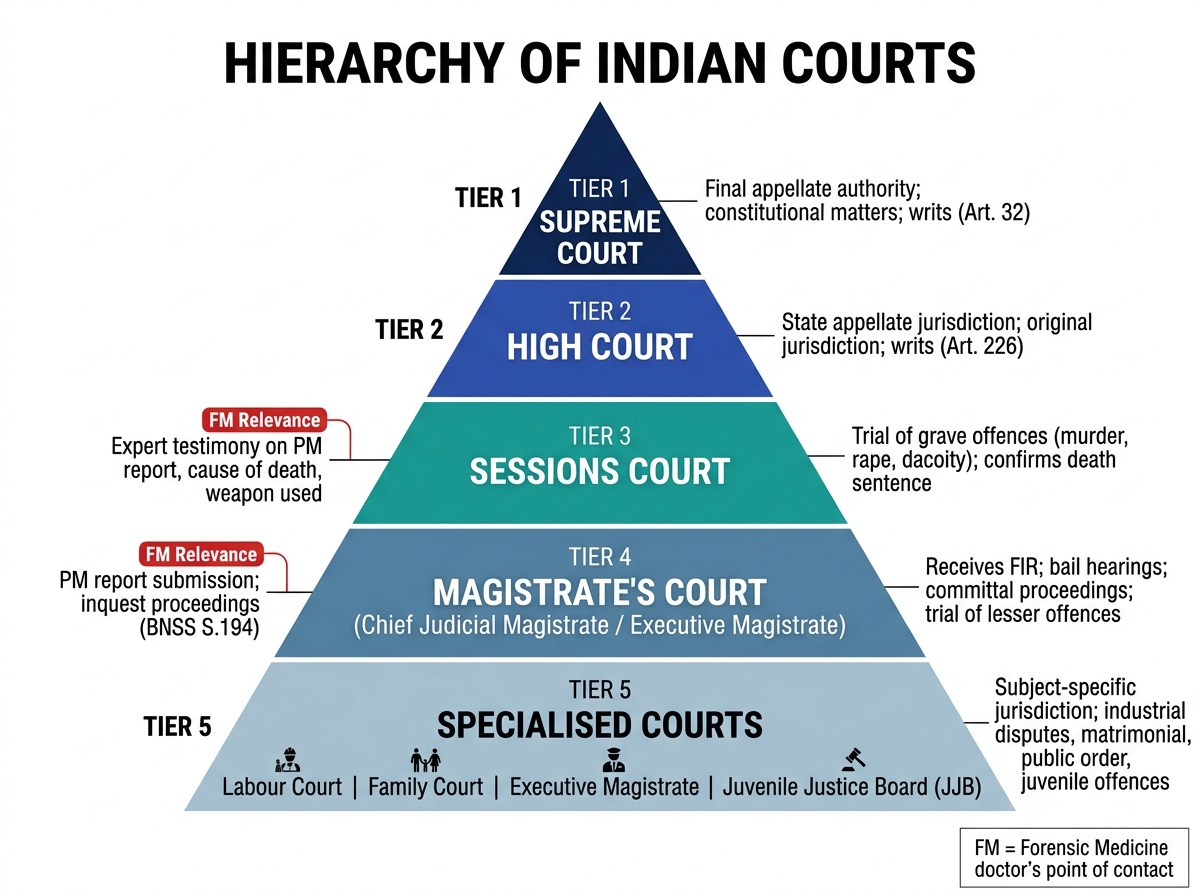
Hierarchy of Indian Courts with Medico-legal Relevance
The Doctor Before the Courts: Statutory Framework in Action
Having mapped the statutes and the courts separately, the forensic physician needs to understand how they interact in practice — which court handles which medicolegal scenario, which statute governs, and what the doctor's specific obligations are in each combination. Three common scenarios illustrate the operational framework.
Scenario 1: Homicide investigation
A patient brought to your casualty department after a suspected assault dies within 24 hours. The Police Inquest (BNSS Section 194) begins immediately, and you provide a preliminary examination report. The body is sent for post-mortem. Once the post-mortem report confirms homicidal violence, the police register an FIR under BNS provisions (the relevant BNS sections governing murder or culpable homicide). The chargesheet is filed before the Magistrate's Court, which commits the case to the Sessions Court for trial. You will be summoned by the Sessions Court to give expert testimony — identifying your post-mortem report, explaining your findings on cause of death, estimating the time of death, and giving your opinion on the weapon used. Your evidence is governed by the BSA 2023 provisions on expert evidence, and the court can compel your attendance and examine you on oath.
Scenario 2: POCSO case involving a minor
A 14-year-old child is brought to your hospital having alleged sexual assault by a family member. Your first obligation under POCSO Section 19 is mandatory reporting to the Special Juvenile Police Unit within 24 hours. Your examination must follow the POCSO-mandated examination protocol. The accused — if an adult — will be tried before the Sessions Court under the BNS and POCSO combined provisions. If the accused is below 18, the case begins before the Juvenile Justice Board. If the JJB finds the offence is heinous and the accused is 16–17 years old, it may transfer to Sessions Court for adult trial. In either path, you will be called to give evidence on the examination findings, the medical evidence of assault, and any forensic samples collected.
Scenario 3: Medical negligence — consumer forum vs civil court
A patient files a complaint alleging that surgical negligence at your hospital caused permanent disability. This is a civil matter. Under the Consumer Protection Act 2019, the patient may file before the appropriate Consumer Disputes Redressal Commission (district, state, or national level, based on the claim value). Alternatively, they may file a civil suit before the civil court (which has a separate hierarchy parallel to the criminal courts). In either forum, you will be called as a witness of fact about the treatment rendered, and an independent medical expert may also be called to opine on the standard of care. The NMC Act 2020 and professional conduct regulations set the standard against which your actions are measured. The standard of proof is 'balance of probabilities,' and the Consumer Forum can award compensation without requiring criminal intent to be proved.
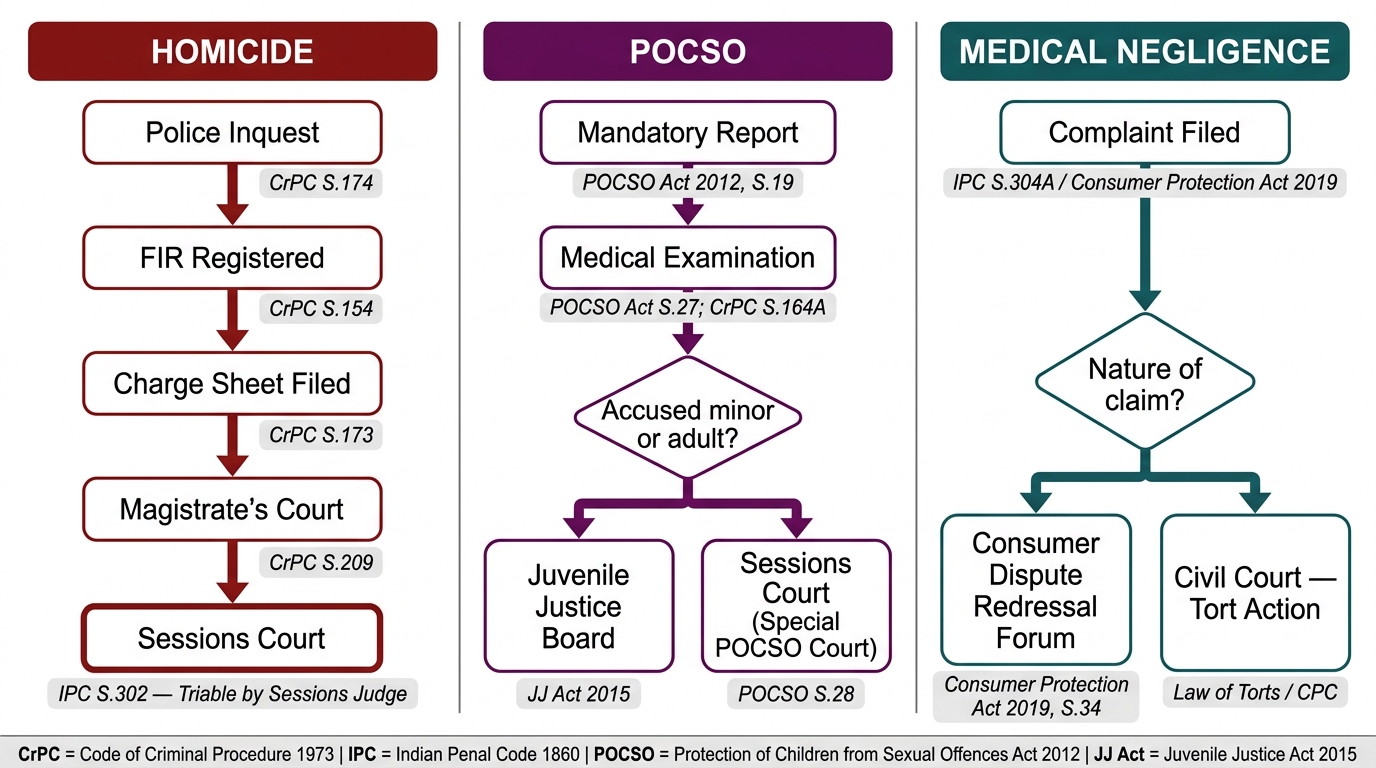
Three Medico-Legal Pathways: Jurisdiction, Procedure, and Governing Statutes
These scenarios make clear that the doctor cannot function in forensic medicine without knowing which court has jurisdiction, which statute defines the offence and the procedure, and what their specific documentation and testimony obligations are in each forum. This knowledge is not peripheral — it is the operational framework of medicolegal practice.
SELF-CHECK
A forensic physician is summoned to give expert testimony about post-mortem findings in a murder trial. Before which court will this evidence most likely be given?
A. Executive Magistrate Court
B. High Court
C. Sessions Court
D. Juvenile Justice Board
Reveal Answer
Answer: C. Sessions Court
Murder is an offence triable by the Sessions Court in India, as it carries the maximum punishment of death or life imprisonment (well above the 7-year threshold for Sessions jurisdiction). The forensic physician gives expert testimony at the Sessions Court level in murder and culpable homicide cases. The Executive Magistrate Court handles inquest proceedings; the High Court hears appeals; the Juvenile Justice Board deals with child offenders.
CLINICAL PEARL
When you receive a court summons, the first thing to check is the heading: which court has issued it? A summons from the Sessions Court carries different weight — and different penalties for non-compliance — than one from the Magistrate's Court or the Executive Magistrate. A summons from the Sessions Court cannot be ignored or rescheduled without the court's leave; failure to appear can result in a warrant, contempt proceedings, or both. Always keep the original summons, note the date, time, and court name, and if you have a clinical commitment that genuinely prevents attendance, seek an adjournment in writing to the court — not just to the police or the requester.
KEY TAKEAWAYS
India's criminal law framework now rests on three 2023 statutes: the BNS (substantive offences, replacing IPC 1860), the BNSS (criminal procedure, replacing CrPC 1973), and the BSA (evidence, replacing Evidence Act 1872). For forensic physicians, civil and criminal cases involve different parties, standards of proof, and doctor roles. Cognizable offences (murder, rape, grievous hurt) allow police to arrest and investigate without a warrant; non-cognizable offences do not. The POCSO Act 2012 imposes mandatory reporting of any sexual offence against a person under 18 years.
Inquest is the formal inquiry into unnatural death: the Police Inquest (BNSS Section 194) is conducted by police for general sudden deaths; the Magistrate's Inquest (BNSS Section 196) is conducted by an Executive Magistrate and is mandatory for custody deaths, dowry deaths, and deaths of women in specified circumstances.
India's court hierarchy from apex to base: Supreme Court → High Court → Sessions Court (serious crimes, >7-year sentences) → Magistrate's Court (most first-instance criminal proceedings). Specialised forums — Labour Court, Family Court, Executive Magistrate Court, and Juvenile Justice Board — handle domain-specific matters. Expert medical testimony in homicide cases is given before the Sessions Court; JJB involves the doctor primarily in age estimation; consumer forum handles medical negligence claims under the Consumer Protection Act 2019.
REFLECT
In your clinical placements so far, have you encountered any situation where a patient or their family interacted with police, lawyers, or courts in connection with their medical care? Think about the hierarchy you have now learned — which court would have been involved, and which statute would have governed? If you cannot yet identify a real example, imagine the following: a patient presents with a fracture after alleged domestic assault. Map out the entire legal pathway from the casualty examination to the potential trial, identifying the statute that applies at each step, the type of inquest that might be required if the patient dies, and the court where the case would ultimately be tried. Building this mapping habit now will make you a fluent medicolegal practitioner when it matters.