Page 3 of 14
FM1.5-7 | Medical Evidence & Conduct in Court — SDL Guide
Learning Objectives
- Describe the procedure from receiving a court summons to taking the oath in the witness box, including the concept of conduct money
- Describe the types of witnesses in Indian courts and the examination sequence — examination-in-chief, cross-examination, re-examination, and court questions — with the rules governing each stage
- Explain the appropriate conduct of a medical officer in the witness box, and the consequences of improper conduct including the offence of perjury under BNS 2023
- Define dying declaration and dying deposition, distinguish them from each other, and state the exact conditions required for each to be legally valid under the Bharatiya Sakshya Adhiniyam 2023
INSTRUCTIONS
Every forensic physician eventually stands in the witness box. That moment is governed by precise legal rules — what you say, how you say it, what you are entitled to demand, and what constitutes a criminal offence on your part. This module walks through the entire court appearance sequence: from the summons that arrives at your hospital, through taking the oath, to answering examination and cross-examination, to avoiding the trap of perjury. It also covers two of the most legally significant documents in forensic medicine — the dying declaration and the dying deposition — which the doctor may be the sole person qualified to record when a magistrate is unavailable.
References
- KSN Reddy — Essentials of Forensic Medicine & Toxicology (textbook)
- BV Subrahmanyam — Modi's Medical Jurisprudence and Toxicology (textbook)
Version 2.0 | NMC CBUC 2024
CLINICAL SCENARIO
You are a medical officer at a district hospital. At 10 PM, a 35-year-old man with severe burns covering 70% of his body surface area is brought in by police. He is conscious and coherent. He tells you, 'My wife set me on fire. I know I'm going to die. Please write down what I say.' The duty magistrate is not available; the nearest magistrate is 40 km away. You must decide: can you legally record his statement? Is it a dying declaration or a dying deposition? Does it require an oath? What must you certify about his mental state? What does the statement have to say to be legally valid? One week later you receive a court summons in a different case — an assault case from six months ago — asking you to appear before the Sessions Court and produce the original wound certificate. You have moved hospitals since then, and the certificate is in the records room of your old hospital. On arrival in court, the defence lawyer spends an hour asking whether your findings were consistent with self-inflicted injury, implying that your report was fabricated to support the prosecution. In each of these situations, knowing the law is not optional — it determines whether justice is served and whether you remain on the right side of it.
WHY THIS MATTERS
The courtroom is one of the most demanding professional environments a doctor will ever enter. Unlike the clinic or the mortuary, where the doctor controls the pace and format of their work, in the witness box the doctor is subjected to examination by lawyers who are trained to find inconsistencies and to challenge expert testimony. Without a clear understanding of the procedural rules — what each stage of examination is allowed to probe, what protections you have as a witness, and what constitutes criminal conduct on your part — a forensic physician can inadvertently damage a case, expose themselves to professional sanctions, or commit an offence. Equally, understanding the conditions for a valid dying declaration allows the doctor to act as a legal first responder when a magistrate is unavailable, preserving crucial evidence that may be the only record of a dying person's account of their own death.
RECALL
From the previous SDL, you learned that expert evidence is governed by the Bharatiya Sakshya Adhiniyam (BSA) 2023, and that the Sessions Court is the principal venue for serious criminal trials. Bring to mind the distinction between ordinary and expert witnesses that was introduced there — we will now give that distinction precise procedural content. From your communications skills teaching in Year 1, recall the concept of active listening and structured information-giving — these skills have direct application in the witness box. From your medical ethics sessions, recall the principles of honesty and veracity — in the courtroom, these principles have a statutory dimension: departing from them under oath is a criminal offence.
Entering the Witness Box: Summons, Conduct Money, and Oath
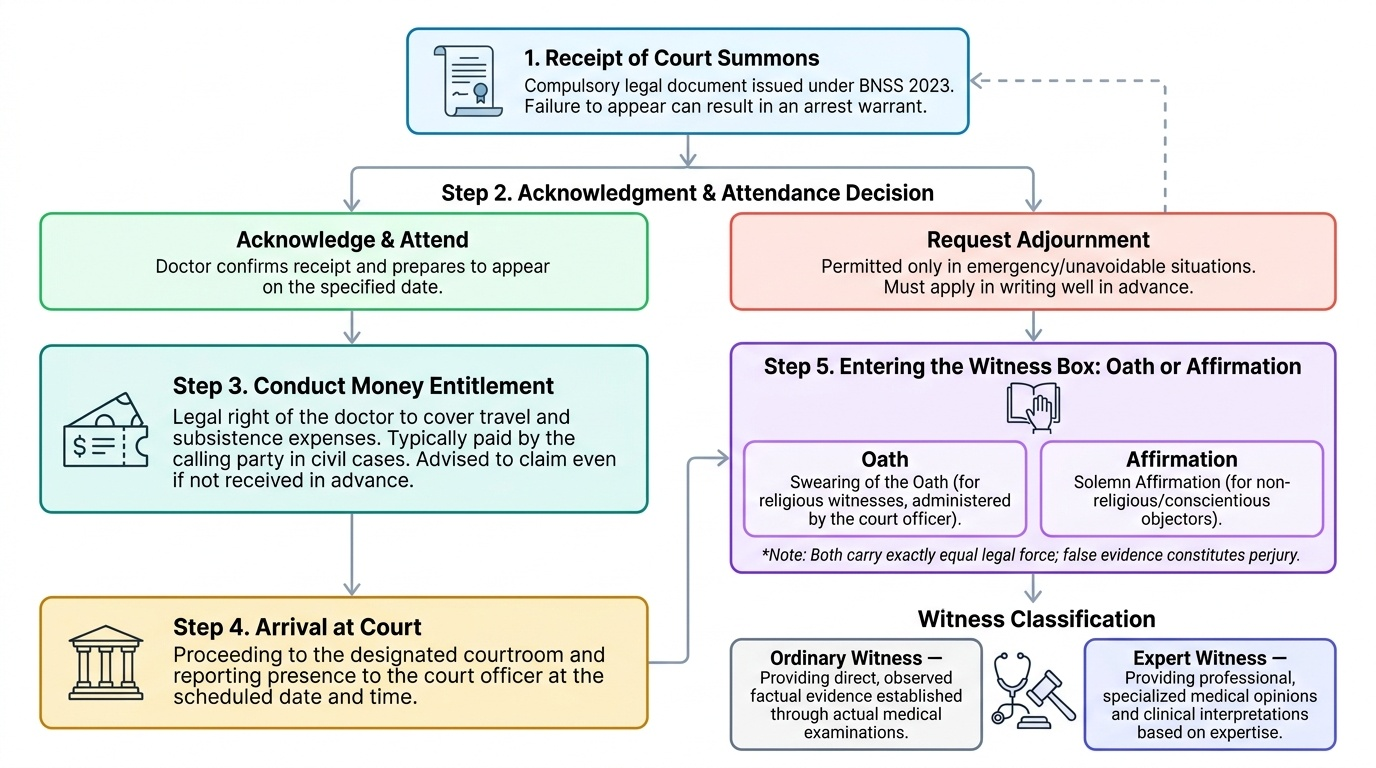
The doctor's journey to the witness box begins with the receipt of a court summons — a formal legal document issued by the court under the BNSS 2023 directing the doctor to appear at a specified date, time, and place. A summons is a compulsory document; it is not an invitation that the doctor may decline based on professional convenience. Failure to appear in response to a summons without lawful excuse constitutes contempt of court and can result in the issuance of a warrant of arrest. The doctor must acknowledge receipt of the summons, and if they cannot appear on the specified date (for example, because they are on duty in an emergency that cannot be covered), they must apply to the court in writing for an adjournment well in advance of the hearing date.
Alongside the summons, the court must provide conduct money — a sum to cover the witness's travel and subsistence expenses for the court appearance. Conduct money is the legal right of every witness, including doctors. A doctor is entitled to insist on the payment of conduct money before appearing in court; however, in practice, Indian courts do not always ensure payment in advance, and the doctor is well-advised to appear regardless and subsequently claim the amount. In civil cases, the party calling the doctor as a witness is typically responsible for paying conduct money.
On arrival in the witness box, the doctor is required to take an oath (if they are of a religious persuasion that supports swearing) or make an affirmation (if they object to taking an oath on religious or conscientious grounds). An affirmation has exactly the same legal force as an oath — both carry the penalty of perjury if the witness gives false evidence. The oath or affirmation is administered by the court officer and is witnessed by the judge or magistrate. After the oath or affirmation, the doctor is formally 'sworn in' and may give evidence.
The distinction between an ordinary witness (also called a witness of fact) and an expert witness is established before examination begins. An ordinary witness testifies only to what they personally perceived with their own senses — they cannot give opinions. An expert witness, by contrast, is permitted to give opinion evidence based on their specialised knowledge. Under BSA 2023 Section 45, courts may receive the opinions of experts on questions of science, art, or specialised knowledge. A forensic physician is typically called as an expert witness in criminal proceedings, meaning their examination-in-chief will include both factual evidence (what they found on examination) and expert opinion (what their findings imply about cause of death, nature of injury, etc.).
Provided image
Types of Witnesses and the Examination Sequence
Once in the witness box, the doctor's testimony proceeds through a structured sequence of examination stages, each governed by precise rules about what questions may be asked and what the witness is obliged to answer. Understanding this sequence is essential because the rules protect the witness from improper questioning and because deviating from proper answers at each stage can open the doctor to legal challenge.
The three recognised types of witnesses in Indian courts are: the ordinary witness (witness of fact, who testifies to perceived events), the expert witness (who gives opinion evidence on technical questions within their expertise), and the character witness (who gives evidence about the general reputation or character of a party — rarely called in Indian criminal proceedings). For the forensic physician, the usual role is that of expert witness, though in some cases they may also be a witness of fact (for example, a doctor who was present at the scene of an incident is both).
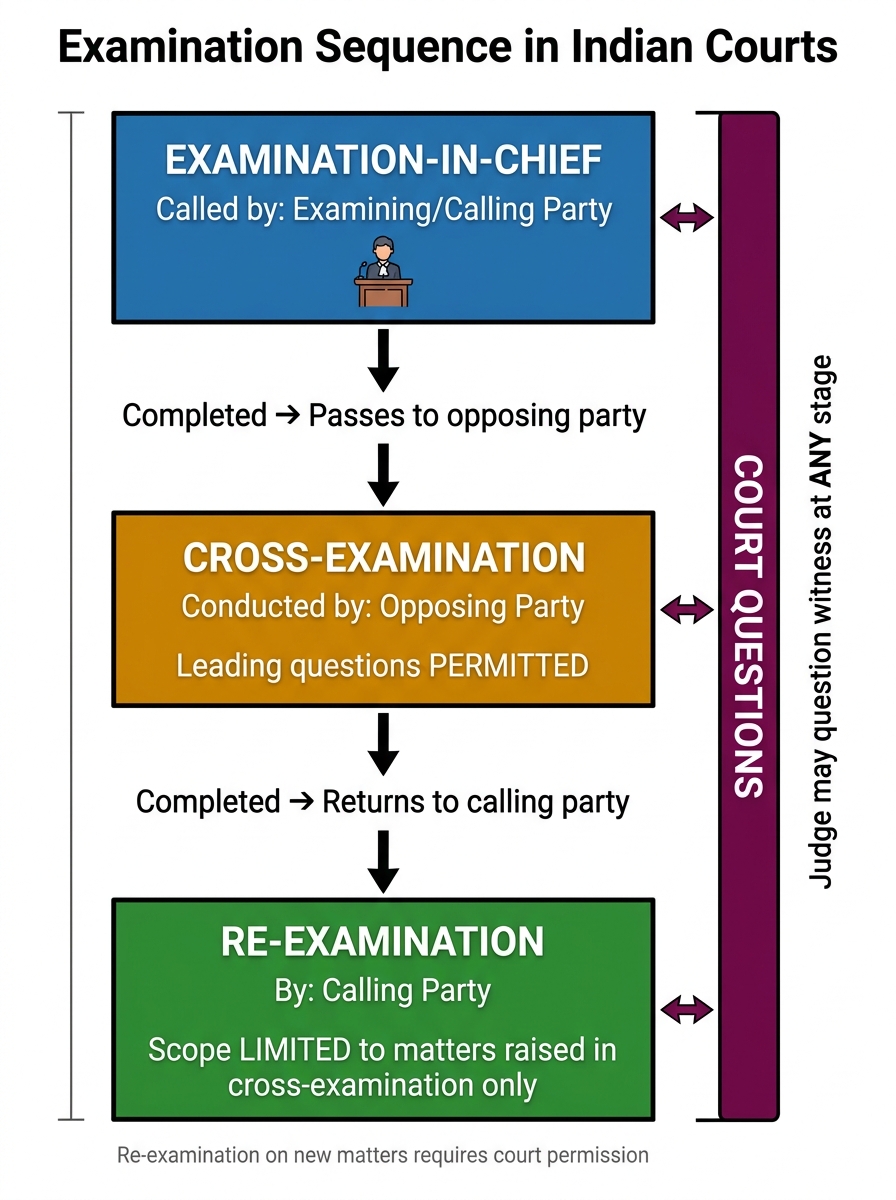
The examination sequence in Indian courts follows a fixed three-stage structure:
Examination-in-Chief
The examination-in-chief is conducted by the party — prosecution or defence — who called the witness. For a forensic physician called by the prosecution, the prosecution's lawyer conducts the examination-in-chief. Questions are open-ended; leading questions (questions that suggest the answer) are NOT permitted during examination-in-chief. The doctor should answer clearly, in non-technical language where possible, and should not volunteer information beyond what is asked. The examination-in-chief establishes the doctor's qualifications, the circumstances of the examination, and the findings and opinions that form the substance of the medical evidence.
Cross-Examination
After examination-in-chief, the opposing party has the right to conduct a cross-examination. Leading questions ARE permitted during cross-examination. The cross-examining lawyer may challenge the doctor's methodology, qualifications, observations, or conclusions; they may confront the doctor with alternative hypotheses; they may ask about matters not covered in the examination-in-chief if those matters are relevant to the case. The doctor must answer questions honestly and without evasion. If a question is not understood, the doctor may ask for clarification. If a question falls outside the doctor's area of expertise, the doctor may decline to answer on that basis, clearly stating: 'That is outside my area of expertise.' The doctor should never become adversarial or defensive — their role is to assist the court, not to win the case for either side.
Re-Examination
After cross-examination, the original calling party may conduct a re-examination. Re-examination is strictly limited to clarifying or explaining matters that arose during cross-examination; it cannot introduce entirely new topics. The purpose of re-examination is to allow the doctor to correct any misimpression created by the cross-examination.
Court Questions
At any stage of the proceedings, the judge or magistrate may put questions directly to the witness. These court questions are not subject to the restrictions on leading questions that apply to examination-in-chief. The judge may ask questions to clarify technical points or to probe apparent inconsistencies. The doctor must answer court questions with the same honesty and precision as all other questions — the judge's questions are not to be taken as hostile or as indicating partiality.
Examination Sequence of a Witness in Indian Courts
SELF-CHECK
During cross-examination, the defence lawyer asks the forensic physician a series of leading questions suggesting that the injuries documented were self-inflicted. The doctor's best professional response is to:
A. Refuse to answer all leading questions during cross-examination, as they are legally impermissible
B. Answer each question honestly with the evidence as it stands, clarifying where the evidence is inconsistent with the hypothesis
C. Become emphatic and assert certainty even about matters where doubt exists, to protect the prosecution's case
D. Request the judge to stop the cross-examination
Reveal Answer
Answer: B. Answer each question honestly with the evidence as it stands, clarifying where the evidence is inconsistent with the hypothesis
Leading questions ARE permitted during cross-examination — they are specifically the tool the opposing counsel uses at this stage. The doctor's duty is to the court and to scientific truth, not to either party. They must answer honestly, neither evading nor overstating certainty. Refusing to answer, asserting false certainty, or requesting the cross-examination be stopped would all constitute professional and potentially legal failures.
Conduct of the Doctor in the Witness Box
The witness box is a unique professional environment, and the forensic physician's conduct there is governed by both legal rules and professional standards. A forensic physician who understands these standards will give evidence that is clear, credible, and legally defensible — protecting both the integrity of the evidence and their own professional standing. A physician who does not understand them risks damaging the case, attracting adverse judicial comment, or committing the offence of perjury.
Provided image
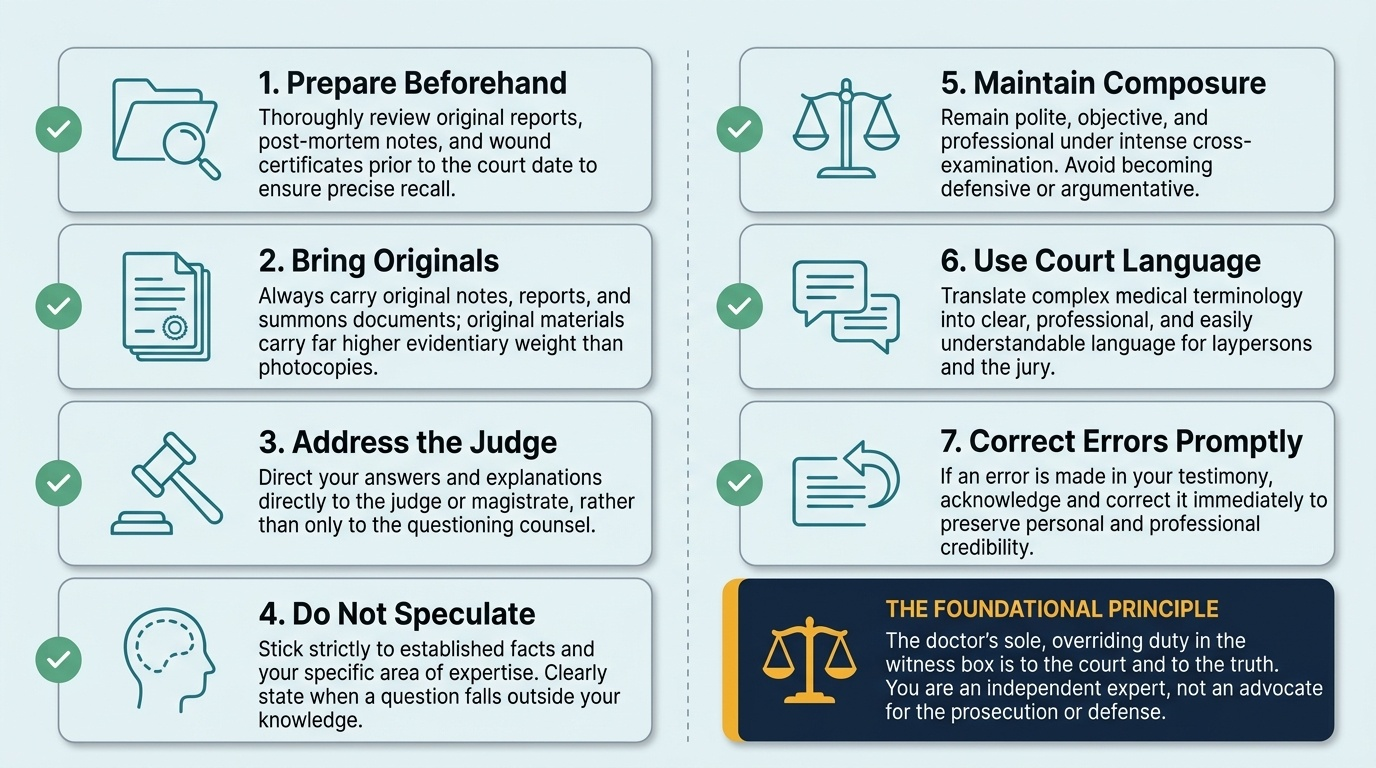
The foundational principle of evidence-giving is that the doctor's sole duty in the witness box is to the court and to the truth. They are not an advocate for the prosecution or the defence. They are not obliged to produce a finding that favours the party who called them. When a forensic physician departs from this principle — for example, by exaggerating the severity of injuries to support a prosecution, or by minimising them to protect an accused — they are no longer fulfilling the role of an expert witness; they are suborning justice.
Practical standards for conduct in the witness box:
- Prepare before appearing. Re-read the original report, post-mortem notes, or wound certificate before the court date. A doctor who cannot recall the details of their own report is an easy target for a skilled cross-examiner and gives the impression of unreliability.
- Bring all original documents. The summons will typically specify what documents to produce. Original certificates, original notes, and the original post-mortem report carry far greater evidentiary weight than photocopies. If originals are in another hospital's records room, liaise well in advance to retrieve them.
- Speak to the judge, not to the lawyers. When answering questions, the doctor should address their answers to the judge or magistrate. The judge is the arbiter of the evidence; the lawyers are merely the conduit.
- Do not speculate beyond your expertise. State what you found, what it implies within the range of scientific opinion, and where genuine uncertainty exists. 'I cannot be certain' is not a weakness in evidence — it is scientific honesty, and courts respect it. Overstating certainty is far more dangerous than admitting uncertainty.
- Maintain composure under pressure. Cross-examination is deliberately designed to challenge. A skilled defence lawyer will probe for inconsistencies, ask questions in misleading sequences, and suggest that the doctor's findings are compatible with an innocent explanation. The doctor must remain composed, answer each question on its merits, and not be drawn into argumentative exchanges.
- Record your evidence in the language of the court. If the court operates in a regional language and your report is in English, be prepared to explain technical terms through an interpreter or in simple language that the interpreter can accurately convey.
- Correct errors promptly. If, during examination, the doctor realises they made an error in their original report, they must correct it — immediately and clearly — even if the correction weakens the case they were called to support. Allowing a known error to stand uncorrected under oath is perjury.