Page 15 of 21
IM17.10-14 | Headache Emergency Care and Treatment — SDL Guide (Part 3)
Self-Assessment: Integrating Headache Treatment
The following integrative scenarios test your ability to apply the treatment knowledge from this module to clinical situations. For each scenario, determine: the appropriate management, the pharmacological rationale, and the key counselling point.
Scenario 1: A 35-year-old woman has 5 migraine attacks per month (each 10–12 hours, moderate-severe, preventing her from working). She has been using ibuprofen 400 mg on 18 days/month for the past 4 months. She asks for a stronger painkiller and wants to try triptans.
Assessment: She has medication-overuse headache (NSAIDs ≥15 days/month for >3 months) superimposed on episodic migraine evolving toward chronic migraine. Management priorities in order: (1) MOH detoxification: counsel her about MOH; stop ibuprofen abruptly (or taper); expect 1–2 weeks of worsening before improvement; bridge with prednisolone taper or IV DHE if withdrawal is severe. (2) Preventive therapy: start topiramate 25 mg at night (titrate) or amitriptyline 10–25 mg nocte — preventive therapy will only be effective once MOH is resolved. (3) Introduce triptan correctly after MOH resolved: sumatriptan 50–100 mg at headache onset, limited to ≤2 days/week to avoid triptan-MOH. (4) Headache diary to track progress.
Scenario 2: A 58-year-old male farmer presents with headache and fever for 8 days. He has meningism. CSF shows: lymphocytes 380/mm³, protein 310 mg/dL, glucose 18 mg/dL (serum 95 mg/dL, ratio 0.19). AFB smear negative. Gram stain negative.
Assessment: The CSF profile is consistent with tuberculous meningitis (subacute course, lymphocytic pleocytosis, very elevated protein, low glucose ratio 0.19, both smears negative — AFB smear negative in TBM is expected and does not exclude the diagnosis). Management: (1) Send GeneXpert MTB/RIF on CSF. (2) Start NTEP anti-TBM regimen empirically: 2HRZE (daily FDC, weight-band dosing) for 2 months, then 10–12HR; add pyridoxine 20 mg/day with isoniazid. (3) Dexamethasone 0.3 mg/kg/day tapering over 6–8 weeks. (4) Notify NTEP/RNTCP (now NTEP), arrange sputum TB work-up and household contact screening. Treat empirically without waiting for culture (TBM mortality >50% untreated).
Scenario 3: A 44-year-old woman with a 10-year history of migraine without aura (4 attacks/month) is counselled for prevention. She has hypertension (well controlled on amlodipine 5 mg) and is concerned about memory problems with one of the medications mentioned.
Assessment: The headache pattern (4 attacks/month) meets the threshold for preventive therapy. The comorbidity of hypertension provides dual indication for propranolol (treats both migraine and hypertension). However, counsel about: (a) potential interaction with amlodipine (additive hypotension — monitor BP); (b) bradycardia; (c) her concern about memory — specifically address that propranolol does not cause cognitive impairment (she may have been warned about topiramate's effects). Topiramate is an alternative but its cognitive side effects are the most clinically important ADR to counsel about — start at 25 mg nocte and titrate slowly. Amitriptyline is a reasonable third option if both are unsuitable. Headache diary to assess response at 3 months.
⚑ AI image — pending faculty review (auto-QA score 3/10; best of 3 attempts)
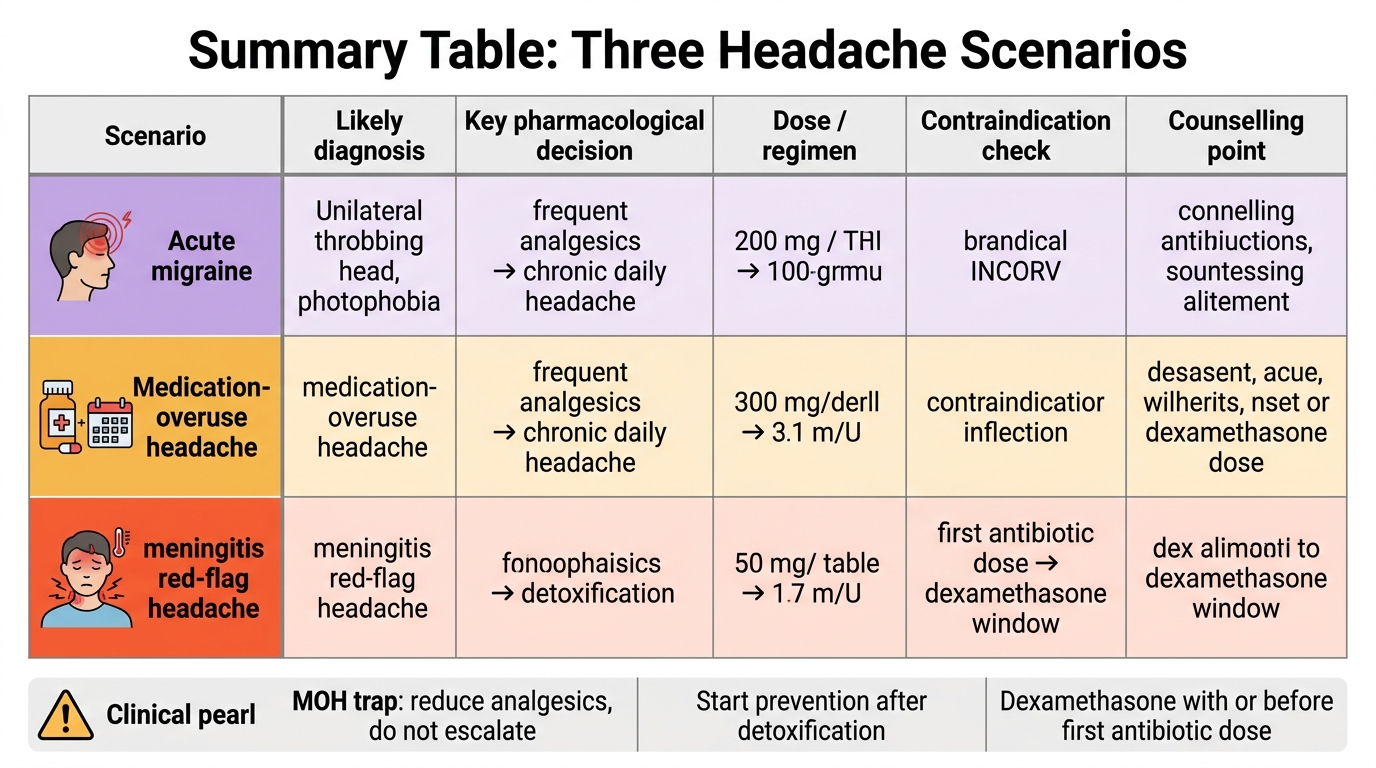
Headache Scenarios: Pharmacology Summary Grid
CLINICAL PEARL
The most important clinical pearl in headache treatment is the MOH trap: when a patient with migraine comes back saying 'my headaches are getting worse and more frequent despite taking more painkillers,' the treatment is not to escalate the analgesics — it is to reduce them. MOH is the most underdiagnosed cause of chronic daily headache in clinical practice, and it is entirely iatrogenic. The second pearl: start preventive therapy after detoxification, not before — preventive agents fail when the brain is locked in MOH.
For meningitis: dexamethasone must start with or before the FIRST antibiotic dose — not after the second or third day. The inflammatory cascade that causes deafness and brain damage is triggered by the first bacterial lysis; dexamethasone given after this window does not prevent the damage it was meant to prevent. In TB meningitis, treat empirically with NTEP regimen + dexamethasone in any high-risk patient with the TBM CSF pattern — waiting for culture confirmation (which takes weeks) leaves untreated TBM to cause irreversible neurological damage.