Page 2 of 17
PE3.1-3 | Developmental Delay — SDL Guide (Part 2)
Management and Parental Counselling
Management of developmental delay is multi-disciplinary, habilitative, and family-centred. The primary goals are to treat any underlying and treatable cause, to minimise further injury or deterioration, to maximise developmental potential through early intervention, and to support the family through what is often a life-changing diagnosis. The evidence base for early intervention — commencing therapy within the first two to three years of life, during the period of maximal neuroplasticity — is robust and consistent: children who receive early, intensive, multi-domain therapy in partnership with engaged parents achieve substantially better functional and cognitive outcomes than those who begin therapy later or in isolation. The family is not merely a recipient of medical advice but is the most powerful therapeutic resource available; a parent who understands how to provide stimulation at home, who reads to the child, engages in play, and reinforces communication, functions as a round-the-clock therapist in a way no clinic appointment can replicate. The treating team must therefore invest in equipping and empowering parents, not just prescribing therapy sessions.
Treating the underlying cause: Where a specific aetiology is identified, directed treatment takes priority. Congenital hypothyroidism → oral thyroxine commenced within the first 2 weeks of life (via RBSK neonatal screening) dramatically normalises cognitive outcome. PKU → phenylalanine-restricted diet prevents intellectual disability. Lead toxicity with blood lead level ≥45 µg/dL → chelation therapy (oral succimer or parenteral dimercaptopropane sulphonate — DMPS). CMV infection → ganciclovir/valganciclovir in selected neonatal cases.
Early intervention:
- Physiotherapy: for gross motor delays, hypotonia, or cerebral palsy — works on strength, posture, balance, and functional mobility.
- Speech and language therapy: for language delay, articulation difficulties, or feeding problems.
- Occupational therapy: for fine motor delays, self-care skill development, and sensory integration.
- Special education: for school-readiness and cognitive skill building; particularly relevant for children with intellectual disability.
- Applied Behaviour Analysis (ABA) and other behavioural therapies: used primarily in autism spectrum disorder but applicable more broadly for adaptive behaviour.
Devices and aids:
- Hearing aids or cochlear implants for hearing impairment.
- Spectacles or patching for visual impairment.
- Orthotic devices (AFO, splints) for motor impairment.
Government programmes and entitlements in India:
- RBSK (Rashtriya Bal Swasthya Karyakram): free screening and management for developmental delay from birth to 18 years.
- National Trust Act 1999: provides legal safeguards and benefits for persons with intellectual disability and autism.
- Rights of Persons with Disabilities (RPWD) Act 2016: guarantees education, employment, and social protection; identifies 21 categories of disability including intellectual disability and autism.
Parental counselling — the key communication tasks:
Counselling parents of a child with developmental delay is one of the most emotionally demanding tasks in paediatric practice. The core principles are:
1. Break news with compassion: Use clear, simple language. Avoid jargon. Acknowledge the emotional impact before moving to clinical information.
2. Provide a diagnosis and its implications: Explain what the delay/disability means for the child's functioning and potential, while being honest about uncertainty regarding long-term prognosis.
3. Emphasise parental role: Parents and caregivers are the primary 'therapists' in a child's natural environment. Parental involvement in early stimulation activities at home dramatically amplifies the benefit of formal therapy sessions.
4. Address guilt and misconceptions: Many parents believe developmental delay results from their own actions during pregnancy. Address this sensitively and factually.
5. Practical next steps: Provide written information, referral letters, and follow-up appointments. Connect the family with peer support groups (e.g., Down Syndrome Federation of India, Asha India for intellectual disability).
6. Long-term planning: Discuss educational options (mainstream inclusion where possible, special schools, and resource rooms), disability certification, and government entitlements.
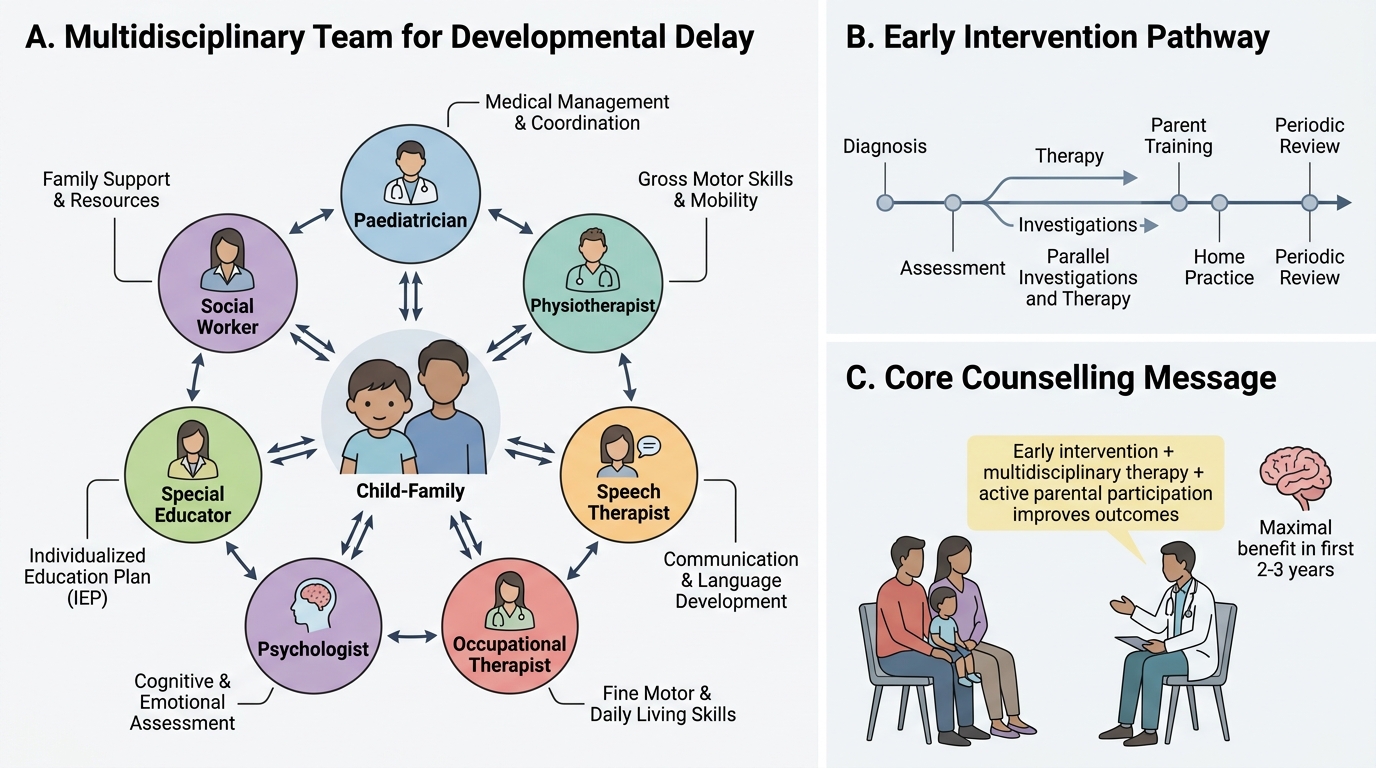
Multidisciplinary Management of Developmental Delay
SELF-CHECK
When counselling parents of a child newly diagnosed with global developmental delay, which of the following is MOST important to emphasise?
A. The child will never achieve independence
B. Parents should enrol the child in a special school immediately and avoid regular school
C. Early intervention with multi-disciplinary therapy and active parental participation significantly improves developmental outcomes
D. Investigations must be completed before any therapy is begun
Reveal Answer
Answer: C. Early intervention with multi-disciplinary therapy and active parental participation significantly improves developmental outcomes
Early intervention with multi-disciplinary therapy and active parental participation is the cornerstone of management and the most critical message to convey to parents. Research consistently shows that therapy begun in the first 2–3 years of life (the period of maximal neuroplasticity) produces the best outcomes. Investigations and therapy should proceed in parallel — not sequentially — so valuable developmental time is not lost waiting for results.
Self-Assessment
Test your understanding of developmental delay with these application questions.
Case 1: A 6-month-old infant is brought for developmental assessment. The mother reports the infant does not seem to follow objects with his eyes. On examination, the infant has poor head control, generalised hypotonia, and rooting and Moro reflexes still present. The baby was born at term after a normal pregnancy. What is the most appropriate next step?
Think about: What milestone is delayed? What domains are affected? What targeted investigations would you order?
Case 2: A 4-year-old girl is brought with concerns that she does not speak clearly and has difficulty understanding instructions at nursery school. Pregnancy and delivery were normal. On examination, the child has mild dysmorphic features including upslanting palpebral fissures, a single palmar crease, and mild intellectual disability. What is the most likely diagnosis and what investigation will you order to confirm?
Think about: What syndrome does this phenotype represent? What investigation confirms it? What comorbidities must be screened?
Case 3: A mother of a 2-year-old with Down syndrome asks you: 'Doctor, what will happen to my child's future? Will he go to school?' How do you counsel her?
Think about: Early intervention, educational inclusion, government entitlements, and the role of parental support.