Page 4 of 21
PA28.1 | Testicular Tumors — SDL Guide (Part 4)
GCNIS and Spermatocytic Tumor — A Comparison
Two entities are often confused in examinations:
Germ Cell Neoplasia In Situ (GCNIS)
GCNIS is the obligate precursor of all invasive GCTs (except spermatocytic tumor). It is detected by:
- Testicular biopsy in high-risk individuals (contralateral GCT, cryptorchidism)
- Adjacent to invasive GCT on orchiectomy specimen
Histology: Atypical large cells with clear cytoplasm and enlarged nuclei confined within the basal compartment of seminiferous tubules, with preservation of the tubular basement membrane (no invasion). The key IHC markers are PLAP (placental alkaline phosphatase) and OCT3/4 positivity.
Natural history: ~50% of GCNIS cases progress to invasive GCT within 5 years.
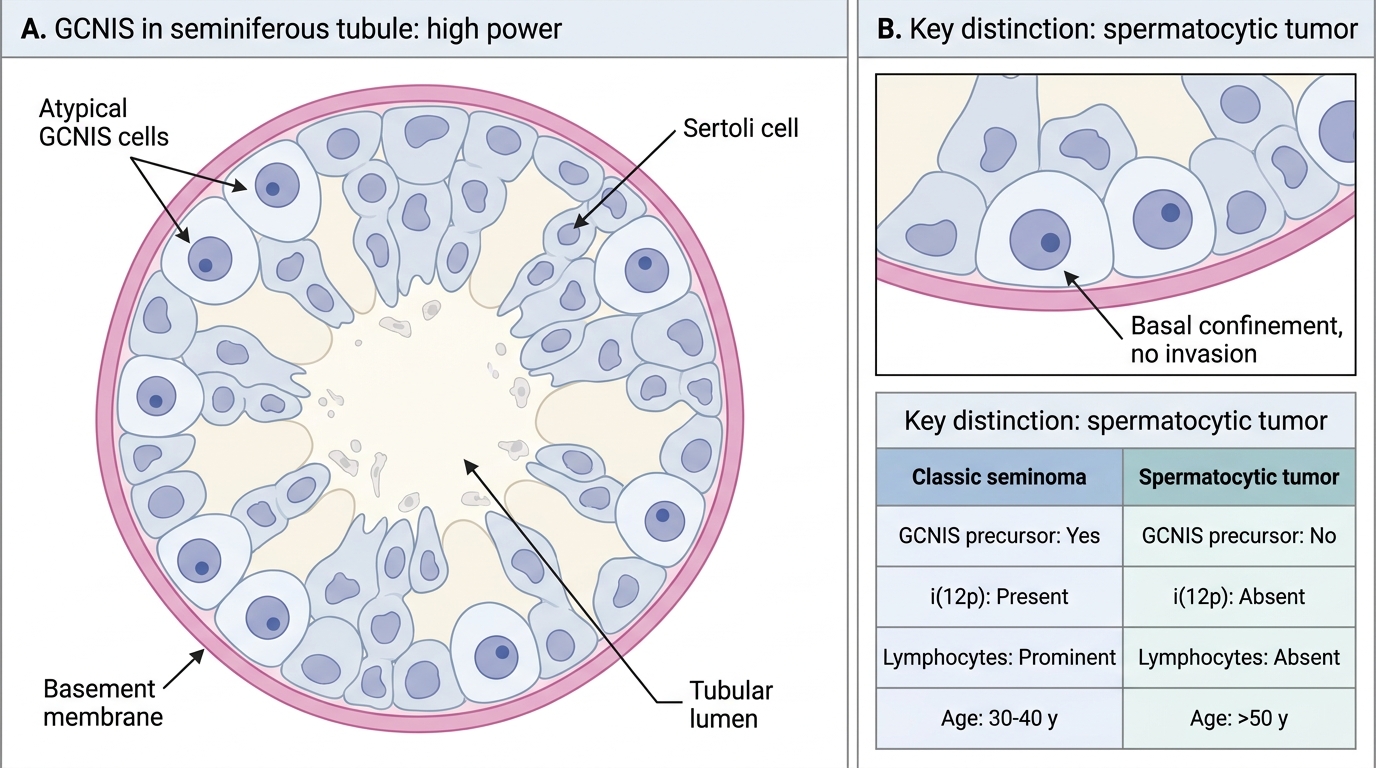
GCNIS in Seminiferous Tubule
Spermatocytic Tumor
Spermatocytic tumor (previously spermatocytic seminoma) is a distinct entity that must NOT be confused with classic seminoma:
| Feature | Classic Seminoma | Spermatocytic Tumor |
|---|---|---|
| Age | 30–40 years | >50 years |
| Precursor | GCNIS | No GCNIS |
| i(12p) | Present | Absent |
| Lymphocytic infiltrate | Prominent | Absent |
| Metastatic risk | Present | Negligible |
| Bilateral | Occasional | Occasional |
| Treatment | Orchiectomy ± RT/chemo | Orchiectomy alone |
Spermatocytic tumor is the only testicular GCT that does NOT arise from GCNIS and is essentially benign.
SELF-CHECK
A 60-year-old man presents with bilateral testicular masses. Biopsy shows a diffuse infiltrate of large lymphoid cells with prominent nucleoli, forming sheets and replacing the normal testicular parenchyma. Which of the following is MOST likely?
A. A. Bilateral seminoma
B. B. Bilateral yolk sac tumor
C. C. Diffuse large B-cell lymphoma
D. D. Bilateral Leydig cell tumor
Reveal Answer
Answer: C. C. Diffuse large B-cell lymphoma
Testicular lymphoma is the most common testicular tumor in men over 60 years of age, and diffuse large B-cell lymphoma (DLBCL) is the most common histological subtype. Bilateral involvement occurs in 20–38% of cases — a key distinguishing feature from GCTs, which are very rarely bilateral. Bilateral seminoma is possible but rare, and seminoma typically presents in younger men (30–40 years). Bilateral Leydig cell tumor is exceedingly rare and would cause endocrine symptoms.